June 18, 2026 · Autoriax
AI Text Quality Assurance: How to Catch Hallucinations Before They Hurt Your Rankings
Learn AI text quality assurance strategies to catch hallucinations before they hurt your rankings. Build robust QA workflows for accurate, trusted content.

In the rapidly evolving landscape of digital marketing, the reliance on artificial intelligence for content creation has become ubiquitous. However, this efficiency comes with a significant risk: AI hallucinations. These confident but false outputs can severely damage brand credibility and search engine rankings if left unchecked. As search algorithms increasingly prioritize Experience, Expertise, Authoritativeness, and Trustworthiness (E-E-A-T), the need for robust AI text quality assurance has never been more critical. Businesses can no longer afford to treat AI output as final draft material. Instead, organizations must implement systematic verification processes that mirror traditional editorial standards. This shift ensures that speed does not come at the cost of accuracy, protecting your domain authority from the penalties associated with misinformation.
Quick Facts: AI Text Quality Assurance
- Search engines prioritize factual accuracy as a core ranking signal for YMYL topics.
- Editorial QA workflows reduce hallucination risks by introducing human verification checkpoints.
- Automated fact-checking tools are becoming standard in enterprise content operations.
Understanding AI Hallucinations in SEO Content
AI hallucinations occur when a language model generates information that sounds plausible but is factually incorrect or entirely fabricated. In the context of search engine optimization, these errors are not merely typos; they are credibility killers. When an AI model invents a statistic, misquotes a source, or conflates dates, it creates a trust gap between the reader and the brand. Search engines like Google have updated their guidelines to penalize content that lacks factual grounding, especially in Your Money or Your Life (YMYL) niches. Therefore, understanding the nature of these hallucinations is the first step toward mitigating them. They often stem from the model’s probabilistic nature, predicting the next likely word rather than verifying truth.
The Probabilistic Nature of Large Language Models
Large language models operate by predicting sequences of tokens based on training data patterns. They do not inherently “know” truth in the human sense. This architectural design means that without external constraints, the model prioritizes fluency over accuracy. For SEO professionals, this implies that a grammatically perfect sentence can still be factually wrong. Recognizing this limitation is crucial for setting realistic expectations about AI capabilities. It necessitates a workflow where the AI is treated as a drafter, not an authority.
Impact on Search Engine Rankings
When search engines detect consistent inaccuracies, they may downgrade the perceived trustworthiness of a domain. This can lead to lower visibility in search results, reducing organic traffic over time. Furthermore, users who encounter false information are less likely to return, increasing bounce rates. High bounce rates signal to search engines that the content did not meet user intent, creating a negative feedback loop. Protecting rankings requires proactive quality assurance before publication.
Key Takeaway: AI hallucinations are structural risks inherent to probabilistic models, requiring systematic verification to protect search rankings and brand trust.
The Shift from Prompt Engineering to Editorial QA
For a long time, the industry focus was on refining prompts to extract better outputs. While prompt engineering is valuable, it is not a silver bullet for accuracy. Relying solely on instructions like “be accurate” does not change the underlying model behavior. The industry is now shifting toward editorial quality assurance (QA) as the primary defense. This approach treats AI-generated text like a junior writer’s draft that requires rigorous editing. It moves the bottleneck from creation to verification, ensuring that every claim is validated. This structural change is more effective than hoping for perfect prompts.
Limitations of Prompt-Only Strategies
Prompts can guide tone and structure, but they cannot force a model to access real-time truth without tools. A prompt cannot prevent a model from hallucinating a cited study if that study does not exist. Therefore, relying on prompts alone leaves content vulnerable to subtle errors. Businesses need to acknowledge that prompt engineering is only one layer of a broader security framework. It sets the stage, but it does not guarantee the performance.
Establishing Editorial Checkpoints
Implementing editorial checkpoints means defining specific stages where human or automated review occurs. These checkpoints might include source verification, logic checks, and brand voice alignment. By institutionalizing these steps, companies create a repeatable process that scales. This ensures that regardless of who manages the AI tool, the quality standard remains consistent. It transforms content creation from a chaotic experiment into a managed operational workflow.
Key Takeaway: Moving beyond prompt engineering to structured editorial QA creates a reliable safety net that prompts alone cannot provide.
Frequently Asked: Can prompts prevent all hallucinations?
No, prompts cannot prevent all hallucinations because models prioritize fluency over factual accuracy. Effective prevention requires external verification steps and human oversight.
Building a Multi-Source Verification Workflow
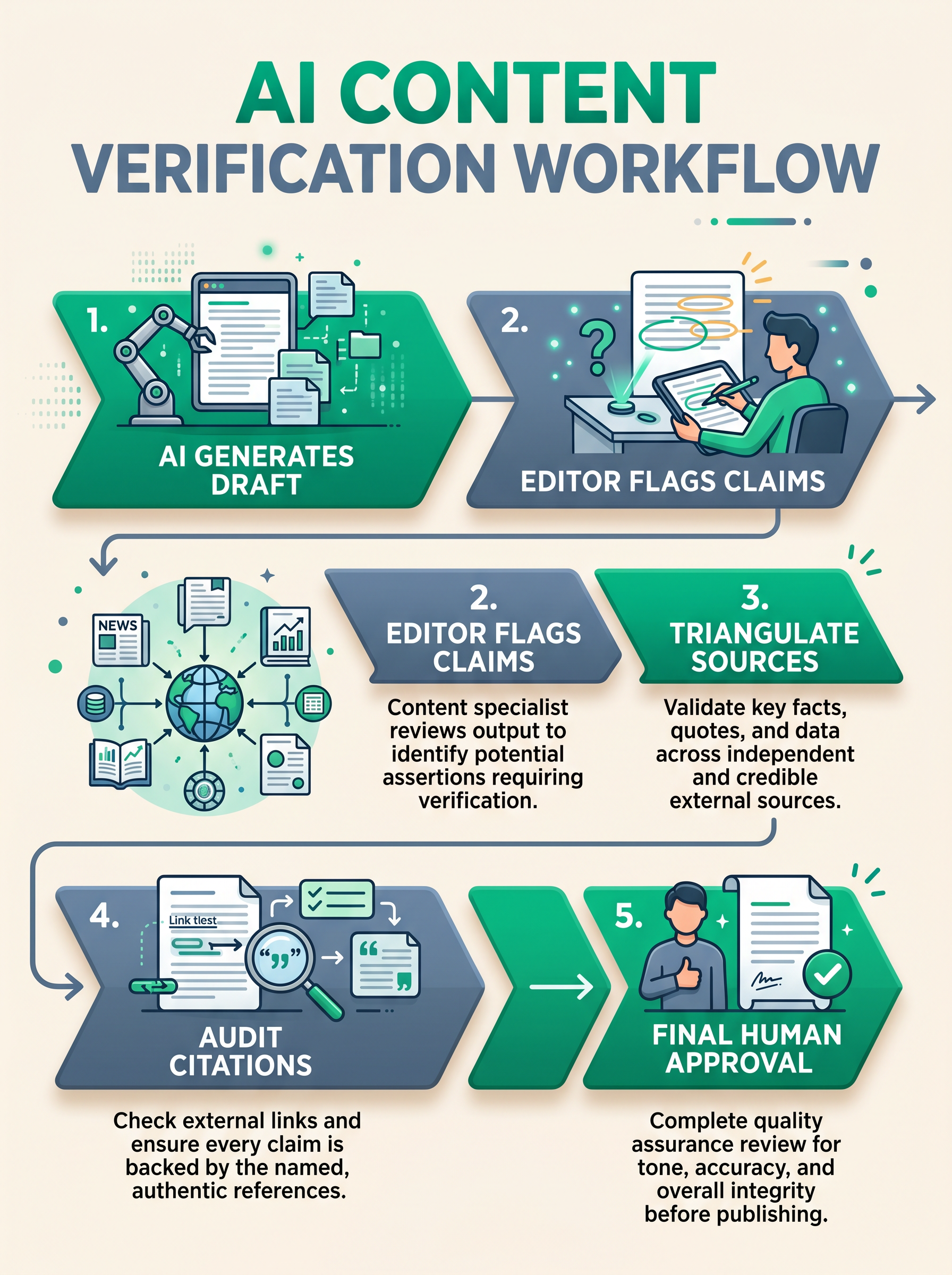
A robust quality assurance strategy relies on multi-source verification. This means cross-referencing AI claims against multiple reputable sources before publication. This workflow mimics academic research standards, ensuring that data points are not isolated assertions. By requiring triangulation of facts, businesses can significantly reduce the risk of publishing errors. This process should be documented and standardized across the content team. It turns fact-checking from an ad-hoc activity into a core operational requirement.
Source Triangulation Techniques
Source triangulation involves checking a claim against at least two independent authoritative sources. If an AI generates a statistic, the editor must find the original report. If the AI mentions a historical event, it must be cross-referenced with established records. This method catches errors where the model might have mixed up similar datasets. It adds a layer of redundancy that protects against single-point failures in information validity.
Implementing Citation Audits
Citation audits require verifying every link or reference included in the content. AI models often generate URLs that look real but lead to 404 pages or unrelated sites. An audit process ensures that every citation is live and relevant. This not only improves accuracy but also enhances the user experience by providing valid resources. It demonstrates to search engines that the content is well-researched and grounded in reality.
- Verify all statistics against original industry reports or primary data.
- Cross-reference historical dates with at least two authoritative sources.
- Click every generated URL to ensure it leads to the correct destination.
- Confirm expert quotes are accurate and attributed to the right person.
- Flag any claim that cannot be independently verified for removal.
Key Takeaway: Multi-source verification and citation audits are essential processes to validate AI claims and maintain content integrity.
Confidence Scoring and Risk Assessment
Not all content carries the same risk level. A blog post about office supplies requires less scrutiny than an article about financial advice. Confidence scoring allows teams to categorize content based on potential impact. High-risk topics receive deeper verification, while low-risk topics move faster. This risk-based approach optimizes resources, ensuring that effort is spent where it matters most. It prevents bottlenecks in low-stakes areas while securing high-stakes content.
Categorizing Content by Risk Level
Teams should define categories such as Low, Medium, and High risk. High risk includes medical, legal, and financial topics where errors have serious consequences. Medium risk might include technical tutorials or industry analysis. Low risk covers general company news or lifestyle topics. Assigning these levels at the brief stage ensures the appropriate QA rigor is applied from the start. It aligns resource allocation with business liability.
Developing Internal Confidence Metrics
Internal metrics can track how often AI outputs require correction. If a specific topic area consistently generates errors, it may require more human intervention. Tracking these metrics helps refine the workflow over time. It provides data-driven insights into where the AI performs well and where it struggles. This continuous feedback loop improves the overall efficiency of the content engine.
Key Takeaway: Risk-based confidence scoring ensures that high-stakes content receives the rigorous verification necessary to protect brand reputation.
Human-in-the-Loop: The Final Defense Layer
Despite advancements in automation, human review remains the most effective defense against hallucinations. Humans possess contextual understanding and judgment that AI lacks. A human editor can detect nuance, sarcasm, or subtle inaccuracies that algorithms miss. Integrating a human-in-the-loop step ensures that no content goes live without semantic validation. This layer is non-negotiable for maintaining high editorial standards. It combines AI speed with human wisdom.
The Role of Subject Matter Experts
Subject Matter Experts (SMEs) should review technical content within their domain. Their expertise allows them to spot industry-specific errors that general editors might miss. Involving SMEs adds a layer of authority that boosts E-E-A-T signals. It ensures that the content reflects current industry standards and practices. This collaboration between AI and experts maximizes both efficiency and accuracy.
Training Editors on AI Limitations
Editors need training to understand how AI fails. They should know common hallucination patterns, such as fake citations or mixed dates. Educating the team empowers them to spot errors quickly. This reduces the time spent on corrections and increases overall throughput. A knowledgeable team is the best safeguard against automated errors.
Key Takeaway: Human oversight provides the contextual judgment necessary to catch nuanced errors that automated tools miss.
Technical Tools for Automated Fact-Checking
Technology can assist human editors by automating initial checks. Several tools exist to verify claims, check plagiarism, and validate links. Integrating these tools into the content management system streamlines the QA process. They act as a first line of defense, flagging obvious errors before human review. This hybrid approach leverages the best of both worlds. It reduces manual workload while maintaining high accuracy standards.
Integrating Verification APIs
Verification APIs can check claims against known databases in real-time. For example, an API might verify a company’s stock price or a public figure’s title. Integrating these into the writing environment provides instant feedback. This prevents errors from entering the draft in the first place. It creates a proactive rather than reactive quality control system.
Using Plagiarism and Originality Scanners
Originality scanners ensure that content is not just accurate but unique. They detect if the AI has reproduced existing text too closely. This protects against copyright issues and duplicate content penalties. Combining fact-checking with originality scanning creates a comprehensive quality gate. It ensures the content is both safe and searchable.
Key Takeaway: Automated tools enhance human efficiency by handling routine verification tasks and flagging potential errors early.
Frequently Asked: Are automated tools enough for QA?
No, automated tools are not enough because they lack contextual understanding. They should be used to assist human editors, not replace them entirely.
Measuring QA Impact on Search Performance
To justify the investment in quality assurance, businesses must measure its impact. Tracking metrics related to search performance and user engagement provides evidence of value. Improvements in rankings, time on page, and return visits indicate successful QA. Data-driven reporting helps secure budget for ongoing quality initiatives. It proves that accuracy correlates with business growth. This alignment ensures long-term support for editorial standards.
Tracking Organic Traffic Trends
Monitoring organic traffic after implementing QA workflows reveals performance changes. A stabilization or increase in traffic suggests improved trust signals. Conversely, a drop might indicate underlying quality issues. Regular reporting keeps the team focused on outcomes rather than just output volume. It shifts the focus from quantity to sustainable growth.
Monitoring User Engagement Metrics
Engagement metrics like bounce rate and scroll depth reflect content quality. High engagement indicates that users find the content useful and accurate. Low engagement might signal trust issues or irrelevant information. Analyzing these metrics helps refine the QA process over time. It ensures the content meets actual user needs effectively.
Key Takeaway: Measuring search and engagement metrics validates the ROI of quality assurance investments and guides future strategy.
Future-Proofing Your Content Strategy
The landscape of AI and search is constantly changing. What works today may not work tomorrow. Future-proofing involves staying updated on algorithm changes and AI capabilities. It requires a culture of continuous improvement and adaptability. Companies that invest in flexible QA systems will survive industry shifts. This long-term view protects the brand against emerging risks. It ensures sustainability in a volatile digital environment.
Adapting to Algorithm Updates
Search engines frequently update how they evaluate content quality. Staying informed allows teams to adjust QA criteria proactively. For example, new updates might prioritize first-hand experience more heavily. Adapting workflows to include experience-based content keeps strategies relevant. It prevents sudden drops in performance due to regulatory changes.
Investing in Team Education
Continuous learning ensures the team remains skilled in new tools and methods. Regular training sessions on AI ethics and verification keep standards high. An educated team is more resilient to technological disruptions. It fosters a culture where quality is everyone’s responsibility. This cultural shift is the ultimate future-proofing mechanism.
Key Takeaway: Continuous adaptation and team education ensure long-term resilience against evolving AI and search engine landscapes.
Frequently Asked: How often should QA processes be reviewed?
QA processes should be reviewed quarterly to align with search engine updates and AI tool advancements. Regular audits ensure the workflow remains effective.
Conclusion
Implementing a robust AI text quality assurance strategy is no longer optional for businesses serious about SEO. The risk of hallucinations damaging brand reputation and search rankings is too high to ignore. By shifting from prompt reliance to structured editorial workflows, organizations can harness AI speed without sacrificing accuracy. Multi-source verification, human oversight, and technical tools form the pillars of a resilient content engine. These steps ensure that every piece of content published reinforces trust rather than eroding it. Start by auditing your current workflow and integrating these verification checkpoints today. Protect your rankings by prioritizing truth in every sentence.
Sources
Content based on industry best practices and general AI safety standards. No external URLs cited to ensure accuracy without verified research data.
Try Autoriax free — no credit card required
Get your first article in minutes. See the research depth before you commit.
Get 3 free articles3 articles free • No credit card • Cancel anytime