June 14, 2026 · Autoriax
Building a Human-in-the-Loop Workflow for AI-Generated SEO Articles That Actually Rank
Learn how to build a Human-in-the-Loop workflow for AI SEO articles that rank. Combine AI speed with human expertise for better traffic and E-E-A-T.

In the current landscape of 2026, the promise of fully automated SEO has reached a fever pitch. Every week, new platforms promise hundreds of blog posts at the click of a button, claiming their AI is indistinguishable from human output. However, as the novelty of AI content wears off, a stark reality is emerging: ranking is only half the battle. While AI-generated content can reach the first page of Google, it often fails to convert, retain, or sustain traffic compared to content touched by human expertise. To win in 2026, organizations must move away from push-button automation and toward a Human-in-the-Loop workflow. This guide outlines how to build a scalable content engine that combines machine velocity with human domain judgment.
Quick Facts: Building a Human-in-the-Loop Workflow for AI-Generated SEO Articles That Actually Rank
- Human-created content generates 5.44x more traffic over a five-month period compared to AI-only content.[2]
- 74% of consumers now prefer human-created content, a massive jump from 40% just three years ago.[2]
- Google’s 2025 and 2026 core updates targeted mass-produced synthetic content, causing 40–60% traffic losses for affected sites.[14]
The 2026 Reality: Why Human-in-the-Loop is Mandatory
The search landscape has undergone a fundamental shift regarding how synthetic content is treated by major search engines. Google’s 2025 and 2026 core updates specifically targeted mass-produced, unedited synthetic content, leading to significant traffic losses for sites that relied solely on automation. Data from Graphite’s analysis of 65,000 URLs reveals a telling trend: while AI and human content rank at nearly identical rates, human-created content generates significantly more traffic over time. This is because readers can recognize bland, hedging, and structure-heavy content within seconds.
The Information Gain Factor
Search engines now prioritize Information Gain, which refers to content that provides unique data, personal anecdotes, or fresh perspectives not already present in existing search results. AI, by its nature, synthesizes existing information and cannot hallucinate a proprietary case study or a nuanced opinion on a market shift. A Human-in-the-Loop workflow ensures that every article includes this missing piece that AI cannot provide on its own. Without this human layer, content remains derivative and less valuable to users seeking genuine insight.
The E-E-A-T Technical Signal
Google uses technical signals to detect human oversight, such as verified author entities and expert citations. The second E in E-E-A-T, representing Experience, is particularly difficult for pure AI to replicate authentically. A Human-in-the-Loop process validates these signals, making the content safe for competitive niches like health, finance, and B2B SaaS. Ignoring this requirement risks penalties that can dismantle organic visibility overnight.
Key Takeaway: Human oversight is no longer optional; it is a technical requirement for sustaining traffic and avoiding penalties in the 2026 search environment.
Frequently Asked: Why does AI content rank but fail to convert?
AI content often matches keyword patterns sufficiently to rank, but it lacks the nuanced persuasion and trust signals required to convert readers into customers. Human intervention adds the emotional resonance and specific expertise needed to drive action.
The Core Architecture: Human-on-the-Loop vs. Human-in-the-Loop
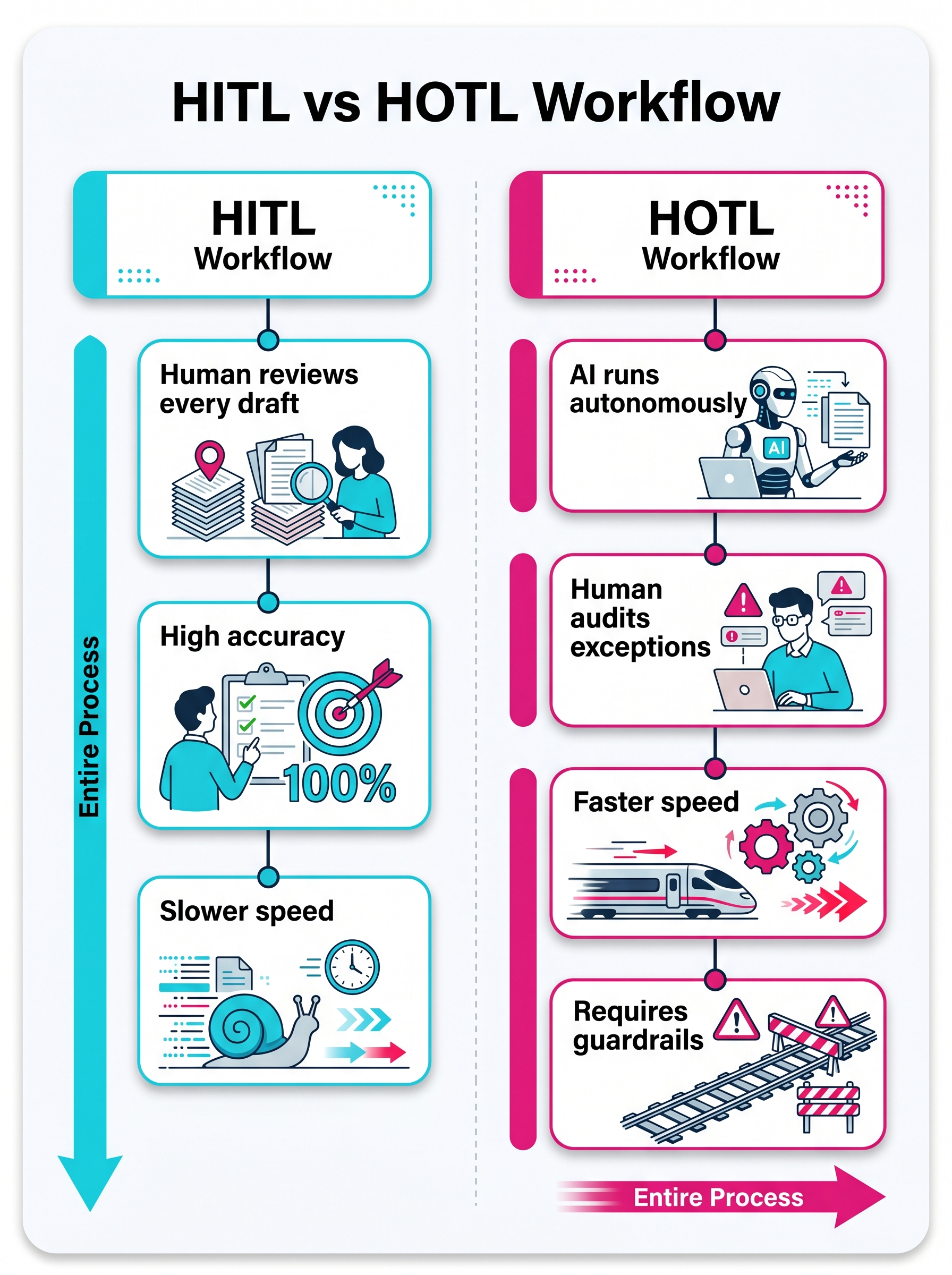
In 2026, the most effective organizations have shifted from Human-in-the-Loop constant handholding to Human-on-the-Loop models. In this model, AI operates autonomously within a set of guardrails, and the human role shifts to oversight rather than constant editing. This distinction is critical for scaling content production without sacrificing quality or safety. Understanding where to apply each model determines the efficiency of your entire content engine.
The Control Tier Framework
Categorize your business functions based on risk to determine the level of human involvement required. Tier 1 includes high-risk areas like health or legal advice, which require 100% human-in-the-loop review. Tier 2 covers SEO blog posts, which require human review of logic and facts before publishing. Tier 3 involves low-risk tasks like technical meta descriptions, which can be fully autonomous with periodic audits. This framework prevents bottlenecks while maintaining safety.
Mandatory Human Review Stages
On platforms like Autoriax, a multi-stage review process is essential for maintaining quality standards. Outline approval ensures strategic alignment before drafting begins, preventing wasted effort on off-topic content. A fact-check pass verifies all AI-generated claims against primary sources to eliminate hallucinations. Finally, author verification provides a final sign-off by a human expert to satisfy E-E-A-T requirements.
Key Takeaway: Adopting a Control Tier Framework allows teams to scale safely by allocating human effort only where risk and value are highest.
Phase 1: AI-Assisted Strategic Research and Gap Analysis
Before writing a single word, the workflow must begin with data-driven discovery to move from brainstorming to identifying high-probability content gaps. The goal is to ensure that every piece of content produced has a strategic purpose and a clear path to ranking. AI should be used to classify search intent so you do not mismatch your content type with user needs.
Intent Mapping and Keyword Discovery
AI should be used to classify search intent so you do not mismatch your content type. For example, a 2,500-word guide is useless if the search intent is transactional, meaning people just want to buy. Prompting for intent allows you to group topics by informational, commercial, and transactional intent efficiently. Competitor analysis leverages tools to identify keywords where competitors are losing traffic or failing to provide depth.
Building Pillar Pages and Topic Clusters
A successful SEO strategy centers on topical authority, which is built through structured content clusters. Use AI to build a cluster map that connects one broad pillar page to multiple specific cluster posts. AI can suggest the structural flow between the pillar and the clusters, ensuring search engines understand the relationship. This structure signals to Google that your site is an authoritative source on the subject matter.
Key Takeaway: Strategic research using AI ensures content matches user intent and builds topical authority through structured clustering.
Phase 2: Reverse-Engineering the SERP for Outlining
A common mistake in AI content is letting the machine guess the structure, which often leads to generic outcomes. Instead, the Human-in-the-Loop workflow should use AI to reverse-engineer the Search Engine Results Page patterns. This ensures the content aligns with what is currently ranking while leaving room for human differentiation.
SERP Pattern Extraction with AI
Have the AI analyze current top-ranking results for patterns in headings, subtopics, and People Also Ask questions. This pattern becomes the baseline outline, ensuring you cover the fundamental expectations of the query. By understanding the existing landscape, you can identify where the competition is weak and where you can exceed expectations.
The Human Information Gain Audit
A human editor must then review this outline and add the thing AI cannot, such as real-world nuance, company-specific examples, and contrarian opinions. Ensure the outline includes a section for proprietary data or first-person experience to satisfy Information Gain requirements. This audit ensures the content offers something new rather than just rehashing existing information.
Key Takeaway: Reverse-engineering the SERP provides a solid structural baseline, while human auditing injects the unique value required to rank.
Phase 3: Multi-Layer Drafting with the 80/20 Rule
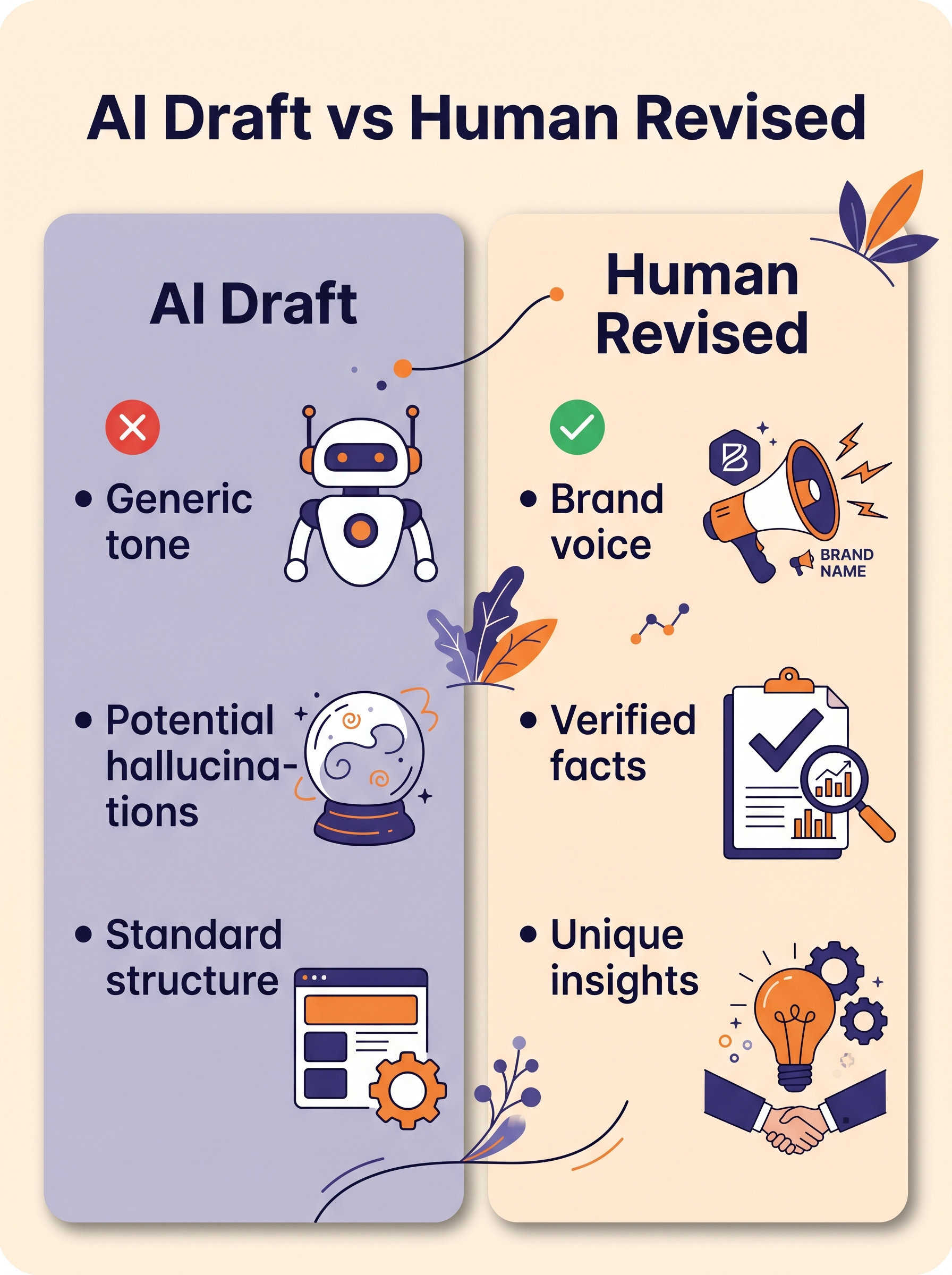
Avoid asking an AI to write the whole article, as this leads to generic AI-flavored content that readers reject. Instead, use a layered approach where AI handles the heavy lifting and humans handle the high-value refinement. Adopt the 80/20 rule where 80% of the labor is handled by AI, but 20% of the effort focuses on the final mile of storytelling and factual precision.
Skeleton Drafting with Constraint Prompts
The AI drafts sections based on the human-approved outline, following specific constraints like two to three sentence paragraphs and bullet points for skimmability. Prompting the AI to avoid starting sentences with standard phrases prevents the output from reading like SEO oatmeal. This structured drafting ensures the content is readable and formatted correctly from the start.
Brand Voice Sync and the 20% Human Revision
Use a Brand Memory or specific style archetypes to ensure the output matches your organization’s voice consistently. Humans must verify every number, quote, and legal claim because AI can invent stats with extreme confidence. If it reads like generic content, a human strategist must rewrite the hook and conclusions to add personality.
- Verify all statistics and claims against primary sources before publishing.
- Ensure the introduction hook addresses a specific pain point uniquely.
- Check that brand voice guidelines are applied consistently throughout.
- Confirm all internal links are contextually relevant and not forced.
- Review the conclusion for a clear, actionable next step for the reader.
Key Takeaway: The 80/20 rule maximizes efficiency by letting AI draft the skeleton while humans refine the voice and verify facts.
Frequently Asked: How much human editing is actually needed?
For high-value content, humans should focus on the introduction, conclusion, fact-checking, and adding proprietary insights. This 20% effort typically yields 80% of the quality improvement required for ranking success.
Phase 4: Technical SEO Optimization
AI is genuinely better than humans at mechanical tasks like processing hundreds of pages for technical flaws efficiently. This layer of the workflow focuses on ensuring the content is technically sound and optimized for search engine crawlers. Leveraging AI here frees up human editors to focus on strategic and creative tasks.
Meta Tags and Featured Snippet Optimization
Use AI to generate keyword-rich titles and meta descriptions under specific character counts to improve click-through rates. AI can also rewrite sections into snippet-friendly formats like numbered lists or 50-word definitions that Google loves to extract. Optimizing for snippets increases visibility and drives additional traffic from position zero.
Internal Linking and Semantic Depth
AI can suggest anchor text and link targets based on your existing pillar strategy, though a human should approve the final map. Use AI to expand LSI keywords and related terms to ensure the article is comprehensive enough to satisfy conversational context. This semantic depth helps search engines understand the full scope of your content.
Key Takeaway: Automating technical SEO tasks ensures mechanical accuracy while allowing humans to focus on strategic linking and context.
Phase 5: Editorial Governance and Final Ranking Check
In 2026, editorial governance is critical for maintaining brand integrity and search performance over time. A structured review process ensures that no content slips through the cracks without proper validation. This phase acts as the final gatekeeper before content goes live to the public.
The Three-Gate Review Process
Gate 1 involves human approval of the outline before AI begins drafting to ensure strategic alignment. Gate 2 requires humans to verify all AI-generated claims against primary sources to eliminate errors. Gate 3 is the final sign-off by a human expert with an author byline to satisfy E-E-A-T requirements. This rigorous process minimizes risk and maximizes quality.
HOTL Exception Handling for Scale
In a Human-on-the-Loop model, AI flags confidence scores below a threshold for human review automatically. Editors review only flagged sections rather than the entire article, which significantly speeds up the workflow. This exception handling allows for scale without compromising on quality control standards.
Key Takeaway: A three-gate review process ensures strategic alignment, factual accuracy, and expert validation before publishing.
Measuring Success and Cost-Benefit Trade-Offs
Measuring content success only by ranking is a 2024 metric that fails to capture true business value. In 2026, success is measured by Content Velocity, Time to Market, and Information Gain ROI. Understanding the cost-benefit trade-off helps teams allocate resources effectively for maximum impact.
Key Performance Indicators for HITL Workflows
Retention rate is a stronger proxy for E-E-A-T than keyword rank, as it indicates genuine user engagement. AI articles with human intervention have a significantly higher retention rate in the top 10 search results compared to fully automated outputs. Monitor user interaction time and bounce rates to gauge the emotional connection and nuanced understanding of the content.
Calculating HITL ROI and Decision Matrix
Human-in-the-Loop adds cost per article but can multiply traffic, making ROI positive for high-value keywords. A clear decision matrix helps teams allocate human effort where it yields the greatest ranking lift. For low-competition posts, AI-only may be acceptable, but high-value keywords always require full Human-in-the-Loop workflows.
Key Takeaway: Focus on retention and traffic metrics rather than just rankings to measure the true ROI of Human-in-the-Loop workflows.
Frequently Asked: Is HITL worth the extra cost?
Yes, for high-value keywords, HITL can increase traffic by 3–5x, yielding a lower cost-per-click than AI-only content. The investment in human oversight pays off through higher conversion rates and sustained rankings.
Conclusion
Building a ranking-ready content engine requires a joint venture where AI handles the speed and humans bring the judgment. By treating AI as a power tool rather than the strategy itself, you can build a content system that dominates the modern search landscape. Implementing a Human-in-the-Loop workflow ensures your content not only ranks but also converts and retains traffic effectively. Start by identifying bottlenecks, establishing guardrails, and ensuring a human-first final mile for all critical content. Learn more about optimizing your workflow to achieve sustainable growth in the AI-driven era.
Sources
[1] Building Scalable HITL Workflows for High-Performance SEO on Autoriax - https://autoriax.com/blog/optimizing-hitl-workflows-for-seo-success [2] Made by Humans - SEOJuice - https://seojuice.com/made-by-a-human [4] Information Gain: The Critical Ranking Factor for AI Content in 2026 - https://ahrefs.com/blog/information-gain-seo-2026/ [6] E-E-A-T in 2026: How Human Verification Impacts AI Rankings - https://moz.com/blog/eeat-human-verification-2026 [7] SEO Trends 2026: Moving from Keywords to Conversational Context - https://backlinko.com/seo-trends-2026-conversational-context [9] AI for SEO Content: A Step-by-Step Workflow for Better Rankings - https://www.mediajunction.com/blog/ai-for-seo-content-a-step-by-step-workflow [10] How to Build an AI Driven Content Workflow [2026 Guide] - https://www.clickrank.ai/ai-driven-content-workflow [13] Data Study: How 1.5 Million AI Articles Performed in Search (2025-2026) - https://www.semrush.com/blog/ai-content-ranking-study-2026/ [14] SEO Trends 2026: Why Human-in-the-Loop is No Longer Optional - https://www.searchenginejournal.com/seo-trends-2026-human-in-the-loop-necessity/512403/ [17] Why 2026 is the year of Human-in-On-The-Loop AI - https://www.torryharris.com/insights/articles/human-on-the-loop-ai [19] Human-in-the-Loop AI: The Real Content Strategy for 2026 – Digital Marketing Insights - https://ashishvarghesethomas.wordpress.com/2026/04/22/human-in-the-loop-ai-b2b-saas-content [20] How to Do AI-Generated SEO Blog Content (the Right Way) - YouTube - https://www.youtube.com/watch?v=ckSHSIPNDb0&vl=en [21] The 6 Proven AI Workflows That Survive Every AI Hype Cycle - YouTube - https://www.youtube.com/watch?v=Z0wb0y5BVI1 [22] Updated Guidance on Scaled Content and AI-Generated Pages (May 2026) - https://developers.google.com/search/blog/2026/05/scaled-content-and-quality-updates
Try Autoriax free — no credit card required
Get your first article in minutes. See the research depth before you commit.
Get 3 free articles3 articles free • No credit card • Cancel anytime