June 14, 2026 · Autoriax
Ethical AI Content Production: Navigating Legal Risks and Google’s Quality Guidelines
Navigate legal risks and Google guidelines for ethical AI content. Learn provenance gates, copyright laws, and compliance strategies for 2026.

The landscape of digital content creation underwent a seismic shift in late 2022 with the emergence of generative AI, a technology that has since evolved from a novelty into a pivotal force for global enterprise [3]. By 2026, the generative AI market is projected to reach over $71 billion, with expectations to soar near $890 billion by 2032 [6]. For platforms like Autoriax, this evolution offers limitless opportunities for scalability and speed. However, as AI-generated text, images, and video become indistinguishable from human-made works, the ethical and legal stakes have moved from academic debate to critical operational reality [6].
Navigating this new era requires more than just mastering prompts; it demands a comprehensive understanding of copyright law, transparency requirements, and the quality standards that search engines and users now expect. This article explores the complexities of ethical AI content production and provides a framework for managing the hidden risks of this technological revolution. The most overlooked legal risk in AI content production is not Google penalties but third-party copyright and data privacy lawsuits stemming from unvetted training data.
Quick Facts: Ethical AI Content Production: Navigating Legal Risks and Google’s Quality Guidelines
- The generative AI market is projected to reach $890 billion by 2032 [6].
- The EU AI Act became effective in August 2024 with strict transparency obligations [5].
- Statutory damages for copyright infringement can reach $150,000 per work [7].
The Hidden Legal Risk: Training Data Provenance
One of the most pressing challenges in AI content production is the redefinition of traditional copyright laws regarding training data. Because machines can now produce creative works without direct human creative input, the legal world is struggling to determine where ownership begins and ends [1]. AI models are trained on gargantuan data lakes that often include millions of copyrighted images, articles, and musical works [3]. This leads to significant legal exposure for businesses that rely on these outputs without verification.
The Data Lake Problem
AI models are trained on internet-scale data that often includes copyrighted works without permission. Companies face liability for both training data ingestion and output that resembles protected content. When a model ingests protected work, the resulting output may inadvertently infringe on the original creator’s rights. This creates a chain of liability that extends from the model developer to the end user publishing the content.
Legal Precedents and Emerging Litigation
Major lawsuits against companies like OpenAI and Midjourney highlight the controversy of using original art as training material without the creator’s consent [3]. The Getty Images vs. Stability AI case in 2023 set a precedent where the court found that training data included copyrighted images without consent [6]. Text-to-text models for marketing content replicate the same pattern. Under the law, the AI did it is not a valid defense against an infringement claim, which can result in statutory damages of up to $150,000 per work [7].
Key Takeaway: Businesses face direct liability for copyright infringement if AI training data includes protected works without consent, regardless of the tool provider.
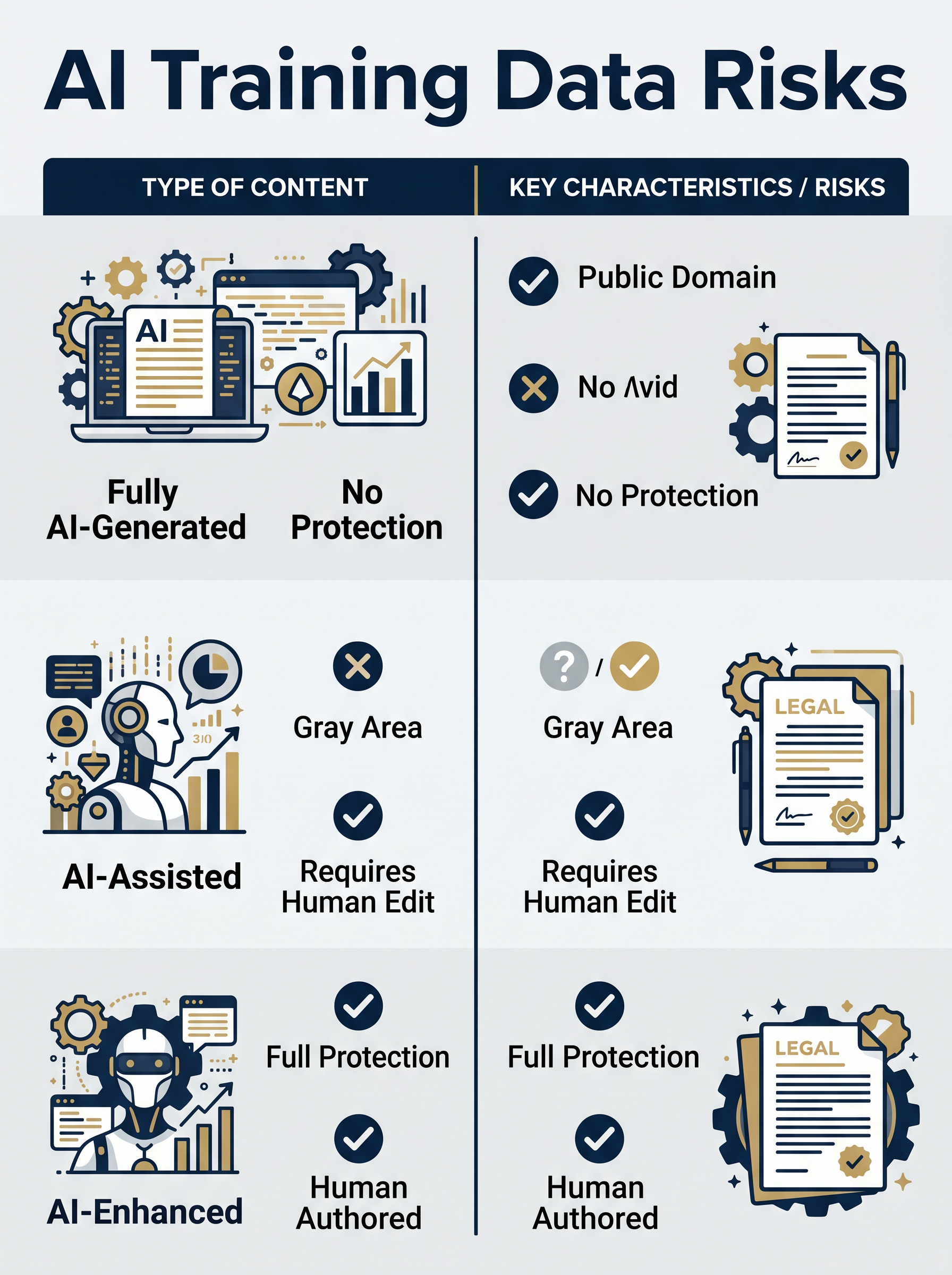
Copyright Ownership in the Age of AI
In the United States, the Copyright Office has been clear: legal protection extends only to works created by human authors [2]. The Office’s ongoing initiative, which began in 2023, has analyzed thousands of public comments to address the copyrightability of AI outputs [2]. The current legal consensus creates a Copyright Ownership Dilemma for businesses relying on automated content strategies.
The Human Authorship Requirement
Fully AI-generated content has no copyright protection. Content created by an AI system with no human editing likely receives no copyright protection, placing it immediately into the public domain where competitors can use it freely [7]. AI-assisted content requires substantial human editing for protection. Works where a human significantly edits, revises, and adds creative layers to an AI draft may qualify for protection, though the exact boundaries remain a gray area [7].
Output Similarity and Infringement
AI can produce content confusingly similar to existing works. AI tools do not always create original material; they sometimes produce results that are confusingly similar or even identical to existing copyrighted works [7]. Human review alone does not guarantee originality; a formal output liability checklist is needed. Businesses risk losing IP rights if they rely solely on AI output without documenting the human creative contribution.
Frequently Asked: Can I copyright AI-generated content?
Generally, no. The U.S. Copyright Office states that works created solely by AI without human authorship cannot be copyrighted. Protection is only possible if a human significantly modifies the output.
Key Takeaway: Fully AI-generated content is public domain, while AI-assisted content requires substantial human editing to qualify for copyright protection.
Ethical Minefields: Bias, Misinformation, and Privacy
Beyond the courtroom, ethical considerations are paramount for maintaining brand integrity and public trust. Generative AI systems are often described as black boxes, complex constructions that are difficult for users to interpret or explain [3]. For media organizations and brands, failing to audit for bias can lead to discriminatory content that alienates audiences and violates emerging regulations like the EU AI Act [5].
Bias and Discrimination
AI algorithms are only as good as the data they consume. If training data contains historical or social biases, the resulting content will perpetuate them, often reflecting common stereotypes or creating a disproportionate representation of the world [3]. Training data bias leads to stereotyped or unfair content. The EU AI Act mandates bias auditing for high-risk systems, requiring organizations to proactively manage these risks [5].
Misinformation and Deepfakes
One of the most alarming concerns is the ability of AI to create human-grade content that distorts reality [3]. Deepfakes, synthetic media created to resemble a person’s face or voice, are often used for malicious purposes, including scams and defamatory campaigns [3]. AI-generated fake news and deepfakes erode credibility. Transparency labels and watermarking are required by law in many jurisdictions to mitigate this risk [6].
Privacy and Data Protection
Pre-trained AI models are fed internet-scale data that may include personally identifiable information (PII). Misusing such data through AI tools can lead to identity theft and harmful data manipulation [3]. Organizations must adhere to strict regulations like the GDPR, ensuring they do not feed sensitive trade secrets or customer PII into external, unauthorized AI tools [5].
Key Takeaway: Ethical AI use requires auditing for bias, preventing misinformation, and protecting privacy to maintain brand trust and regulatory compliance.
Google’s Quality Guidelines: The Provenance Connection
While Google’s specific algorithms are proprietary, the principles of E-E-A-T (Experience, Expertise, Authoritativeness, and Trustworthiness) align closely with ethical AI practices. AI-generated content that lacks human oversight often fails these quality standards due to several factors. Provenance documentation required for EU AI Act compliance also boosts search signals [6].
E-E-A-T and AI-Generated Content
Experience, Expertise, Authoritativeness, Trustworthiness are undermined by opaque AI content. AI systems are notorious for hallucinations, generating confident-sounding statements that are factually incorrect or fabricated [7]. Provenance records, such as author credentials and data sources, improve E-E-A-T. For a website to maintain its reputation and search ranking, human-in-the-loop verification is essential [3].
Transparency as a Shared Requirement
Google requires transparency for AI content; EU AI Act mandates similar disclosures. Global regulatory frameworks and search best practices now increasingly require the disclosure of AI involvement [6]. Watermarking and metadata serve both search engine and legal needs. Studies show that while users may be comfortable with AI-generated music, a vast majority are uncomfortable with AI-generated news articles, suggesting that transparency is vital for brand credibility [9].
Key Takeaway: Google’s E-E-A-T principles reward content provenance documentation, which aligns with legal compliance requirements for transparency.
The Provenance Review Gate: A Strategic Solution
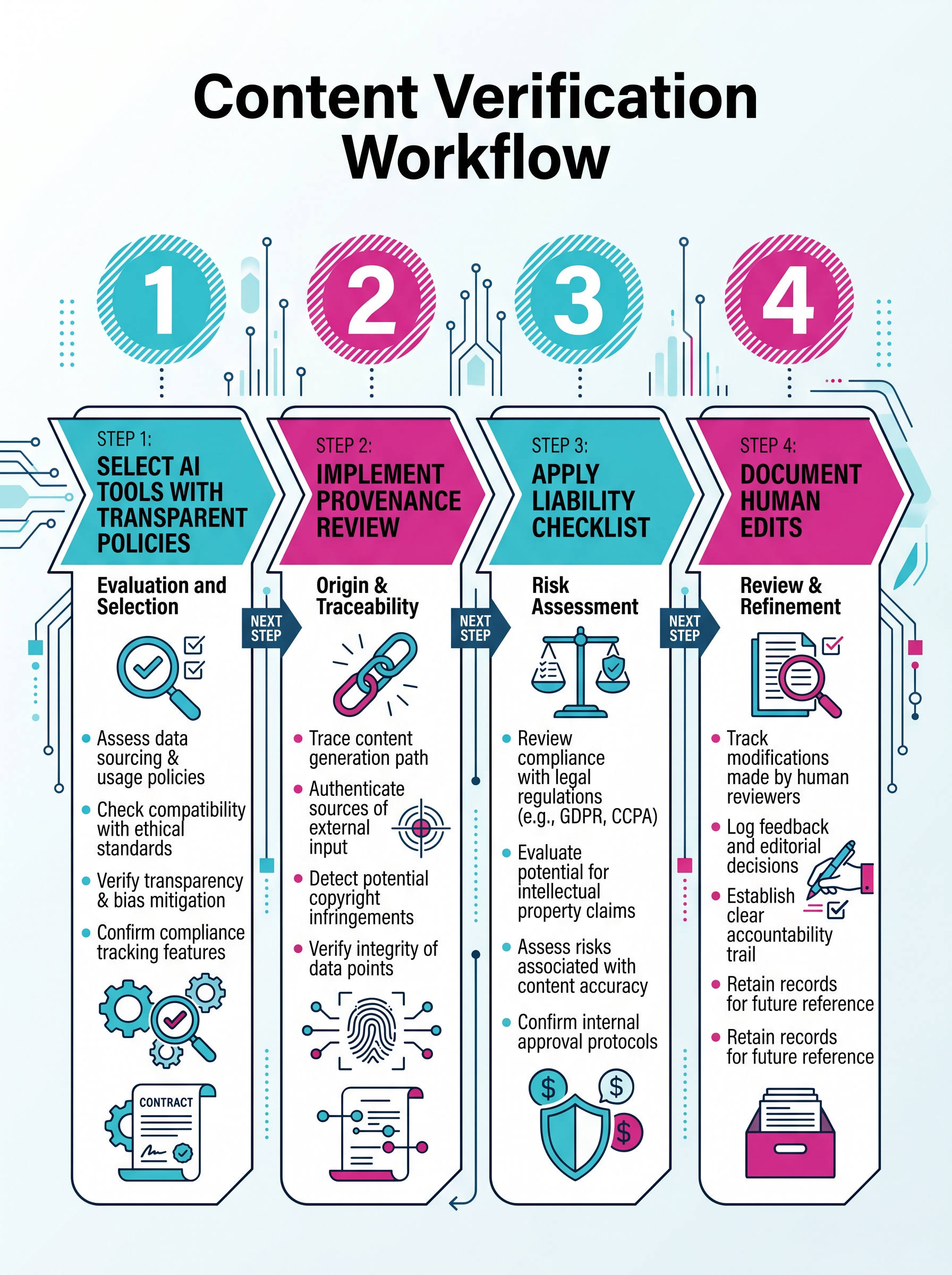
To harness the power of AI at Autoriax without succumbing to legal or ethical pitfalls, organizations should adopt a robust governance framework. A provenance review gate verifies training data sources and output originality before publication. This reduces legal exposure while improving E-E-A-T signals for original research [6].
What Is a Provenance Review Gate?
A step in the content workflow that checks training data provenance and output originality. It includes verifying sources, checking for copyrighted material, and documenting human edits. Hands-on example: a financial firm avoids reproducing proprietary data by auditing AI inputs. This process not only catches hallucinations but also helps establish the human authorship necessary for copyright protection [7].
Implementation in Enterprise Workflows
Automated tools can flag potential provenance issues. Human reviewers certify compliance before publication. Media organizations should consider integrating AI tools directly with their Content Management Systems (CMS). This allows for better control over access, automated flagging of AI content, and the use of sandboxes where teams can experiment with prompts without affecting live systems [5].
- Verify AI tool training data sources for copyright compliance
- Audit output for similarity to existing copyrighted works
- Document all human edits and creative contributions
- Check for bias and misinformation before publishing
- Ensure no PII is exposed in generated content
Key Takeaway: Implementing a provenance review gate reduces legal exposure and improves search ranking signals by ensuring content originality and compliance.
Global Regulatory Frameworks and Compliance
Ethical AI use is no longer just a best practice; it is becoming a legal requirement. Different regions are adopting varied approaches to manage the risks of algorithmic content [6]. Effective as of August 2024, the EU AI Act is the first legislation dedicated solely to artificial intelligence [5]. By February 2025, specific prohibitions within the act will become active, requiring rigorous risk assessments for generative systems [6].
The EU AI Act
Risk-based classification of AI systems. It classifies AI systems by risk level and imposes strict obligations on transparency, data governance, and cybersecurity [5]. Requires transparency, data governance, and risk assessments for generative AI. Organizations must adhere to strict regulations like the GDPR, ensuring they do not feed sensitive trade secrets or customer PII into external, unauthorized AI tools [5].
United States and International Guidelines
U.S. Federal Level: While no comprehensive federal AI law exists yet, the FTC has issued guidelines for the ethical use of AI [6]. State Level: California’s AI Safety Act (2025) addresses content misuse and discrimination [6]. International: Organizations like UNESCO and the OECD have published guidelines emphasizing human rights, diversity, and the need for human-centric AI that supports human well-being [3].
Frequently Asked: What are the penalties for non-compliance?
Penalties vary by region but can include significant fines under the EU AI Act and statutory damages up to $150,000 per work for copyright infringement in the U.S. [7].
Key Takeaway: Global regulations like the EU AI Act and U.S. state laws mandate transparency and risk assessments, making compliance essential for international operations.
Conclusion
The fusion of AI and content creation is transforming the digital world at an unprecedented pace. While tools offer incredible creative potential, they also introduce a complex landscape of legal and ethical challenges [6]. For Autoriax, the path forward involves a delicate balance between innovation and responsibility. By prioritizing transparency, maintaining human oversight, and staying informed about evolving global regulations, businesses can leverage AI to scale their production while maintaining the trust and credibility that define high-quality content.
The most successful organizations will be those that view AI not as a replacement for human creativity, but as a tool to be governed by human values [9]. Implementing a provenance review gate and liability checklist ensures that content remains safe, compliant, and optimized for search engines. As we move deeper into 2026 and beyond, ethical AI content production will become the standard for sustainable digital growth.
Sources
[1] Ethical Use of AI - Navigating Copyright Challenges - https://www.globsec.org/sites/default/files/2024-09/Ethical%20Use%20of%20AI%20-%20Navigating%20Copyright%20Challenges.pdf [2] Copyright and Artificial Intelligence | U.S. Copyright Office - https://www.copyright.gov/ai [3] Navigating the ethical landscape of AI content creation - https://www.ust.com/en/insights/navigating-the-ethical-landscape-of-ai-content-creation [4] The Critical Impact and Socio-Ethical Implications of AI on Content Generation Practices in Media Organizations - https://www.mdpi.com/2075-4698/15/8/214 [5] The Ethical & Legal Challenges of AI in Media - https://ringpublishing.com/blog/ai-tools-and-insights/the-ethical-and-legal-challenges-of-ai-in-media/4g2vh4b [6] Ethical Considerations in AI-Generated Content Creation - https://contentbloom.com/blog/ethical-considerations-in-ai-generated-content-creation [7] When AI Content Creation Becomes a Legal Nightmare: The Hidden Risks Every Business Owner Must Know - Kelley Kronenberg - https://www.kelleykronenberg.com/when-ai-content-creation-becomes-a-legal-nightmare-the-hidden-risks-every-business-owner-must-know [8] Assessing the Ethical Implications of Artificial Intelligence … - https://www.researchgate.net/publication/384831429_Assessing_the_Ethical_Implications_of_Artificial_Intelligence_Integration_in_Media_Production_and_Its_Impact_on_the_Creative_Industry [9] AI Generated Content - Legal & Ethical Complexities - https://www.lumenova.ai/blog/aigc-legal-ethical-complexities [10] Ethical and Legal Considerations When Using AI- … - https://www.youtube.com/watch?v=K7cJOwTpgBY
Try Autoriax free — no credit card required
Get your first article in minutes. See the research depth before you commit.
Get 3 free articles3 articles free • No credit card • Cancel anytime