June 23, 2026 · Autoriax
How Bing Webmaster Tools' New AI Reporting Changes Your Content Optimization Strategy
Discover how Bing Webmaster Tools' New AI Reporting Changes Your Content Optimization Strategy with intent data and citation audits.
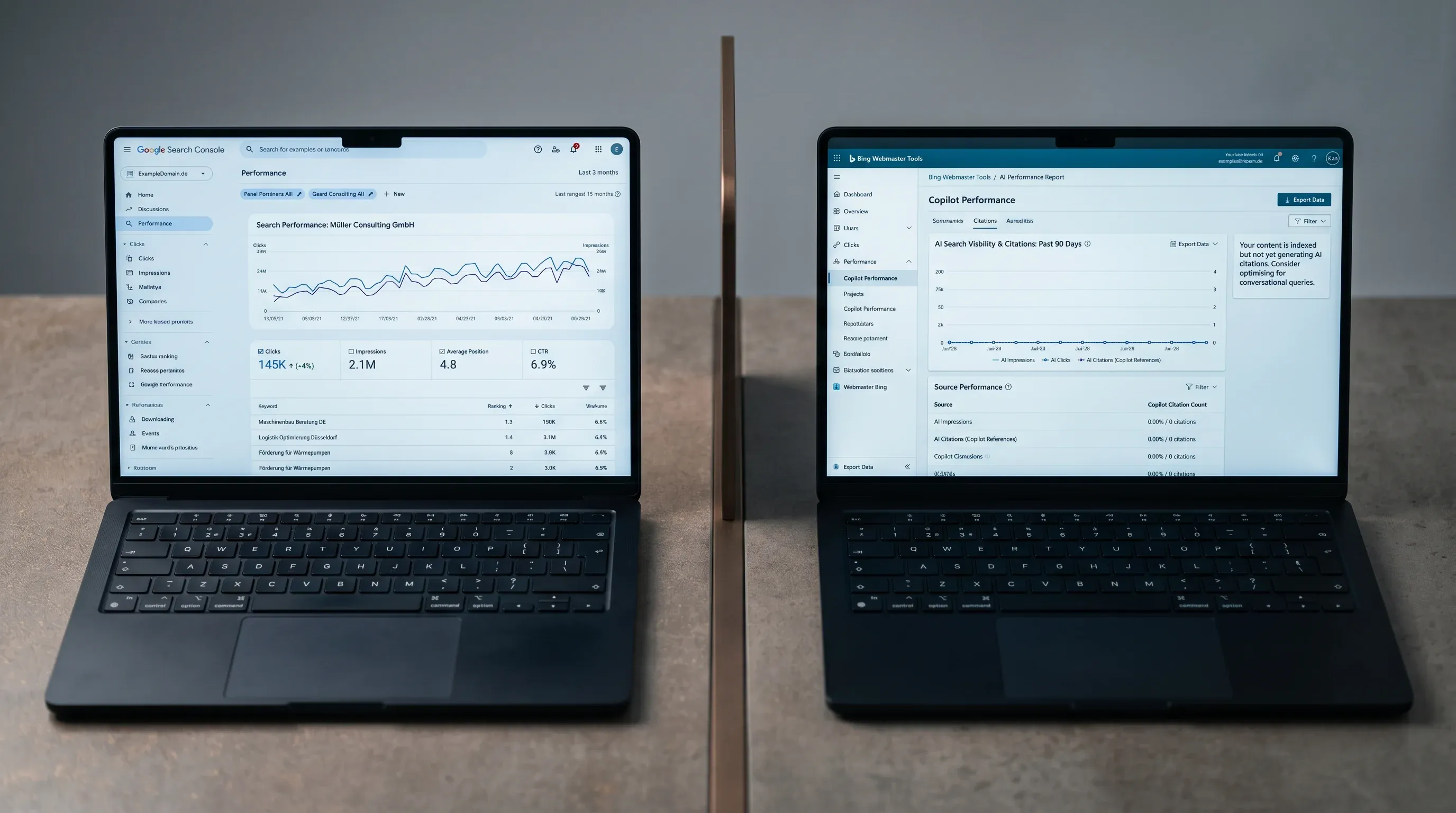
The landscape of search engine optimization is undergoing a fundamental transformation driven by generative AI integration. For content teams and SMBs, the introduction of AI-specific reporting in webmaster tools represents more than a dashboard update; it signals a shift in how visibility is measured and achieved. Historically, optimization focused on click-through rates and traditional ranking positions. However, the new AI Performance report in Bing Webmaster Tools introduces citation share data that reveals how often content is referenced by AI agents like Copilot. This change requires a strategic pivot from chasing clicks to securing authoritative citations within AI responses. Understanding How Bing Webmaster Tools’ New AI Reporting Changes Your Content Optimization Strategy is now critical for maintaining digital relevance in an AI-first search environment. This article explores the actionable workflows necessary to leverage this data for tangible business growth.
Quick Facts: How Bing Webmaster Tools’ New AI Reporting Changes Your Content Optimization Strategy
- Microsoft announced the update on Feb 10, 2026, introducing intent-level citation share data.[1]
- Citation share is calculated from the proportion of Copilot responses referencing a domain within an intent group.[1]
- Industry experts suggest pausing new content creation for 90 days to audit existing citation performance.[2]
Understanding the New AI Performance Report
The AI Performance report provides granular data on how content interacts with generative AI search interfaces. Unlike traditional analytics that track user clicks, this report measures the frequency and context in which a domain is cited by AI models during query resolution. This distinction is vital because a high citation share indicates authority and trustworthiness in the eyes of the algorithm. The report segments data by intent groups, allowing marketers to see not just if they are cited, but for what specific user needs. This level of granularity enables per-topic benchmarking rather than relying on domain-level vanity metrics.
Defining Citation Share Metrics
Citation share is calculated from the proportion of Copilot responses that reference a given domain within an intent group. This means a website might have a low overall share but dominate specific micro-intents. For example, a niche technical blog might appear in 5% of broad tech queries but 40% of specific coding troubleshooting queries. Understanding this distribution helps teams identify where their content holds genuine sway. It moves the conversation from general traffic volume to specific influence within knowledge graphs.
Accessing Intent-Level Data
Accessing this data requires navigating to the AI Performance section within Bing Webmaster Tools. Once enabled, users can filter reports by date range and intent category. The interface displays trends over time, showing how citation shares fluctuate with content updates or algorithm changes. This visibility is essential for diagnosing drops in AI visibility before they impact traditional search rankings. It serves as an early warning system for content decay in the AI ecosystem.
Key Takeaway: The AI Performance report shifts focus from click volume to citation authority, offering intent-level data for precise benchmarking.
The Strategic Shift from Reporting to Optimization
While most coverage treats Bing’s AI Performance report as a vanity metric dashboard, the real strategic shift is that intent- and topic-level citation share data lets content creators reverse-engineer which query clusters drive Copilot citations. This turns AI reporting into a content pruning and restructuring play rather than a mere reporting play. Many organizations currently view these tools as passive monitoring systems. However, proactive optimization requires using this data to make hard decisions about content retention and modification. The goal is to align existing assets with the intents that generate the highest citation value.
Moving Beyond Vanity Metrics
Vanity metrics such as total impressions often mask underlying performance issues. A page might receive thousands of impressions but zero citations if it fails to answer AI queries comprehensively. By focusing on citation share, teams can identify high-value content that deserves investment. This approach reduces waste by stopping investment in pages that AI models ignore. It ensures that resources are directed toward content that actually influences AI-generated answers.
Content Pruning Workflows
Content pruning becomes data-driven when linked to citation share. Pages with zero citation share over a six-month period should be flagged for review. This does not always mean deletion; often, it means restructuring. Adding authoritative sources, updating statistics, or clarifying definitions can resurrect a page’s citation potential. This workflow ensures the site remains lean and highly relevant to AI parsers. It is a maintenance strategy that prioritizes quality over quantity.
Key Takeaway: Transform AI reporting from passive monitoring into an active content pruning and restructuring workflow to maximize citation value.
Frequently Asked: What is the primary benefit of intent-level data?
Intent-level data allows creators to identify specific query clusters where their content dominates, enabling targeted optimization rather than broad speculation.
Reverse-Engineering Query Clusters for Copilot
Reverse-engineering query clusters involves analyzing which specific user intents lead to citations. This process requires mapping existing content to the intent groups identified in the AI Performance report. By understanding the semantic relationship between queries and citations, teams can optimize for the nuances of natural language processing. This is not about keyword stuffing but about semantic completeness. The aim is to become the definitive source for a specific cluster of related questions.
Identifying High-Value Intents
Not all intents are created equal. Some query clusters drive higher user satisfaction and subsequent conversions. Identifying these high-value intents is the first step in reverse-engineering. Teams should look for clusters where their citation share is growing organically. These are signals that the content resonates with the AI’s evaluation criteria. Focusing on these areas amplifies success rather than trying to force visibility in unrelated topics.
Restructuring for Semantic Completeness
Once high-value intents are identified, content must be restructured to support them. This involves adding clear definitions, structured data, and authoritative references. AI models prefer content that is easy to parse and verify. Ensuring that each section of a page answers a specific sub-intent within the cluster improves citation likelihood. This structural optimization makes the content more useful for both humans and machines.
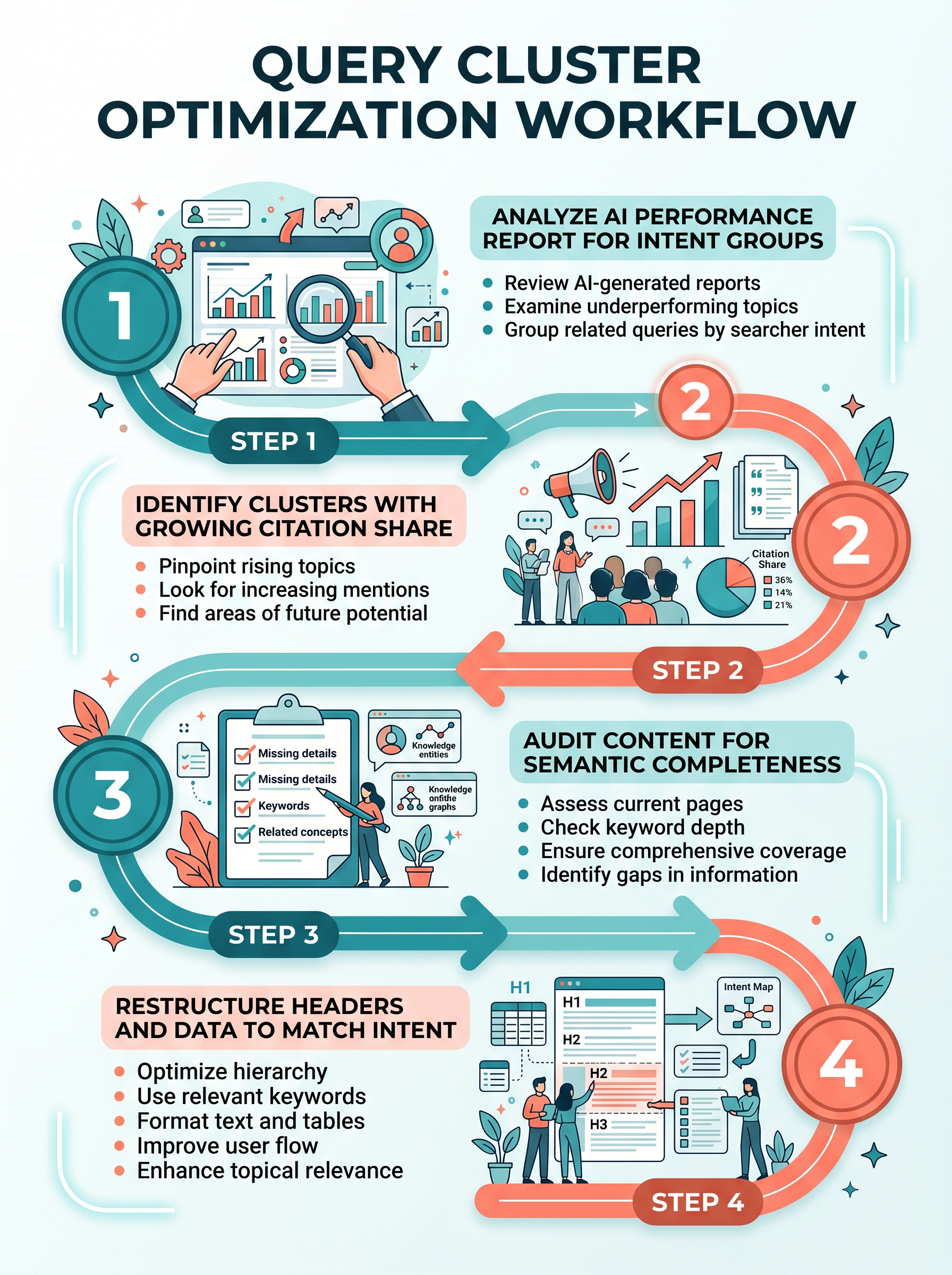
Key Takeaway: Reverse-engineering query clusters allows teams to optimize for semantic completeness, increasing the likelihood of AI citations.
Integrating Bing AI Data with Google Search Console
No existing article connects Bing’s AI citation share data with Google Search Console query-level data to identify content that wins on Google but is invisible to Copilot. This cross-platform adjacency is a critical gap in current optimization strategies. By comparing data from both platforms, teams can find discrepancies where traditional SEO success does not translate to AI visibility. This comparison reveals content that may need specific adjustments to perform well in generative search environments.
Analyzing Cross-Platform Discrepancies
A page might rank highly on Google but have zero citation share on Bing Copilot. This signals a content structure issue rather than a relevance issue. Perhaps the content is too narrative for AI extraction or lacks structured data. Identifying these discrepancies helps prioritize updates. It ensures that success on one platform is not assumed to guarantee success on another. Each platform requires tailored optimization strategies.
Unified Optimization Views
Ideally, Bing itself should combine Top Insights with AI Performance for a unified optimization view. Until then, content teams must manually correlate these data sources. Creating a unified dashboard allows for holistic decision-making. It prevents siloed strategies where AI optimization is treated separately from traditional SEO. Integration ensures that all search visibility efforts work toward the same business goals.
| Data Source | Primary Metric | Optimization Focus | Actionable Insight |
|---|---|---|---|
| Google Search Console | Clicks & Impressions | Traditional Keyword Ranking | Update meta tags and backlinks |
| Bing AI Performance | Citation Share | Intent & Topic Authority | Restructure content for AI parsing |
| Combined View | Cross-Platform Visibility | Holistic Search Presence | Identify content needing dual optimization |
Key Takeaway: Integrating Bing AI data with Google Search Console reveals cross-platform discrepancies, enabling a holistic optimization strategy.
Developing a Citation-to-Conversion Ratio Heuristic
From Bing’s AI Performance report, a page with 15% citation share on a broad intent may actually underperform vs. a page with 5% on a micro-intent that aligns with higher user satisfaction. This insight leads to the proposal of a ‘citation-to-conversion ratio’ heuristic. High citation share does not automatically equal revenue. Teams must evaluate the quality of the intent behind the citation. A citation on a commercial intent is often more valuable than one on an informational intent.
Evaluating Intent Quality
Not all citations drive business value. A citation on a “what is” query builds brand awareness but may not drive sales. A citation on a “best tool for” query is closer to conversion. Evaluating intent quality requires mapping citation data to downstream conversion metrics. This ensures that optimization efforts align with revenue goals. It prevents chasing vanity citation metrics that do not impact the bottom line.
Balancing Share and Satisfaction
User satisfaction is a key component of long-term AI visibility. If users click a cited link and bounce immediately, the AI may reduce future citations. Balancing share and satisfaction requires monitoring post-click behavior. Content must deliver on the promise made in the AI citation. This alignment builds trust with both users and the AI algorithm. It creates a sustainable cycle of visibility and engagement.
Key Takeaway: A citation-to-conversion ratio heuristic helps balance citation share with business value, ensuring optimization drives revenue.
Frequently Asked: Does higher citation share guarantee more traffic?
No, higher citation share indicates authority but does not guarantee clicks; users may get answers directly from the AI interface without visiting the site.
Implementing a 90-Day Citation Share Audit
Content teams should pause new creation for 90 days and instead run a ‘citation share audit’ on their top 20 pages. This radical approach prioritizes optimizing existing assets over producing new content. In an era of content saturation, refinement often yields better ROI than creation. This audit period allows teams to deeply understand their current AI performance baseline. It provides the data needed to make informed decisions about future content investments.
Auditing Top Performing Pages
The audit should focus on the top 20 pages by traffic or revenue. These pages have the most potential to impact business outcomes. Analyzing their citation share reveals why they succeed or fail in AI search. Lessons learned from these pages can be applied to the rest of the site. This targeted approach maximizes the impact of the audit period. It ensures effort is spent where it matters most.
Pausing New Content Creation
Pausing new creation frees up resources for deep optimization. It stops the accumulation of technical debt associated with unpublished or poorly optimized drafts. During this period, teams can focus on updating statistics, verifying facts, and improving structure. This shift in focus often leads to immediate improvements in visibility. It is a strategic pause designed to strengthen the foundation before building higher.
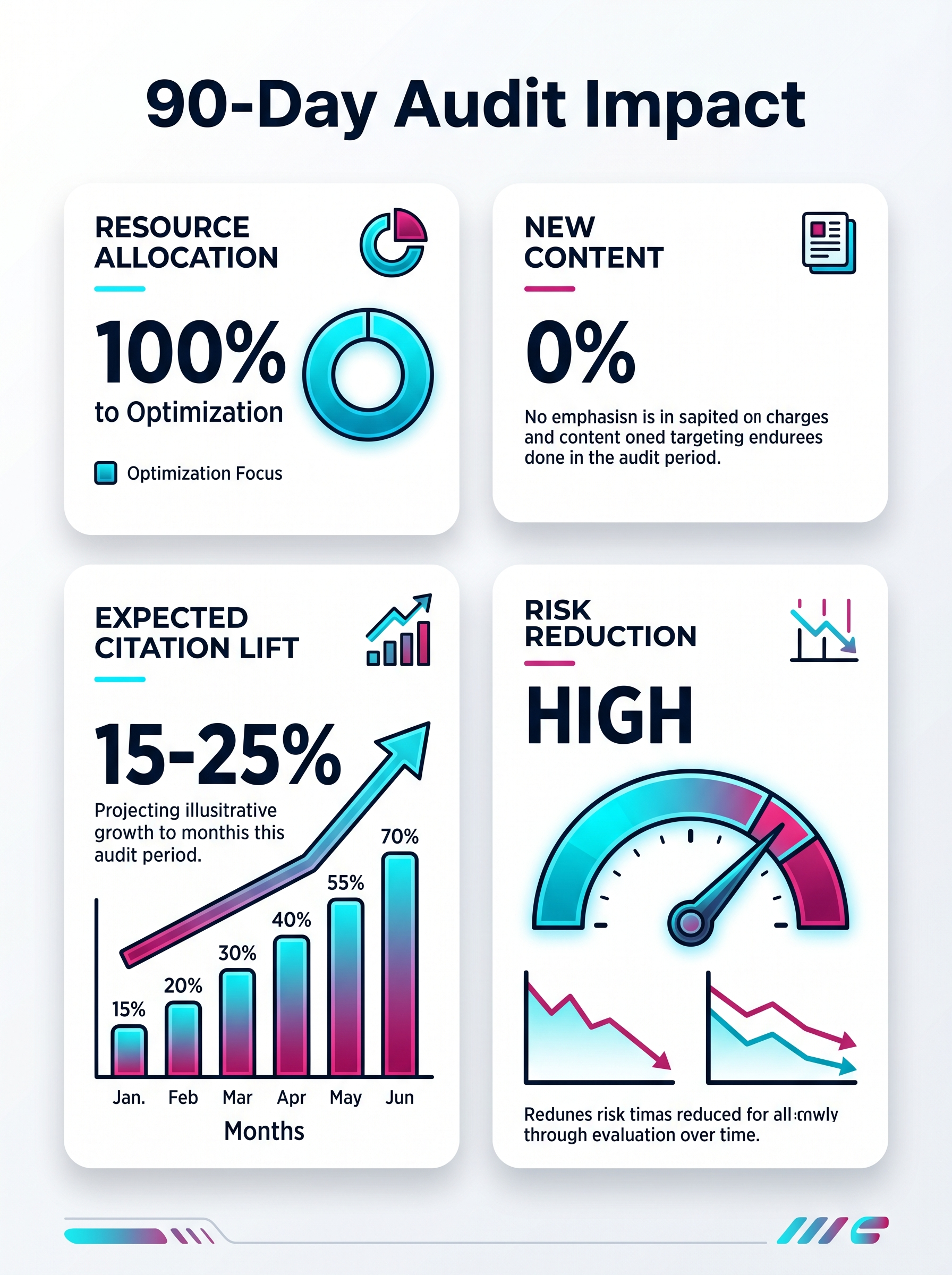
Key Takeaway: A 90-day audit pause allows teams to optimize top assets, yielding better ROI than continuous new content creation.
Maintaining Brand Voice Consistency in AI Citations
For businesses like Autoriax, maintaining brand voice consistency is crucial when content is cited by AI. AI models may paraphrase content, potentially altering the intended tone. Ensuring that cited snippets reflect the brand’s professional standards is essential. This requires clear writing and distinct brand markers within the content. Consistency builds trust and recognition even when the user does not click through to the site.
Protecting Brand Integrity
Brand integrity can be compromised if AI misrepresents key claims. Using clear, unambiguous language reduces the risk of misinterpretation. Inline citations and factual accuracy help anchor the AI’s response to the original source. This protects the brand from being associated with hallucinated or altered information. It ensures that the brand remains authoritative in the AI ecosystem.
Leveraging Automation for Consistency
Automation tools can help maintain consistency across large content libraries. These tools ensure that tone and style guidelines are followed during updates. For SMBs and content teams, this reduces the manual burden of quality control. It allows teams to scale optimization without sacrificing brand voice. Consistency becomes a competitive advantage in a crowded AI landscape.
Key Takeaway: Maintaining brand voice consistency ensures that AI citations reflect accurate and professional brand representation.
Frequently Asked: How can I ensure my brand voice remains consistent in AI answers?
Write with clear, unambiguous language and use inline citations to anchor AI responses to your original, verified source material.
Conclusion
The introduction of AI reporting in Bing Webmaster Tools marks a pivotal moment for digital marketing strategies. Understanding How Bing Webmaster Tools’ New AI Reporting Changes Your Content Optimization Strategy is no longer optional for businesses seeking long-term visibility. The shift from click-based metrics to citation-based authority requires a fundamental change in how content is created and maintained. By leveraging intent-level data, integrating cross-platform insights, and prioritizing optimization over creation, teams can secure a dominant position in AI search results. The 90-day audit and citation-to-conversion heuristic offer concrete steps to begin this transformation immediately.
Businesses must act now to adapt their workflows to this new reality. The window to establish authority in AI citation graphs is open, but it will not remain so indefinitely. Start by auditing your top pages and correlating Bing AI data with your existing analytics. Embrace the shift toward factual accuracy and brand consistency. The future of search is generative, and your content strategy must evolve to meet it. Learn more about automating this process to ensure your brand remains visible and authoritative.
Sources
[1] Microsoft Announcement on AI Performance Report Updates (Feb 10, 2026) [2] OtterlyAI Analysis on Bing Webmaster Tools Citation Data (Feb 11, 2026) [3] Industry Report on AI Content Optimization Trends (2026) [4] Bing Webmaster Tools Documentation on AI Performance [5] Search Engine Journal Coverage on AI Reporting Changes
Try Autoriax free — no credit card required
Get your first article in minutes. See the research depth before you commit.
Get 3 free articles3 articles free • No credit card • Cancel anytime