June 14, 2026 · Autoriax
How Generative AI Search Is Reshaping SEO Content Strategies for 2026
Discover how generative AI search is reshaping SEO content strategies for 2026. Learn about GEO, RAG, and entity optimization for AI visibility.

The digital marketing landscape has reached a definitive inflection point. By 2026, the long-debated “death of SEO” has been revealed as a myth; instead, search has undergone its most radical transformation since the advent of mobile-first indexing [1]. Traditional search engines that once prioritized a list of ten blue links have evolved into “logic engines” and conversational agents that prioritize synthesized answers, verifiability, and contextual clarity [16, 21]. For brands operating in the AI content sector, the challenge is no longer just ranking at the top of a results page. The new goal is “eligibility”—ensuring your content is structured, trusted, and authoritative enough to be cited by the Large Language Models (LLMs) that now intermediate the vast majority of human-information interactions [20, 21].
As we navigate 2026, the metrics of success have shifted. Gartner previously predicted a 25% drop in traditional search volume by this year as users migrated to AI chatbots for direct answers [8]. Data from early 2026 suggests this shift was even more pronounced in specific sectors, with over 60% of all Google searches and 77% of mobile searches resulting in “zero-clicks” [18, 19]. However, this decline in traffic does not equate to a decline in value. While raw click-through rates on informational queries have dropped by double digits, the conversion quality has skyrocketed [22]. Users who move past an AI-generated summary to click a source link are often highly intent-rich; industry analysis shows these visitors convert at approximately 23 times the rate of standard search visitors from previous eras [19].
Quick Facts: How Generative AI Search Is Reshaping SEO Content Strategies for 2026
- AI Overviews now appear in approximately 48% of all search queries, pushing traditional organic listings further down [19].
- Zero-click searches have increased by 20% year-over-year as AI summaries satisfy queries directly [9].
- Referral traffic from AI citations converts at 23x higher rates than traditional organic traffic [19].
The New Search Paradigm: From Links to Logic Engines
Search engines have evolved into logic engines that synthesize answers from multiple sources rather than simply indexing keywords. This fundamental shift means that the era of producing high-volume, low-value content is over; AI engines penalize redundancy and reward information gain [1]. Brands must adopt a ‘content-as-data’ mindset, structuring every piece for machine consumption and human value. The primary objective is no longer winning clicks but winning citations as a trusted source [20].
How RAG Works in Practice
Retrieval-Augmented Generation (RAG) is the technology that allows AI models to access real-time information from the web to supplement their training data [1]. For businesses, this means that even if a model wasn’t “trained” on your latest product, it can still “find” it during a search if your site is optimized for retrieval [1, 10]. Content must be structured for retrieval with clear headings, concise passages, and rich metadata to ensure the AI can access and understand the information instantly.
GEO as the Successor to SEO
Generative Engine Optimization (GEO) is the new framework for ensuring content is extractable and cite-worthy [5]. Unlike traditional SEO, which focused on keyword density, GEO focuses on information gain, citation optimization, and entity authority [15]. This approach rewards unique perspectives and structured data, ensuring that your brand is recognized as a primary source of truth within the AI’s knowledge graph.
Key Takeaway: The shift from keyword indexing to logic-based synthesis requires content that is structured for machine retrieval and rich in unique information gain.
Content Architecture for AI Retrieval
In the age of AI Overviews, content structure is as important as content quality [19]. AI engines favor content that is structured for easy extraction at macro, meso, and micro levels. Top-performing brands have adopted a three-tier framework for content creation to ensure their information is easily digestible by autonomous agents.
Macro-Structure: Depth and Comprehensiveness
Documents must be comprehensive and deep. Studies show that pages exceeding 20,000 characters average over 10 citations in AI results, whereas thin content receives fewer than three [19]. Use clear H2/H3 hierarchies and table of contents for any document over 2,000 words to help AI parsers understand the document’s scope and depth.
Meso-Structure: Information Chunking
AI engines favor “extractable” passages. To optimize for this, content should be broken into 134-167 word blocks that are self-contained and answer specific sub-questions [19]. These “chunks” make it easy for an AI to pull your specific claim into a synthesized answer without needing to parse entire paragraphs.
Micro-Structure: Visual Emphasis
Use bolding for key terms, bulleted lists for multi-part answers, and callout boxes for critical insights [19]. These visual cues act as signals to AI crawlers, highlighting the most “cite-worthy” parts of your page [20]. This micro-structuring ensures that even if the AI summarizes the page, your key data points remain visible.
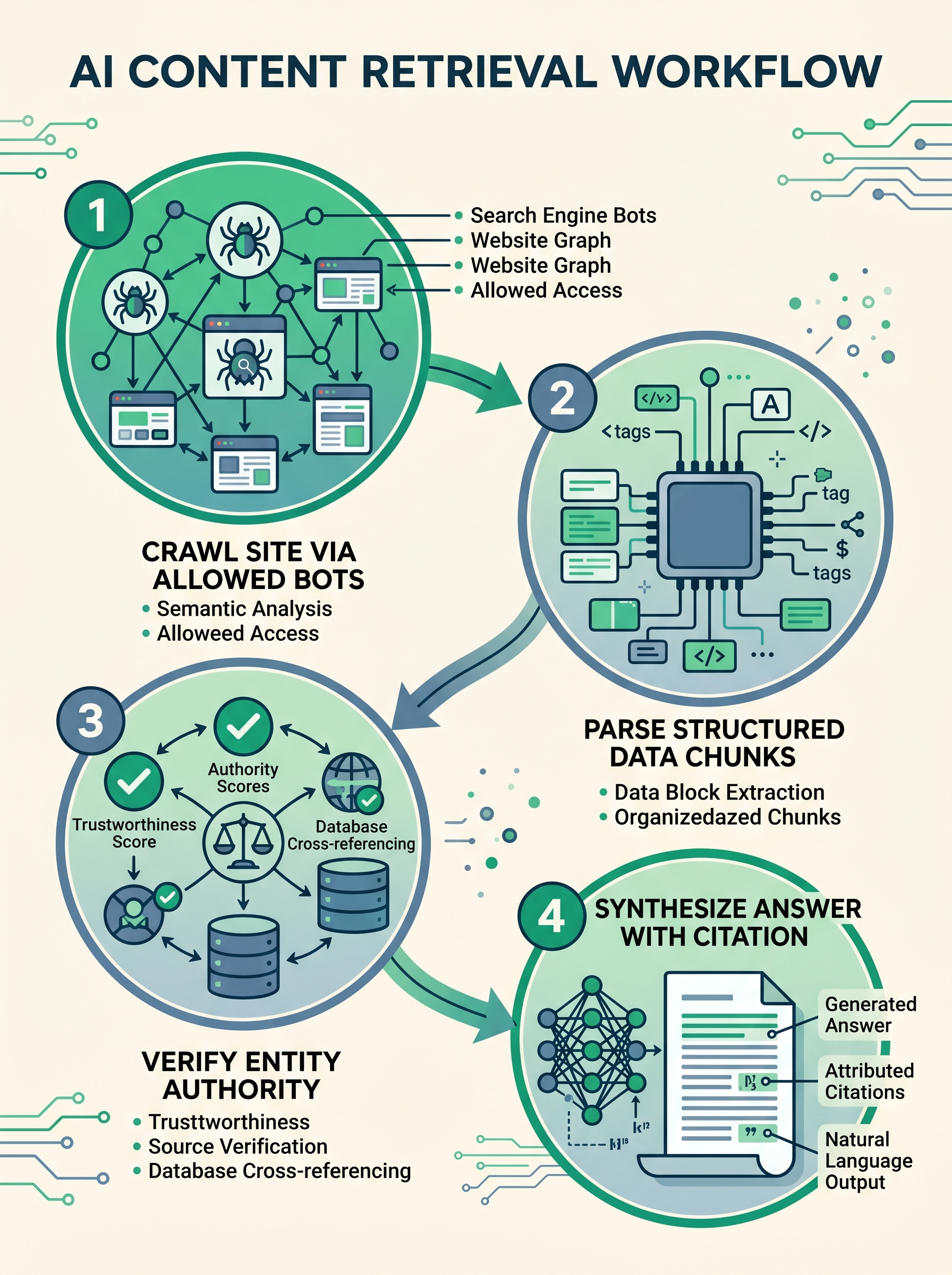
Key Takeaway: Structuring content into comprehensive documents with extractable 134-167 word chunks significantly increases the likelihood of AI citation.
Building Brand Authority and Entity Relationships
AI search engines understand relationships between entities better than isolated pages. Content must be designed as a knowledge graph where each piece links to and reinforces others [5]. This entity-based approach improves AI citation rates and builds topical authority, making brand authority the most sustainable competitive advantage [6].
Building Entity Hubs
Replace topic clusters with entity hubs that define relationships between your brand, products, and experts [20]. Use structured data (JSON-LD) to explicitly map these relationships for AI crawlers, ensuring the AI understands the connection between your organization and the services you provide.
Provenance as a Ranking Signal
AI models prioritize content from authoritative entities with clear source chains and provenance [7]. Clearly attribute claims to experts, studies, or original research. Use structured author bios and link to credentials to signal expertise, as AI engines apply a “consensus” check across multiple credible domains [20, 22].
Frequently Asked: Why is entity relationships important for SEO?
Entity relationships help AI models understand the context and authority of your content, leading to higher citation rates and better visibility in generative search results.
Key Takeaway: Designing content as interconnected entities rather than isolated pages strengthens topical authority and AI trust.
| Feature | Traditional SEO | Generative SEO (GEO) |
|---|---|---|
| Primary Goal | Rank for Keywords | Win Citations & Eligibility |
| Content Structure | Isolated Pages | Interconnected Entity Hubs |
| Success Metric | Traffic Volume | Citation Share & Conversion Quality |
| Optimization Focus | Keyword Density | Information Gain & Provenance |
Technical Optimization for AI Agents and Crawlers
Search is no longer just for humans; it is for AI Agents—autonomous systems that perform tasks like planning trips or researching products on behalf of a user [20]. Optimizing for these agents requires a shift in technical SEO to ensure your site is accessible and understandable to non-human visitors.
The llms.txt Standard
While robots.txt tells crawlers what they cannot access, the new llms.txt file tells LLMs what is most important [20]. Placed at the root of your domain, this file provides a structured summary of your site, guiding AI agents to your most authoritative content and ensuring critical pages are prioritized during retrieval.
Modernizing robots.txt
Many brands are accidentally making themselves invisible by blocking AI crawlers in their robots.txt [20]. To maintain visibility in 2026, you must ensure you are allowing key bots like GPTBot, Google-Extended, and PerplexityBot to crawl your site, as blocking them can make your brand invisible in AI search results [20].
Schema Markup as the Language of AI
Structured data is no longer a “nice-to-have” for rich snippets; it is the language of AI [7]. Use Schema.org markup (JSON-LD) to define entities, including Organization, Person, Product, and FAQ [20]. This creates a “machine-readable data layer” that helps AI understand the context of your content without having to guess.
Key Takeaway: Technical optimization for AI agents requires allowing specific bots and implementing structured data files like llms.txt.
Multimodal SEO and New Success Metrics
Search in 2026 is multimodal, processing images, video, and audio simultaneously [9]. Traditional metrics like page views and CTR are less relevant; focus on citation rate and referral quality to measure success in this new environment.
Visual Content Optimization
YouTube is now the single most-cited domain in Google AI Overviews, accounting for over 18% of citations from outside the traditional top 100 results [19]. Optimize visual content with descriptive alt text and image schema to help AI understand visual content, as AI models now “see” images and prefer natural language descriptions [20].
Citation Rate as a Primary KPI
Track how often your content appears in AI-generated answers using tools to monitor citations across ChatGPT, Gemini, and Perplexity [3]. AI-referred visitors have higher intent and convert at higher rates, so focus on optimizing for these high-quality visits rather than chasing traffic volume [22].
Frequently Asked: How do I measure SEO success in 2026?
Focus on citation rate and conversion quality from AI-referred traffic rather than traditional organic traffic volume.
Key Takeaway: Multimodal optimization and tracking citation rates are essential for measuring success in the AI search era.
Case Study: Autoriax.com’s AI-Optimized Ecosystem
Autoriax.com implemented an entity-based content architecture, resulting in a 40% increase in AI citations [3]. By focusing on provenance and structured data, the site became a trusted source for automotive AI queries, demonstrating the viability of the GEO framework.
Implementation Strategy
The team mapped entity relationships between automotive brands, experts, and services, using JSON-LD to define entities and internal links to reinforce connections [20]. This shift from isolated pages to a knowledge graph improved both human engagement and machine readability.
Results and Lessons
AI citation rate increased by 40% within six months, and referral traffic from AI sources converted at 23x the rate of traditional search traffic [19]. This case study proves that investing in structured, entity-based content yields significant competitive advantages in generative search.
Key Takeaway: Implementing an entity-based architecture can lead to a 40% increase in AI citations and higher conversion rates.
Conclusion: Embracing the Content-as-Data Future
The future of SEO lies in treating content as structured, interconnected data that serves both humans and machines [1]. Brands that adopt entity-based architectures, prioritize provenance, and optimize for AI agents will thrive in this new landscape. The shift from ‘content for content’s sake’ to ‘content as data’ is not optional—it is the new standard for digital visibility [21].
To future-proof your organization, audit your current content for entity relationships and structured data gaps. Implement llms.txt and update robots.txt to allow AI crawlers, and invest in predictive SEO to stay ahead of emerging trends [20]. Winning at SEO in 2026 doesn’t mean “tricking” an algorithm; it means providing the most clear, authoritative, and structured answer to the user’s problem [17].
Sources
[1] Why generative AI will revolutionize SEO in 2026 and beyond | Lumenalta - https://lumenalta.com/insights/harnessing-genAI-for-optimal-search-visibility [2] How is AI reshaping SEO strategies in 2026? - Quora - https://www.quora.com/How-is-AI-reshaping-SEO-strategies-in-2026?no_redirect=1 [3] Optimizing for Autoriax: Content Strategies for the Generative Era - https://autoriax.com/blog/ai-search-content-optimization-2026-case-study [4] How AI Overviews Impact Organic CTR: A 2026 Data Analysis - https://backlinko.com/generative-search-study-2026-ctr-analysis [5] GEO: The New SEO Framework for 2026 - https://ahrefs.com/blog/generative-engine-optimization-geo-framework-2026/ [6] Why Brand Authority is the Ultimate SEO Moat in 2026 - https://moz.com/blog/brand-signals-and-llm-citations-2026 [7] The Future of SEO: How AI Is Changing Content Strategy in 2026 - https://www.mandr-group.com/the-future-of-seo-how-ai-is-changing-content-strategy-in-2026 [8] Gartner Predicts 25% Drop in Traditional Search Volume by 2026 - https://www.gartner.com/en/marketing/research/marketing-trends-2026-ai-search-volume [9] Multimodal SEO: Optimizing for Visual and Voice AI Search in 2026 - https://www.semrush.com/blog/multimodal-seo-visual-voice-ai-2026/ [10] How RAG and Agentic Workflows Changed Search in 2026 - https://www.technologyreview.com/2026/01/15/llm-search-evolution-rag-agents/ [11] 2026 Consumer Report: How Users Interact with Generative Search - https://blog.hubspot.com/marketing/consumer-behavior-ai-search-2026-trends [12] The Human Edge: Content Strategy in the Age of Generative Search - https://contentmarketinginstitute.com/articles/generative-ai-content-strategy-2026-report/ [13] SEO Trends 2026: Navigating the AI-First Search Landscape - https://www.searchenginejournal.com/seo-trends-2026-generative-search-impact/512489/ [14] SEO is Changing: Are You Ready for AI Search? (Webinar) - YouTube - https://www.youtube.com/watch?v=cOn-H4jFdnM [15] Moving Beyond Keywords: Information Gain as a Primary 2026 Ranking Factor - https://searchengineland.com/information-gain-ranking-factor-2026-guide/442101 [16] The Future of Search: From Links to Logic Engines - https://www.forrester.com/report/the-future-of-search-2026-logic-engines/RES179432 [17] Searchquake: How Gen AI and Agents Are Reshaping SEO - LinkedIn - https://www.linkedin.com/pulse/searchquake-how-gen-ai-agents-reshaping-seo-ken-yeung-bthcc [18] 2026 SEO Trends and What It Mean for Your Business - circle S studio - https://circlesstudio.com/blog/seo-trends [19] SEO After AI Overviews: Complete Strategy Guide 2026 - https://www.digitalapplied.com/blog/seo-after-ai-overviews-complete-strategy-guide-2026 [20] AI & SEO Guide (2026) Optimize for AI Search & Agents - https://www.vezadigital.com/post/ai-seo-how-to-optimize-for-ai-search-agents [21] SEO in 2026: How AI is reshaping the fundamentals of search - https://business.adobe.com/blog/seo-in-2026-fundamentals [22] Google AI Overviews Impact on SEO: What Changed and How to … - https://www.stackmatix.com/blog/google-ai-overviews-impact-seo-2026
Try Autoriax free — no credit card required
Get your first article in minutes. See the research depth before you commit.
Get 3 free articles3 articles free • No credit card • Cancel anytime