June 14, 2026 · Autoriax
How to Scale AI Content Production Without Triggering Google’s E-E-A-T Penalties
Learn how to scale AI content production without triggering Google’s E-E-A-T penalties. Expert strategies for 2026 SEO success and safety.

The digital landscape of 2026 has undergone a fundamental transformation. As AI search platforms like ChatGPT, Perplexity, and Google AI Overviews reshape how consumers find information, brands face a critical paradox. You must produce content at a massive scale to remain visible, yet navigate increasingly sophisticated quality filters designed to weed out low-effort automation. For marketing directors and SEO leads, the fear of a manual action or an algorithmic “cliff-edge” drop in traffic is real. Recent data shows that sites accumulating rankings through unedited AI pages saw 50–80% of their organic traffic disappear during the March 2026 core update [10]. However, the solution is not to abandon AI, but to evolve your strategy. Learning how to scale AI content production without triggering Google’s E-E-A-T penalties requires moving from a “commodity” mindset to a “non-commodity” model that prioritizes unique value and human-level nuance [6].
Quick Facts: How to Scale AI Content Production Without Triggering Google’s E-E-A-T Penalties
- Sites publishing unedited AI pages lost 50–80% of traffic in March 2026 [10].
- 17% of top 20 search results were AI-generated as of 2025 [4].
- Safe AI productivity multiplier is 2–4x human baseline, not 100x [10].
Understanding Google’s Stance on AI Content and E-E-A-T
Before scaling, it is essential to clear the air regarding search engine policies. Google does not penalize content simply because it was generated by AI. Google’s official guidance remains consistent: the focus is on the quality and helpfulness of the content, not how it was produced [11]. In fact, as of 2025, approximately 17% of the top 20 search results were AI-generated [4]. Google’s ranking systems are designed to reward original, high-quality content that demonstrates the principles of E-E-A-T, regardless of whether a human or a machine held the “pen” [11].
What Google Actually Penalizes
The risk lies in what Google classifies as “Scaled Content Abuse.” Introduced as a named spam category in 2024 and aggressively enforced in 2026, this policy targets the practice of generating large volumes of pages primarily to manipulate search rankings without adding real value for users [5, 10]. You are at risk of a penalty if your AI content is thin, repetitive, or lacks first-hand experience. Generic summaries that regurgitate publicly available information are considered commodity content and are heavily deprioritized [6].
Why E-E-A-T Is the New Quality Proxy
In a world flooded with automated text, E-E-A-T has become Google’s mathematical proxy for quality [12]. To scale successfully, you must bake these signals into your automated workflows. Experience, Expertise, Authoritativeness, and Trustworthiness are now algorithmic signals that determine visibility. Brands must prove they are not just aggregating data but creating genuine value.
Key Takeaway: Google penalizes low-quality scale, not AI usage itself. Focus on value and E-E-A-T signals to avoid “Scaled Content Abuse” flags.
The Four Pillars of E-E-A-T in the AI Era
In a world flooded with automated text, E-E-A-T has become Google’s mathematical proxy for quality [12]. To scale successfully, you must bake these signals into your automated workflows. Each pillar requires specific attention when integrating AI tools into your content engine.
Experience: The AI-Killer Differentiator
In December 2022, Google added “Experience” to the existing E-A-T framework. This is the most difficult pillar for AI to replicate because LLMs lack a physical presence or personal history [7, 13]. To scale this, infuse your AI drafts with “I/we” statements, proprietary photos, and specific personal observations. Google scans for signals that the creator actually did the thing, such as testing a vehicle part or attending a trade show [2, 12].
Expertise and Authoritativeness Through Credentials
Expertise is evaluated by the comprehensiveness and nuanced vocabulary of the content [12]. Use subject matter experts (SMEs) to provide the “seed” data. AI should be used to structure the expert’s knowledge, not to invent the knowledge itself. Authority is built off-page through brand mentions and citations. Content optimized for AI visibility correlates strongly with brand mentions [1].
Trustworthiness as the Foundation
Trust is the most critical pillar. If a site is deemed untrustworthy, it will fail E-E-A-T regardless of its expertise [7, 13]. Ensure technical foundations like HTTPS, clear contact information, and transparent editorial policies are present across all pages [5, 7]. Avoid publishing unverified claims or hallucinated data that could erode user confidence.
Key Takeaway: Experience is the hardest pillar for AI to fake. Use first-person observations and verifiable credentials to satisfy E-E-A-T requirements.
Auditing Your Current AI Content Readiness
Before expanding, test your brand across ChatGPT, Perplexity, and Google AI Overviews for your target queries. Document where competitors appear and which questions trigger AI responses [1]. Identify “dead weight”—pages with zero organic traffic over the last six months—as these are candidates for removal or consolidation rather than AI-assisted expansion [5].
Assessing AI Visibility and Competitor Gaps
Use tools to see if your content is cited in AI-generated answers. Find zero-volume queries from customer support tickets that competitors miss. This helps you identify gaps where AI can add value without competing directly with established commodity content. Understanding the competitive landscape is vital for how to scale AI content production without triggering Google’s E-E-A-T penalties [6].
Cleaning Up Dead Weight Before Scaling
Remove or consolidate pages that add no value. Focus on quality over quantity to avoid triggering scaled content abuse. Three weak AI posts covering the same topic should be merged into one comprehensive, expert-reviewed guide. Redirect the old URLs to the new authoritative page to preserve equity [5, 10].
Key Takeaway: Audit existing content for zero-traffic pages and consolidate weak articles before attempting to scale new AI production.
Building Technical Foundations for AI Extraction
Traditional SEO focuses on keywords; AI-driven SEO focuses on extractability. AI systems pull individual passages rather than entire pages [1]. Ensure clean robots.txt and valid JSON-LD schema markup to facilitate this process [1]. Use structured data (Schema.org) to help AI bots understand the “Who, How, and Why” of your content production [11, 12].
Schema Markup for Authorship and Expertise
Implement schema.org/Person with sameAs links to LinkedIn, Google Scholar, etc. Mark up article authors and their credentials explicitly. This helps search engines attribute expertise correctly and validates the human element behind the content. Structured data is non-negotiable for enterprise-scale AI content strategies.
Optimizing for Passage Extraction
Use clear headings, bullet points, and concise paragraphs. Ensure each section can stand alone as an answer. AI models favor content that is easily segmented and summarized. Clear structure improves the likelihood of your content being cited in AI Overviews.
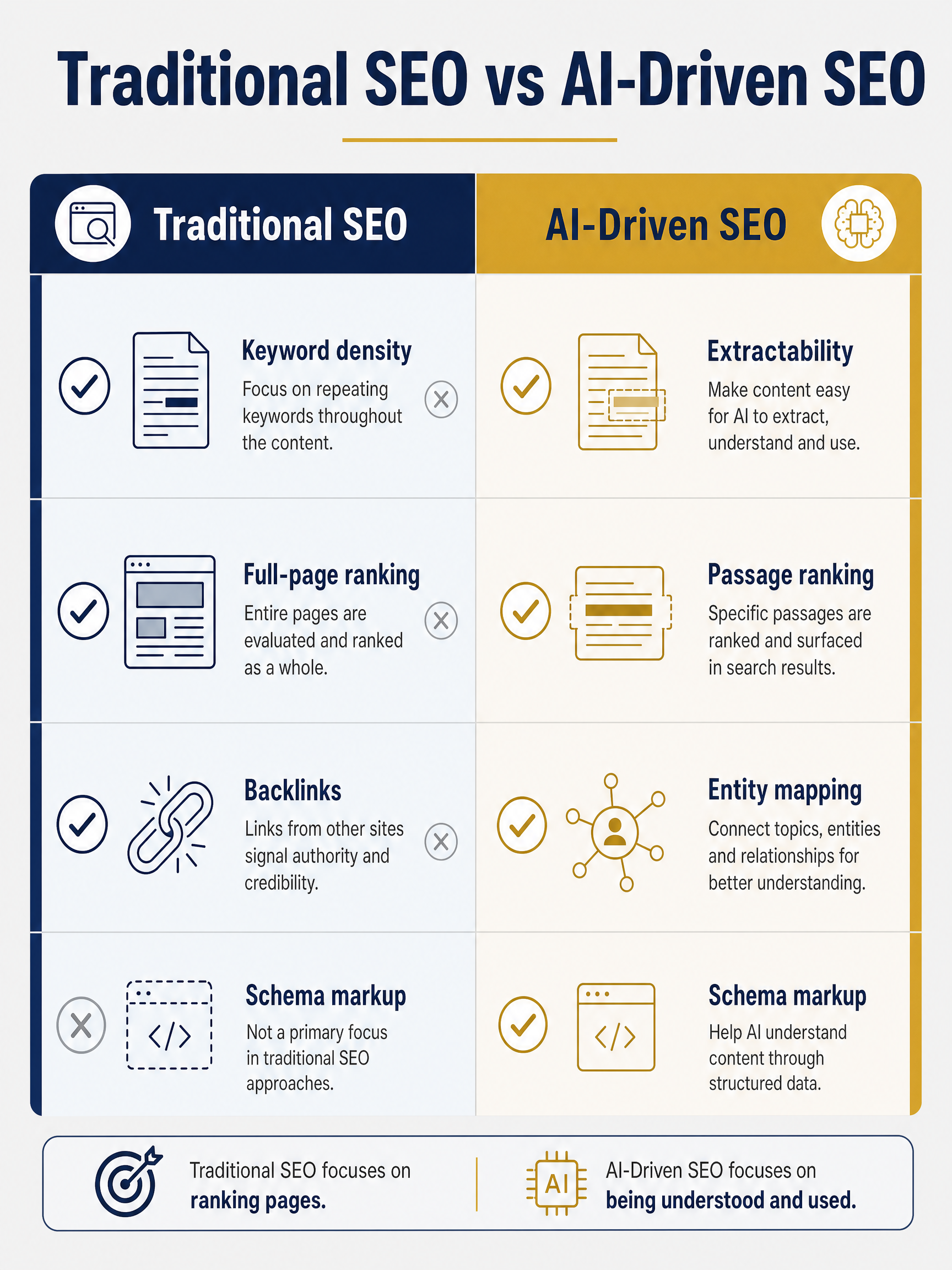
Key Takeaway: Optimize for extractability using schema markup and clear structures to ensure AI systems can cite your content accurately.
Entity-Based Semantic Optimization for Topical Authority
Modern algorithms map “entities”—people, concepts, and things—rather than isolated keywords [12]. Create content clusters with pillar pages and supporting articles covering subtopics and FAQs. This signals deep topical authority to search engines [1, 12]. Co-locate related entities to signal comprehensiveness to LLMs.
Building Content Clusters
Pillar page covers broad topic; cluster articles cover subtopics and FAQs. Internal linking reinforces topical authority. This structure helps search engines understand the depth of your knowledge. It also provides a clear pathway for users to explore related concepts.
Entity Co-location for LLM Comprehensiveness
Include related entities naturally in the text. For example, an article on “Technical SEO” must also mention “Crawl Budget,” “Schema Markup,” and “Core Web Vitals” to be considered comprehensive by an LLM [12]. Use schema.org to mark up entities like products, people, and organizations. This enhances semantic relevance.
Key Takeaway: Map entities and build content clusters to signal topical authority and improve comprehension by large language models.
Implementing a Human-in-the-Loop Editorial Workflow
The difference between a successful content operation and a penalized one is the editorial hand. Sites that survived the March 2026 core update had a human step in to fact-check and add context [5, 10]. AI should draft, but a domain expert must review and add context before publishing. The 2-4x productivity multiplier is safe; jumping to 500 articles per week flags abuse [10].
Drafting vs. Publishing: The Critical Distinction
Use AI for research, outlines, and first drafts only. Never publish AI output without human editing and approval. Fact-checking and adding first-hand experience are non-negotiable. This ensures accuracy and maintains brand voice consistency.
Setting Safe Scaling Limits
Gradually increase volume while maintaining per-article quality. Monitor traffic and rankings for sudden drops after scaling. A reasonable productivity multiplier with AI is 2–4x the human baseline. If your team suddenly jumps from 5 articles a week to 500, you are flagging your site for a “scaled content abuse” review [10].
- Verify every AI claim with a primary source before publishing.
- Ensure every article has a verifiable human author byline.
- Limit AI output scaling to 2-4x human baseline initially.
- Add proprietary data or unique insights to every draft.
- Conduct monthly E-E-A-T audits on published AI content.
Key Takeaway: Maintain a human-in-the-loop workflow with fact-checking and safe scaling limits to prevent penalties.
Leveraging First-Party Data as a Competitive Moat
The only way to create content that AI cannot replicate is to use data that doesn’t exist in the AI’s training set. This is your “moat” [4, 6]. Infuse proprietary data into your AI drafts to create non-commodity content. Original research and surveys attract links and citations.
Sources of Proprietary Data
Sales call transcripts reveal zero-volume queries. Customer support tickets answer specific, unaddressed questions. Product analytics show how users actually interact with tools. These sources provide unique insights that competitors cannot access via public scraping.
Turning Data into Content Assets
Create unique guides, benchmarks, and case studies. Use AI to structure the data, but human experts interpret and add context. By infusing proprietary data into your AI drafts, you move from “commodity” content to “non-commodity” content that adds genuine value to the web [6].
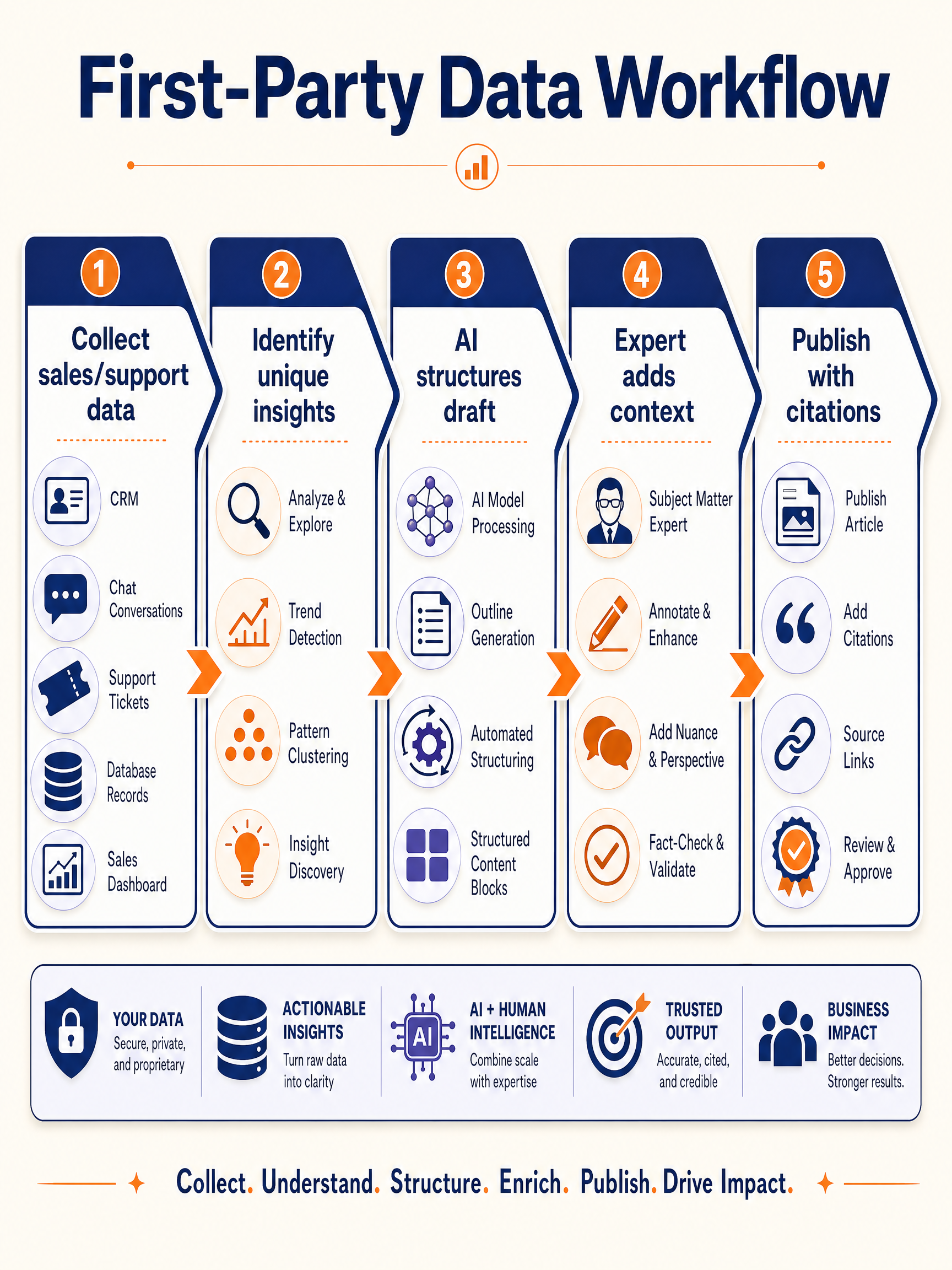
Key Takeaway: Use first-party data like sales calls and support tickets to create unique content that AI models cannot replicate.
Measuring E-E-A-T Success and Monitoring for Penalties
Track author citation count, update frequency, and backlink growth as E-E-A-T proxies. Monitor organic traffic and rankings for sudden drops after scaling. Conduct regular E-E-A-T audits using checklists and structured data validation [2, 5, 12].
Key Metrics for E-E-A-T Strength
Author citation count measures how often the author is referenced externally. Content update frequency signals trust through fresh, maintained content. Backlink quality from authoritative sites boosts authoritativeness. These metrics provide a quantitative view of your E-E-A-T health.
Frequently Asked: How many AI articles can I publish per week?
There is no magic number. Google penalizes patterns of low quality at scale, not frequency. You can publish 100 articles if they all provide unique value and human-level quality, but 5 thin, repetitive articles could trigger a penalty [4, 5].
Setting Up Alerts for Algorithmic Penalties
Use Google Search Console to monitor manual actions and traffic drops. Set up automated reports for ranking changes after content scaling. Recovery from a quality penalty typically takes 3–6 months and requires a consistent track record of publishing high-quality, human-vetted content [1, 10].
Key Takeaway: Monitor traffic, author citations, and backlinks to detect early warning signs of E-E-A-T issues or penalties.
Conclusion
The brands that will dominate the search results of 2026 are not those that avoid AI, but those that use it as a creative amplifier [6]. AI content scaling is currently the #1 priority for enterprise organizations, yet it remains the #1 challenge [6]. To succeed, you must treat AI as a tool to turn experts into “super producers.” By grounding your automated output in first-party data, adhering to the E-E-A-T framework, and maintaining a rigorous editorial layer, you can achieve the scale required for modern search without the risk of penalties. Google’s position has been clear for years: content should be created for people first [11]. If your AI-assisted content answers a searcher’s question better than anything else on the internet, you don’t need to fear the algorithm—you will be the one it chooses to cite [4, 13]. Mastering how to scale AI content production without triggering Google’s E-E-A-T penalties is the key to sustainable growth.
Sources
[1] AI Content Scaling: How to Produce More Without Triggering Penalties - https://recomaze.ai/ai-content-scaling-how-to-produce-more-without-triggering-penalties [2] How Google’s E-E-A-T Framework Impacts Brand Visibility in AI Search Results - https://www.yext.com/blog/how-google-e-e-a-t-framework-impacts-ai-visibility [3] AI Content, EEAT and Google: How to Avoid Getting Penalized in 2026 - https://medium.com/@makarenko.roman121/ai-content-eeat-and-google-how-to-avoid-getting-penalized-in-2026-575f3cb56e37 [4] Google AI Content Penalties: February 2026 Truth - https://maintouch.com/blogs/does-google-penalize-ai-generated-content [5] How to Scale AI Content Without Getting Penalized - https://highground.ai/seo/scale-ai-content-without-penalties [6] Scaling AI Content Is The #1 Enterprise Priority - https://www.searchenginejournal.com/scaling-ai-content-is-the-1-enterprise-priority-how-do-you-scale-without-penalty/574518 [7] Google E-E-A-T: creating content that puts people first - https://www.iodigital.com/en/insights/blogs/google-e-e-a-t-creating-content-that-puts-people-first [8] Enterprise AI trends 2026: AI transformation strategy - https://www.deloitte.com/us/en/what-we-do/capabilities/applied-artificial-intelligence/blogs/pulse-check-series-latest-ai-developments/ai-transformation-predictions-2026.html [9] Is Google Penalizing AI Content? Why 200 AI Pages Failed - https://www.youtube.com/watch?v=B3vRc1475wg [10] Scaled Content Abuse: Google’s AI Page Crackdown Guide - https://www.digitalapplied.com/blog/scaled-content-abuse-google-march-update-ai-pages-decimated [11] Google Search’s guidance about AI-generated content - https://developers.google.com/search/blog/2023/02/google-search-and-ai-content [12] Enterprise AI trends 2026: AI transformation strategy - https://www.authencio.com/blog/scale-e-e-a-t-top-ai-semantic-seo-tools [13] The State of AI: Global Survey 2025 - https://www.bestwebdesign.co.za/how-e-e-a-t-impact-seo-ai-search-google-rankings-in-2026/
Try Autoriax free — no credit card required
Get your first article in minutes. See the research depth before you commit.
Get 3 free articles3 articles free • No credit card • Cancel anytime