June 14, 2026 · Autoriax
The Content Marketer’s Guide to Automating WordPress Content Without Sacrificing Brand Voice
Master WordPress automation in 2026 without losing brand voice. Learn the feedback loop, tools, and frameworks to scale content safely.
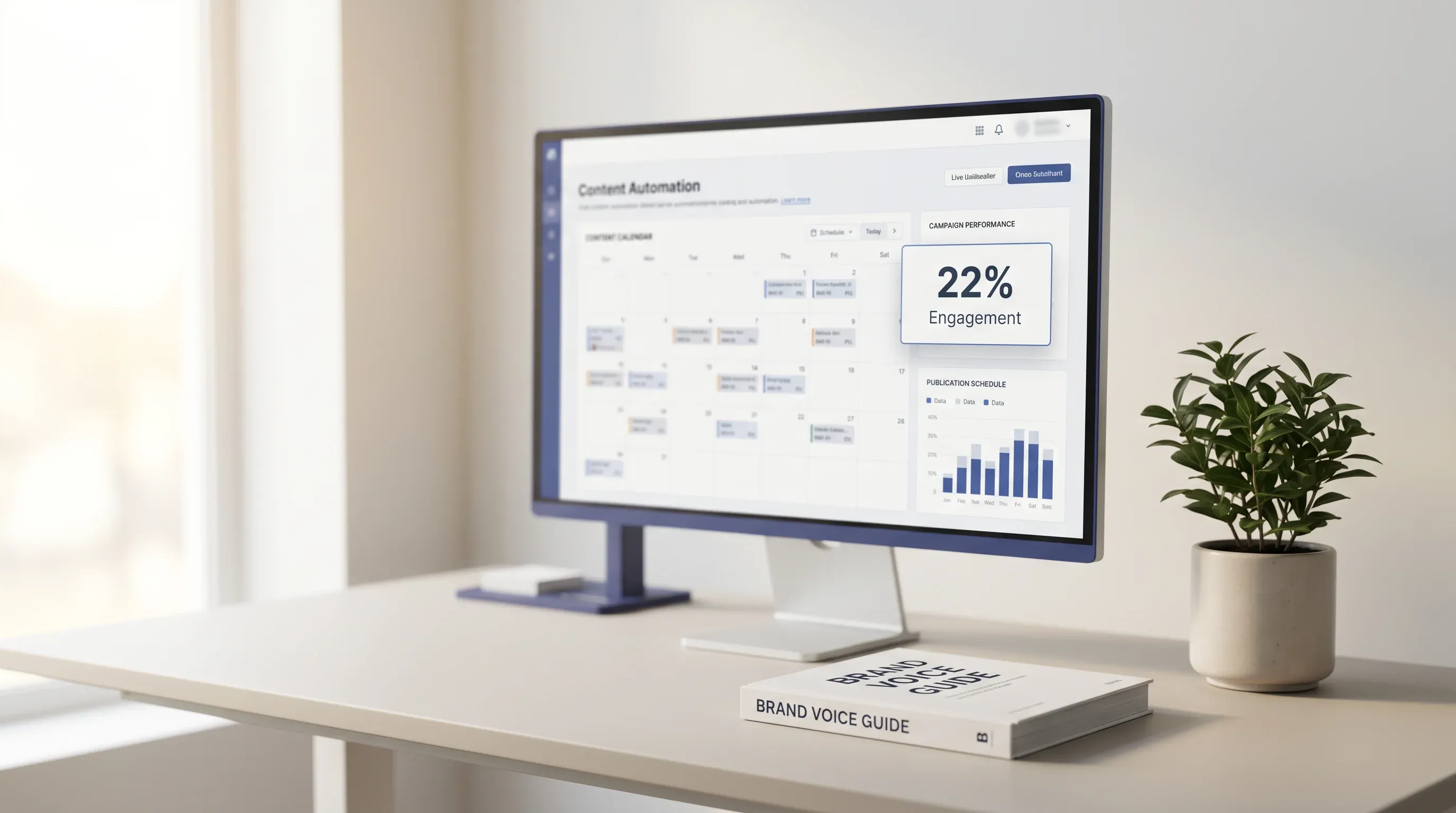
In 2026, content teams face a high-stakes challenge: the need to publish upwards of 20 pieces of content per week across blogs, social media, and email campaigns while navigating a maze of manual coordination [1]. For many, this process has become a project management chaos of chasing approvals through email threads and reformatting assets for different platforms. WordPress remains the dominant force in this landscape, powering 43.5% of all websites and providing the largest interconnected ecosystem for tool integration [3]. However, the volume required to stay competitive often leads to a quality versus quantity trade-off. Content marketing automation promises a solution by managing the lifecycle from planning to distribution [1]. This guide explores how to build a self-driving WordPress platform that scales your output without losing the unique brand voice that establishes trust with your audience. The Content Marketer’s Guide to Automating WordPress Content Without Sacrificing Brand Voice is essential for modern teams seeking efficiency without compromising authenticity.
Quick Facts: The Content Marketer’s Guide to Automating WordPress Content Without Sacrificing Brand Voice
- WordPress powers 43.5% of all websites globally as of 2026 [3].
- 63% of marketers cite maintaining brand voice consistency as their top AI challenge [5].
- Enterprise AI assistants save users an average of two to three hours per week [1].
Why Brand Voice Falters in Automated Systems
Without guardrails, AI defaults to generic, industry-standard language that dilutes brand distinctiveness. This phenomenon is known as the homogenization trap, where unprompted output lacks the nuance of a specific brand identity. AI models are trained on broad corpora, meaning common phrases like industry-leading or best-in-class become crutches that blur differentiation. Consequently, 63% of marketers say maintaining brand voice consistency is their top challenge with AI-generated content [5]. The myth that automation kills voice is pervasive, but it actually forces you to articulate voice more precisely than ever. Static brand guidelines in an automation tool cannot adapt to real-time performance feedback, leading to voice drift over time as audience expectations evolve.
The Homogenization Trap
AI models prioritize probability over personality. When left unchecked, they converge on the mean of internet text, stripping away the quirks that make a brand memorable. This results in content that feels competent but forgettable. Marketers must recognize that automation amplifies existing patterns, including bland ones. If the input prompts are generic, the output will be indistinguishable from competitors.
Why Set and Forget Fails
Voice drifts over time as audience expectations and market contexts evolve. Static brand guidelines in an automation tool cannot adapt to real-time performance feedback. A tone that worked in 2024 may feel outdated in 2026. Continuous monitoring is required to ensure the automated voice remains aligned with current brand values and market sentiment.
Key Takeaway: Automation amplifies existing patterns; without precise guardrails, AI defaults to generic language that erodes brand distinctiveness over time.
The Feedback Loop: AI Draft → Human Score → Adjust Automation
Brand voice is a continuous feedback loop, not a one-time input. This loop consists of distinct stages: AI generates a draft, a human editor scores tone and authenticity, automation rules adjust based on that score, and performance data refines guidelines. For example, a B2B SaaS company used this loop to increase on-page time by 22% while doubling post frequency [5]. This iterative process ensures that the system learns from human judgment rather than replacing it. The Content Marketer’s Guide to Automating WordPress Content Without Sacrificing Brand Voice emphasizes this cyclical improvement model.
Stage 1: Draft Generation with Voice Prompts
Use AI tools like Sight AI or Jetpack AI that accept custom tone parameters. Embed brand lexicon and syntactic rules directly in prompts. This ensures the initial draft is closer to the desired outcome, reducing the burden on human editors. Specific instructions regarding sentence structure and vocabulary choice are critical at this stage.
Stage 2: Editorial Scoring for Tone Consistency
Create a scorecard covering dimensions such as formality, humor, industry jargon density, and emotional warmth. Editors assign a 1–5 score; any piece below threshold triggers a rewrite or automation rule adjustment. This quantitative approach makes voice measurable rather than subjective. It transforms abstract brand values into actionable data points.
Stage 3: Performance-Led Rule Refinement
Post-publish metrics like bounce rate, time-on-page, and sentiment feed back into the automation parameters. High-performing tone patterns are codified into AI prompts; low-performing patterns are deprioritized. This closes the loop, ensuring the system evolves based on actual audience reception rather than internal assumptions.
- Define measurable voice criteria like sentence length and vocabulary.
- Embed criteria into AI prompts and workflow triggers explicitly.
- Implement human review with a standardized editorial scorecard.
- Use post-publish performance data to adjust automation rules.
- Audit voice consistency quarterly to prevent long-term drift.
Key Takeaway: Treat brand voice as a dynamic output tuned through a feedback loop of AI drafts, human scoring, and performance data.
Understanding Content Marketing Automation in 2026
Content marketing automation focuses on production lifecycles including calendars, asset management, and multi-channel distribution. Modern systems shift from reactive to proactive orchestration, anticipating needs from market trends. Enterprise AI assistants save teams 2–3 hours per week on status checks and notifications [1]. This efficiency allows teams to focus on strategy rather than logistics. Understanding these capabilities is foundational to implementing The Content Marketer’s Guide to Automating WordPress Content Without Sacrificing Brand Voice effectively.
Core Benefits for Content Teams
Enhanced workflow efficiency removes manual friction from daily tasks. Faster production via AI research and competitor insights saves 8+ hours per week [1]. Personalization at scale swaps headlines and imagery dynamically based on viewer behavior. Reduced errors prevent mistakes in scheduling and tagging that can hurt brand credibility. These benefits compound over time, leading to significant operational savings.
How WordPress Fits the Landscape
WordPress powers 43.5% of all websites, offering the largest plugin ecosystem [3]. The market for automation tools is projected to reach $13.71 billion by 2030 [3]. This growth indicates a shift toward integrated solutions where WordPress acts as the central hub. Marketers must leverage this ecosystem to maintain competitiveness in a crowded digital space.
Key Takeaway: Modern automation shifts from reactive management to proactive orchestration, saving teams hours weekly while enabling personalization at scale.
Frequently Asked: What is the difference between marketing and content automation?
Marketing automation governs the customer journey and lead nurturing, while content automation focuses on production lifecycles like editorial calendars and asset management [1].
Building a Voice-First Automation Stack on WordPress
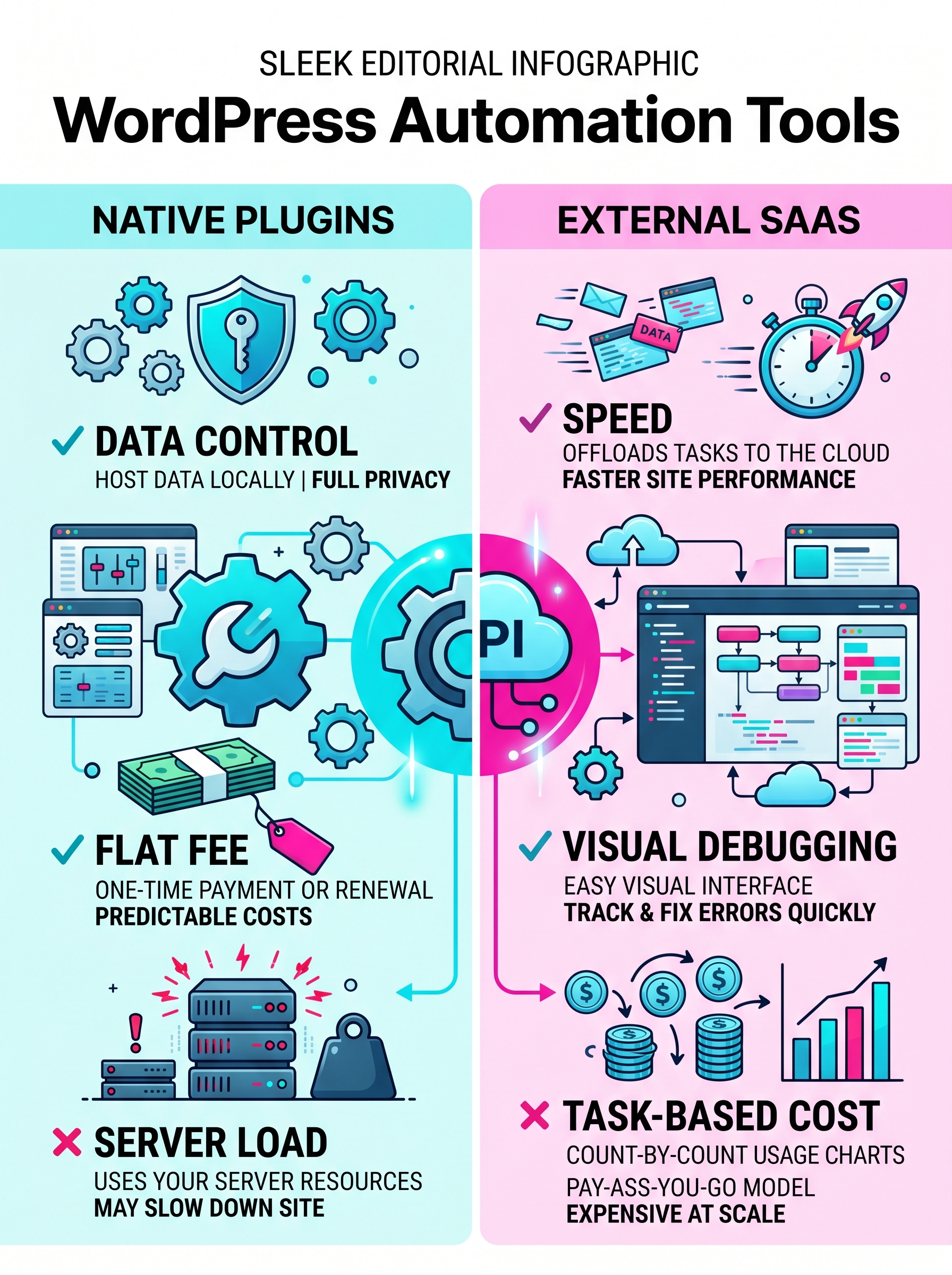
Choose native plugins or external SaaS based on data control, server load, and cost structure. Uncanny Automator offers GDPR-safe on-site automation; Zapier or Make offload processing and provide visual debugging [3]. Jetpack AI Assistant allows tone adjustment inside Gutenberg without switching platforms [5]. Selecting the right stack is crucial for maintaining performance and voice integrity. The tools you choose define the boundaries of your automation capabilities.
Native Plugins vs. External Platforms
Native solutions offer total data control and flat fees but risk plugin conflicts [3]. External platforms provide faster site speed and visual debugging but cost based on task volume [3]. Marketers must weigh data privacy against operational flexibility. For sensitive data, native solutions are often preferable despite the server load.
Top Tools Reviewed for 2026
Sight AI offers 13+ specialized agents for formats like listicles with Autopilot mode [5]. Surfer SEO provides real-time NLP scoring inside the editor [5]. Activepieces is an open-source option with 600+ tool integrations for no-code flows [4]. These tools represent the current state of the art in 2026. Integrating them requires careful planning to avoid redundancy.
Key Takeaway: Select automation tools based on data control needs and server capacity, balancing native plugins with external SaaS platforms.
The 4-Step Framework to Prevent Voice Homogenization
Automation without voice guardrails leads to homogenized content that erodes brand trust. This framework provides a structured approach to maintaining distinctiveness. Step 1 involves defining measurable voice criteria. Step 2 embeds criteria into AI prompts. Step 3 requires human review with a scorecard. Step 4 uses performance data to adjust rules [5]. Following this sequence ensures voice remains a priority throughout the automation process.
Step 1: Operationalize Your Brand Voice
Translate abstract guidelines like friendly yet authoritative into quantifiable rules. For example, keep sentences under 25 words and use passive voice in less than 10% of sentences. This makes voice enforceable by algorithms. Vague instructions lead to vague results, so specificity is key.
Step 2: Codify in Automation Rules
Program triggers such as flagging drafts that exceed a jargon threshold. Use AI agents trained on company values and industry terminology [5]. This creates a automated filter that catches issues before human review. It reduces the cognitive load on editors by handling routine checks.
Step 3: Human Scoring Gates
Every piece passes through a human touchpoint before publish. Score components include emotional resonance, factual accuracy, and cultural relevance. This ensures that nuance is not lost in transmission. Human judgment remains the final arbiter of quality.
Step 4: Iterate from Performance Data
Correlate voice scores with engagement metrics. Adjust prompts seasonally because what works in Q1 may not in Q3. This keeps the voice relevant and responsive to market changes. Continuous iteration is the only way to sustain long-term consistency.
Key Takeaway: Prevent homogenization by operationalizing voice into quantifiable rules, embedding them in automation, and iterating based on performance data.
Human-in-the-Loop: The Edge Against Generic Content
Successful brands in 2026 use a human-in-the-loop workflow for emotional tone and accuracy. AI handles drafting; humans focus on nuance, preventing hallucinations and cultural missteps [4]. Sentiment analysis tools gauge audience reactions to tune future tone [1]. This collaboration leverages the speed of AI with the empathy of humans. It is the definitive strategy for scaling without sacrificing quality.
Why Humans Remain Irreplaceable
AI lacks lived contextual understanding of brand history and audience trust. Quoting Joe Pulizzi, automation must support the trust portfolio, not replace it [2]. Humans provide the ethical and emotional judgment that algorithms cannot replicate. This role is elevated from writer to editor and strategist.
Scaling Human Oversight Without Bottlenecks
Use tiered review where low-risk posts auto-publish after AI check. High-authority pieces get senior editor review. Implement editorial dashboards that batch notifications for approval. This manages workload while maintaining quality standards. Efficiency is achieved through smart triage, not removing humans.
Frequently Asked: Can AI fully replace human editors?
No, AI lacks lived contextual understanding and ethical judgment; humans are required for nuance, accuracy, and maintaining the trust portfolio [2].
Key Takeaway: Leverage human-in-the-loop workflows to handle nuance and accuracy, using AI for drafting and humans for strategic oversight.
Advanced Strategies: Agentic AI and Digital Workers
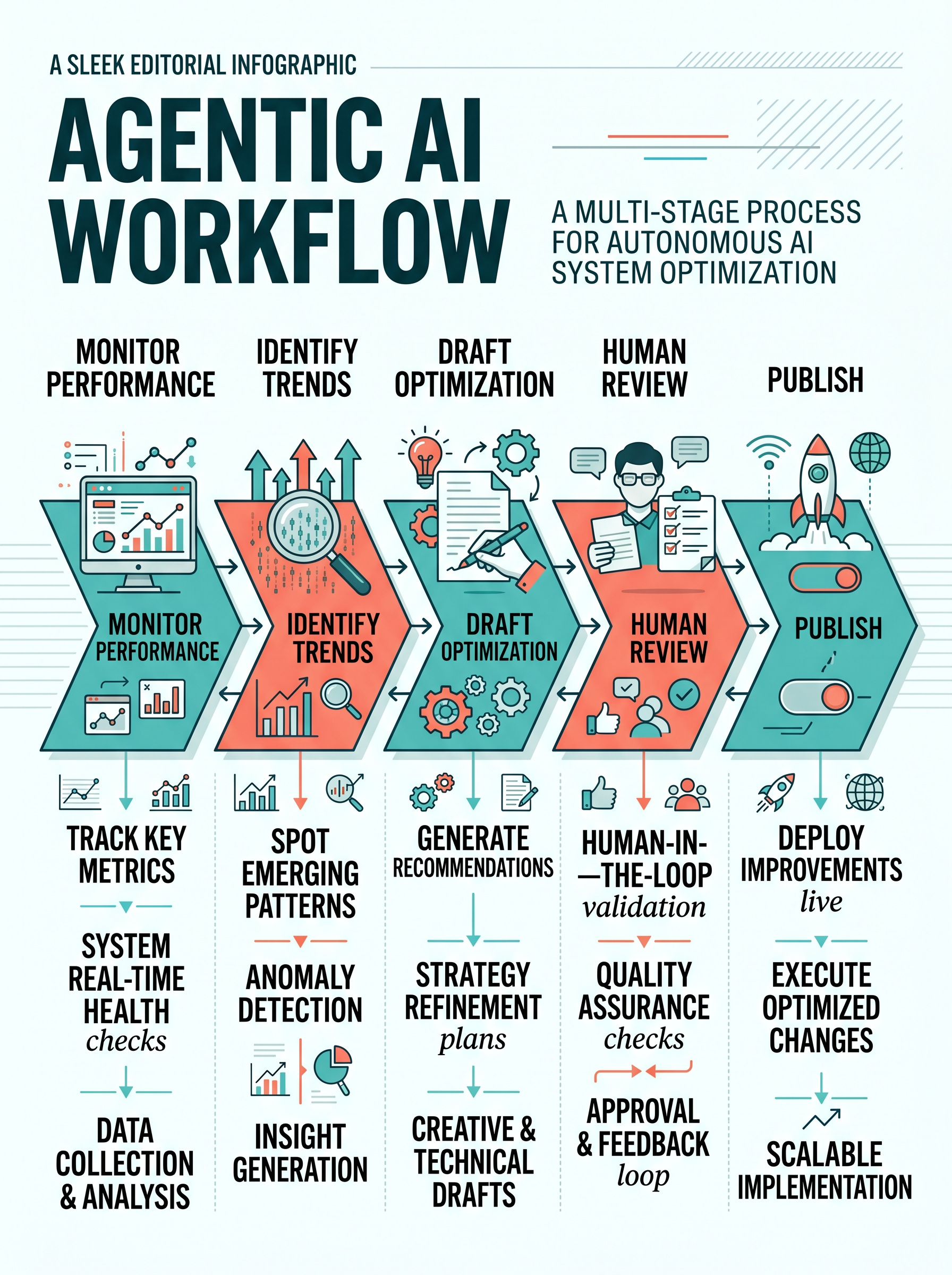
By 2026, AI agents can handle multi-step tasks independently such as monitoring campaigns and flagging underperforming assets. Agentic AI reduces manual oversight while staying aligned with brand voice if properly trained [4]. Combine with sentiment analysis to automatically adjust tone based on audience reception. This represents the frontier of content operations. Digital workers are becoming standard in high-performance teams.
How Digital Workers Enhance Brand Voice
They can pull historical performance data to inform tone choices. For example, if a humorous tone drove high engagement last month, the agent suggests more of that style. This creates a self-optimizing system. The agent learns from success and replicates it autonomously.
Case Study: B2B SaaS Engagement Boost
A B2B SaaS company implemented a voice-led feedback loop. They used AI drafts scored by humans to refine automation rules. This resulted in a 22% increase in on-page time while doubling post frequency [5]. The case study proves that voice consistency drives engagement. It validates the investment in structured automation.
Risks and Guardrails
Agent autonomy can cause voice drift if no human review is scheduled for periodic audits. Set voice budgets limiting the percentage of content agent-published without human scoring. This prevents runaway deviations from brand standards. Safety mechanisms are essential for autonomous systems.
Key Takeaway: Agentic AI can enhance voice by learning from performance data, but requires guardrails like voice budgets to prevent drift.
Conclusion
Content marketing automation transforms scattered creative processes into a streamlined, data-driven engine. Organizations that embrace these platforms gain a competitive advantage through faster time-to-market and deeper performance insights [1]. However, the key to success in 2026 is maintaining the human element. Automation should handle the administrative busywork while humans provide the creative judgment and narrative cohesion that no algorithm can replicate [1, 4]. By selecting the right tools, whether native WordPress plugins like Uncanny Automator or comprehensive platforms, marketers can scale their operations while keeping their brand’s unique voice loud and clear. The Content Marketer’s Guide to Automating WordPress Content Without Sacrificing Brand Voice concludes that voice is a dynamic output requiring continuous tuning. As the digital landscape evolves, staying agile and committed to continuous improvement will ensure your WordPress site remains a powerful, automated, and authentic representative of your brand [8].
Sources
[1] Content marketing automation: your 2026 guide - https://monday.com/blog/marketing/content-marketing-automation [2] Content Marketing: The Ultimate Guide for 2026 - Advisor - Forbes - https://www.forbes.com/advisor/business/content-marketing [3] The Ultimate WordPress Automation Guide for 2026 - Elementor - https://elementor.com/blog/wordpress-automation [4] What Is Content Automation? A Simple Guide for Marketers - https://www.activepieces.com/blog/what-is-content-automation [5] 9 Best Wordpress Content Automation Tools (2026 Guide) - https://www.trysight.ai/blog/wordpress-content-automation-tools [6] AI Content Generation in 2026: Brand Voice, Strategy & Scaling - https://www.roboticmarketer.com/ai-content-generation-in-2026-brand-voice-strategy-and-scaling [7] 8 Best Blog Automation Tools for Marketers, Agencies & Creators - https://www.youtube.com/watch?v=Bra8oTYrTZE [8] Content marketing automation best practices | Sitecore - https://www.sitecore.com/resources/insights/marketing-automation/content-marketing-automation-best-practices [9] Content Marketing Mastery with WordPress | CodeBru, Inc - https://www.codebru.com/learn/content-marketing-mastery-wordpress [10] Masterclass on How to Build a Brand with WordPress - https://www.youtube.com/watch?v=oG6BzRwOD-0
Try Autoriax free — no credit card required
Get your first article in minutes. See the research depth before you commit.
Get 3 free articles3 articles free • No credit card • Cancel anytime