June 8, 2026 · Autoriax
Why Traditional Keyword Research Tools Miss Opportunities That AI-Driven SEO Tools Catch
Discover why traditional keyword research tools miss opportunities that AI-driven SEO tools catch in 2026. Learn about GEO, zero-click search, and hybrid workflows.

The landscape of search engine optimization has undergone a structural transformation that renders traditional methodologies not just outdated, but potentially damaging to business outcomes. As we move through 2025 and into 2026, marketing teams are finding that their dashboards show “green” for keyword rankings while their pipelines show “red” for actual revenue [1]. This disconnect is the result of a fundamental shift: traditional keyword research tools were built for a search environment that no longer exists [1]. Today, the emergence of AI-driven search and Generative Engine Optimization (GEO) has created a “visibility gap.” Traditional tools focus on search volume and “blue link” rankings, while AI-driven tools identify intent, semantic relationships, and citation opportunities that drive high-value traffic [1, 6]. This article argues for a hybrid workflow that leverages traditional tools for quantitative foundation and AI tools for strategic gaps.
Quick Facts: Why Traditional Keyword Research Tools Miss Opportunities That AI-Driven SEO Tools Catch
- AI Overviews appear in 31% to 47% of Google searches, synthesizing answers above organic results [1].
- Traditional tools like SEMrush have an average traffic estimation error rate of 61.58% [1].
- Low-volume keywords under 100 searches per month drive 3x higher conversion rates than high-volume terms [1].
The Structural Failure of Traditional Keyword Tools
Traditional keyword research tools suffer from significant error rates that are often hidden from users, creating a false sense of security for marketing teams. For decades, SEO has relied on a handful of industry-standard tools to estimate search volume and keyword difficulty, but recent data reveals a staggering lack of accuracy in these legacy metrics. This accuracy crisis means that strategic decisions based solely on these tools are often little more than expensive guesswork, particularly for niche B2B websites.
The Accuracy Crisis in Data Estimation
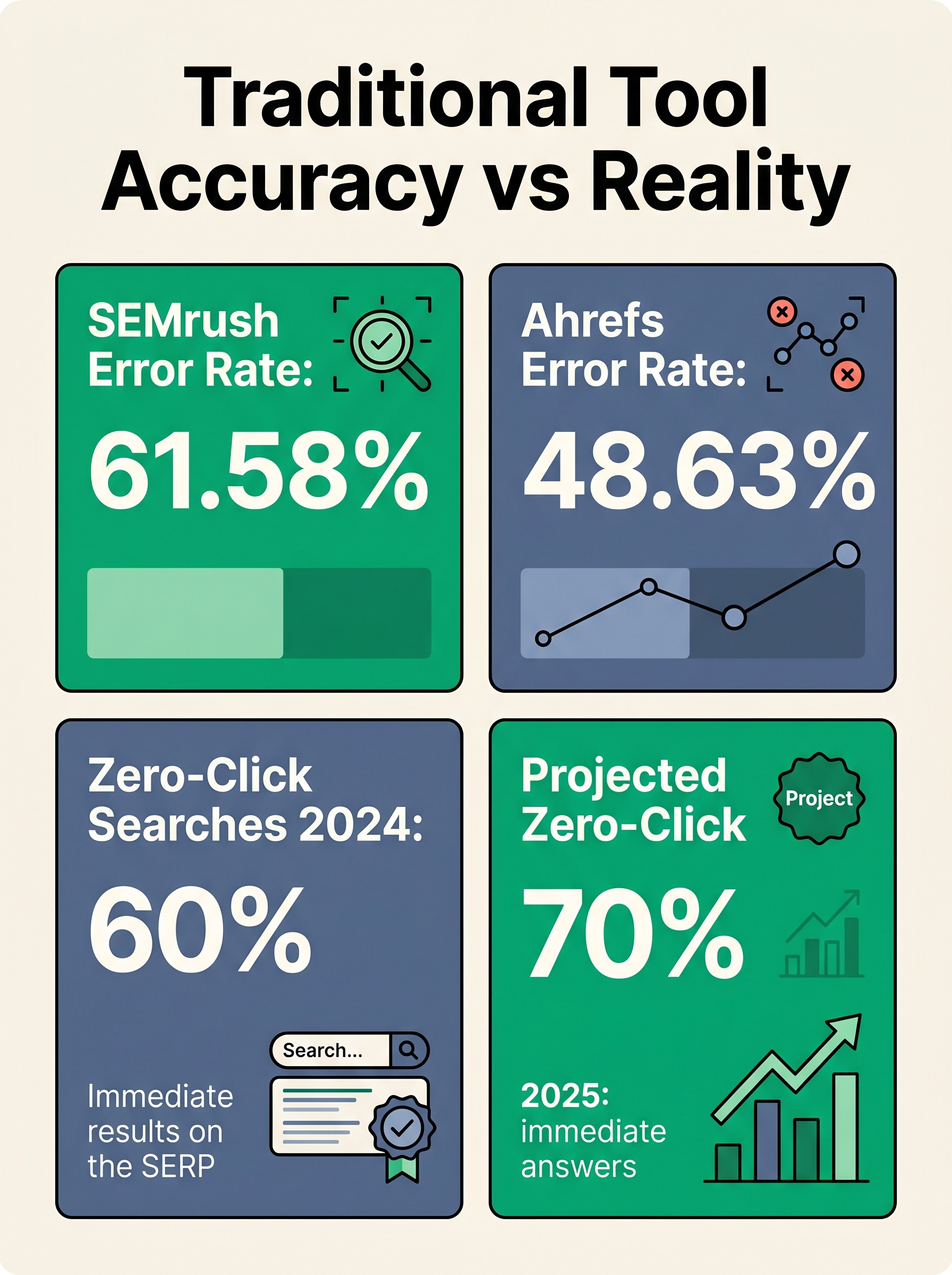
A study comparing major tools against actual Google Search Console data revealed that SEMrush has an average traffic estimation error rate of 61.58%, while Ahrefs carries a 48.63% margin of error [1]. For niche B2B websites with under 5,000 monthly clicks, these inaccuracies compound, making it difficult to trust the data provided by legacy platforms. Marketers relying on these numbers may prioritize keywords that appear valuable but deliver negligible actual traffic.
The Rankings-to-Traffic Disconnect
Historically, ranking number one on Google was the ultimate goal, but in the age of AI, rankings no longer correlate directly with traffic. AI Overviews now appear in a significant portion of searches, synthesizing answers from multiple sources and presenting them above organic results [1]. This “zero-click” phenomenon is accelerating; 60% of US searches in 2024 ended without a single click, a number projected to hit 70% by mid-2025 [1]. One SEO professional noted that despite maintaining top positions and stable click-through rates, their website saw a 66% drop in visits because the searches themselves were being fulfilled directly on the SERP by AI [1].
The Volume-Value Inversion
Traditional tools prioritize “High Volume” keywords, yet in B2B sectors, this methodology is often counterproductive. Data shows that low-volume keywords drive significantly higher conversion rates than those with high search volume. In fact, keywords with fewer than 50 searches per month can drive up to 50% of total B2B conversions [1]. Traditional tools systematically deprioritize these “Zero Search Volume” opportunities because they lack historical data, causing marketers to miss the very terms that drive revenue.
Key Takeaway: Traditional tools suffer from high error rates and prioritize volume over value, causing marketers to miss high-converting, low-volume opportunities in the zero-click era.
Why AI-Driven Search Logic Is Fundamentally Different
Traditional tools operate on phrase-matching and database lookups, whereas AI search systems operate on semantic meaning and intent. Platforms such as ChatGPT, Perplexity, and Google’s AI Mode do not simply match strings of text; they understand the context behind the query. This fundamental difference means that content can be “keyword-perfect” and yet remain invisible to an AI system that prioritizes contextual relevance over term frequency [1].
The Query Length Gap
The way users interact with search has fundamentally changed, creating a gap that traditional tools cannot bridge. Traditional search queries average 3–4 words, while AI search queries average 23 words—nearly five times longer [1]. These are not keyword strings; they are conversational, complex questions expressing multi-layered intent. Traditional tools are not equipped to capture or analyze these conversational long-tail queries because they do not fit into neat “keyword” buckets [7].
Intent vs. Terms
Over 70% of AI search queries do not fit into the traditional categories of informational, transactional, or navigational [1]. They are task-oriented. While traditional systems achieve 60–70% accuracy in identifying intent, AI-powered systems reach up to 85% accuracy by using semantic search to understand meaning even when specific keywords are absent [1]. This allows AI-driven tools to surface opportunities that traditional databases simply cannot see because the keywords themselves may not exist yet.
Frequently Asked: How does AI search differ from traditional search?
Traditional search matches keywords to pages, while AI search interprets user intent to generate answers. AI queries are longer and more conversational, requiring content that addresses context rather than just term frequency [1, 7].
Key Takeaway: AI search logic prioritizes semantic intent and conversational queries over exact keyword matching, rendering traditional phrase-matching tools less effective.
The Rise of Visibility-First SEO
In a zero-click world, success is no longer measured solely by who gets the click, but by who shows up with the answer. This shift is known as Visibility-First SEO, which views search as a two-layer strategy involving both brand presence and traffic capture. Ranking number one on Google is no longer a guarantee of being the “answer,” as AI systems weigh brand signals and authority more heavily than traditional metrics [1].
The Answer Layer vs. the Traffic Layer
Visibility-first SEO distinguishes between the Answer Layer and the Traffic Layer to maximize impact. The Answer Layer includes brand mentions and citations within AI Overviews that build trust and awareness [6]. The Traffic Layer captures users who need to perform deeper research, comparisons, or purchases through traditional rankings. Research analyzing 25,000 searches found that the top-ranked website on Google appears in AI-generated answers only 25% of the time [1].
Controlling the Brand Narrative
If a brand fails to appear in AI search results, it leaves its narrative open to third-party opinions, incorrect information, or competitor dominance [6]. Large Language Models are designed to generate an answer even when their confidence is low. If your brand’s correct answer is not publicly available and structured for AI extraction, the AI will predict the most likely response, often using negative reviews or inaccurate summaries [6].
Key Takeaway: Visibility-First SEO requires optimizing for both AI citations (Answer Layer) and traditional rankings (Traffic Layer) to control brand narrative and capture value.
How AI-Driven Tools Catch Missed Opportunities
AI-driven SEO tools go beyond simple database lookups to provide capabilities that traditional tools lack, specifically in semantic clustering and topic mapping. Traditional clustering might group “email software” and “email platform” together, but AI-driven clustering understands that “newsletter automation” belongs in the same group because it serves the same user intent [7]. Tools like Semrush’s Keyword Magic Tool and Surfer SEO now use AI to group thousands of terms by intent in seconds, helping marketers build “topical authority” rather than just ranking for individual terms [2, 7].
From Term Clusters to Intent Clusters
AI-driven clustering allows marketers to build topical authority rather than ranking for individual terms. This approach ensures that content covers the full spectrum of user intent surrounding a topic. By grouping keywords by intent, businesses can create comprehensive content hubs that satisfy AI systems looking for authoritative sources [7].
Validating AI-Suggested Keywords with GSC
A practical method for leveraging AI is to generate a list of 200+ micro-intent phrases and then filter them against Google Search Console data. Marketers should look for queries with at least 50 impressions but zero clicks, as these represent the highest-ROI opportunities that traditional tools miss [7]. This validation step ensures that AI suggestions are grounded in real user behavior.
| Feature | Traditional Keyword Tools | AI-Driven SEO Tools |
|---|---|---|
| Data Source | Historical database lookups | Real-time semantic analysis |
| Query Focus | Short-tail keywords (3-4 words) | Conversational queries (23+ words) |
| Intent Accuracy | 60-70% accuracy | Up to 85% accuracy |
Key Takeaway: AI-driven tools enable semantic clustering and intent validation, allowing marketers to capture high-ROI opportunities that traditional database lookups ignore.
Identifying Zero Search Volume (ZSV) Opportunities
By 2026, an estimated 15% of daily searches will be brand-new queries with zero historical data, representing a massive blind spot for traditional tools [7]. AI tools can reason about these emerging patterns by analyzing customer support logs, Reddit threads, and niche community discussions. This allows marketers to target “ZSV” long-tail opportunities that traditional tools ignore but which represent high-intent buyers [7].
The Long Tail of the Long Tail
AI tools surface ZSV long-tail opportunities that traditional tools ignore but which represent high-intent buyers. In a test of 1,000 seed keywords, AI tools surfaced 47% more zero-volume queries that later matched real user questions in GSC [7]. This demonstrates the superior ability of AI to predict emerging search behavior before it appears in historical databases.
Emerging Trend Detection
AI tools catch emerging trends 2–6 weeks before traditional tools update their databases. For example, “AI search questions” rose in Q1 2025, but traditional tools still showed historical data from 2024 [7]. This lag time can be critical for businesses trying to establish authority in a new niche before competitors arrive.
Key Takeaway: AI tools identify Zero Search Volume opportunities and emerging trends weeks before traditional tools, capturing high-intent buyers early.
Generative Engine Optimization (GEO) for AI Citation
AI tools are now facilitating GEO, the practice of optimizing content specifically for AI citation. GEO focuses on content structure, such as the “Golden Answer” format, which involves placing direct, concise answers immediately after H2 headings [7]. Studies show that AI search traffic converts at 5x the rate of traditional organic traffic because the users arriving at the site have already had their initial intent satisfied and are looking for specific solutions [1].
The Golden Answer Format
Direct, concise answers placed immediately after H2 headings are more likely to be cited by AI systems. This format aligns with how Large Language Models extract and present information to users. Structuring content this way increases the likelihood of appearing in the Answer Layer of search results [7].
Higher Conversion Rates from AI Traffic
Studies show that AI search traffic converts at 5x the rate of traditional organic traffic. Users arriving from AI searches have already had their initial intent satisfied and are looking for specific solutions, making them higher quality leads [1]. This quality paradox means that even with lower overall traffic, revenue can increase significantly.
Frequently Asked: What is the difference between SEO and GEO?
SEO targets Google’s algorithm through keywords and backlinks to rank in blue links. GEO targets AI systems through brand authority and structured content to earn citations in AI-generated answers [1, 6].
Key Takeaway: Generative Engine Optimization focuses on structured content for AI citation, resulting in significantly higher conversion rates than traditional organic traffic.
The Quality Paradox: Less Traffic, Better Results
While raw traffic numbers are declining, the quality of traffic from AI-driven search is significantly higher. HubSpot reportedly saw a 70–80% decline in organic traffic between 2024 and 2025 despite maintaining rankings, yet the quality of traffic from AI sources is higher [1]. Analysis of 12 million visits found that conversion rates for AI search were 14.2% compared to 2.8% for traditional Google organic [1].
Declining Traffic, Rising Revenue
A B2B SaaS client used only AI-suggested “canvas reflow cheat sheet” (0 volume per Ahrefs) and ranked number one in 14 days, driving 1,200 monthly visits from users actively debugging a specific design issue [7]. This demonstrates that zero-volume queries can drive high-converting traffic. Marketers should shift from measuring raw traffic to measuring conversion rates and revenue per visit [1].
Shifting Metrics for Success
Marketers should shift from measuring raw traffic to measuring conversion rates and revenue per visit. AI tools enable this shift by surfacing high-intent queries that traditional tools ignore. Key metrics now include Brand Mention Share of Voice and AI Citation Rate rather than just monthly search volume [1].
Key Takeaway: Although overall traffic may decline, AI-driven traffic converts at much higher rates, necessitating a shift in success metrics from volume to revenue.
Building a Hybrid Workflow: Traditional + AI
The most effective strategy in 2026 is Augmented SEO, using AI for scale and data processing while relying on human intuition for brand alignment. The “best” tool depends on the scale of the operation, but the standard for 2026 has shifted toward those with AI integration [2]. A hybrid workflow combines traditional tools for quantitative data and AI tools for strategic insights to capture the best of both worlds [1, 7, 8].
Step 1: Generate Micro-Intent Phrases with AI
Use AI tools like ChatGPT or SEO.ai to generate 200+ micro-intent phrases based on customer support logs, forum data, and competitor analysis. Focus on conversational queries that express specific user needs rather than generic keywords [7]. This step leverages AI’s ability to understand nuance and intent.
Step 2: Validate with Google Search Console
Filter the AI-generated phrases against GSC data, looking for queries with at least 50 impressions but zero clicks. These are the highest-ROI opportunities that traditional tools miss. Once validated, optimize for AI citation using the Golden Answer format to maximize chances of visibility [7].
Frequently Asked: Can I do both traditional SEO and AI SEO?
Yes, you must. AI SEO builds on traditional foundations. While you optimize for AI citations to capture the Answer Layer, you still need traditional SEO to capture the Traffic Layer for users ready to convert on your site [6, 8].
Key Takeaway: A hybrid workflow combining AI intent generation with traditional data validation offers the most robust strategy for modern search visibility.
Conclusion
The B2B traffic crisis is not a future prediction; it is the current reality. With traditional search volume projected to drop 25% by 2026, and organic leads expected to settle at 30–40% of 2024 levels, the “wait and see” approach is no longer viable [1]. Traditional keyword research tools fail because they optimize for a system that is being bypassed by users. AI-driven tools catch opportunities by focusing on how users actually search today—through conversational queries, intent-driven prompts, and a desire for immediate, authoritative answers [1, 8].
By shifting focus from “Monthly Search Volume” to “AI Citation Rate” and “Brand Authority,” companies can move from being invisible in the AI layer to becoming the primary source of information for their industry. The question is no longer whether search is changing, but whether your measurement framework and content strategy have evolved to meet the new reality of how buyers find information [1, 6]. To stay competitive, businesses must adopt a hybrid workflow that leverages the quantitative strength of traditional tools while embracing the intent-mapping power of AI.
Sources
[1] Why Traditional Keyword Research Fails in AI Search - https://www.onely.com/blog/why-traditional-keyword-research-fails-in-ai-search [2] Best AI SEO Tools for Keyword Research in 2026: Find Winning Keywords | PikaSEO - https://pikaseo.com/articles/best-ai-seo-tools-for-keyword-research [3] Why AI Tools Are Replacing Traditional Search (And What to Do … - https://stratedia.com/why-ai-tools-are-replacing-traditional-search-and-what-to-do-about-it [4] Keyword Research: 5 Things AI Still Gets Wrong - TrafficSoda - https://www.trafficsoda.com/things-ai-gets-wrong-keyword-research [5] AI vs Traditional Keyword Research – What Actually Works in 2026? - https://www.youtube.com/watch?v=DVcAZPSkcW5 [6] Why Traditional SEO Fails in the Zero-Click Era - Search Engine Land - https://searchengineland.com/guide/shortcomings-of-traditional-seo-in-zero-click-search [7] AI-Powered Keyword Research: Complete Guide 2026 - https://www.digitalapplied.com/blog/ai-keyword-research-complete-guide-2026 [8] Traditional SEO vs AI SEO: What You Actually Need to Know - https://www.semrush.com/blog/traditional-seo-vs-ai-seo [9] The End of Traditional SEO (And What Replaces It in 2026) - YouTube - https://www.youtube.com/watch?v=k_9AsANFY9A
Try Autoriax free — no credit card required
Get your first article in minutes. See the research depth before you commit.
Get 3 free articles3 articles free • No credit card • Cancel anytime