· Autoriax · Updated
The Real Cost of Content Automation
The Hidden Costs of AI Content Automation: When It Becomes a Time Sink explained with real cost data and fixes.

The Hidden Costs of AI Content Automation: When It Becomes a Time Sink start with a familiar promise. Generate 100 SEO-optimized articles in minutes. Cut content costs by 80%. Replace drafting time with a $20 subscription. For teams under pressure to publish more, the offer is hard to refuse.
The first weeks often confirm the story. Drafts appear fast, calendars fill, and the subscription line looks small. Then industrial use begins. Review queues grow, brand edits multiply, integrations need fixing, and token bills arrive. What felt like a shortcut becomes coordination work.
The most useful answer sits early: automation saves time only when the accepted output costs less than the manual alternative, including review, rework, and governance. The signal from 2026 surveys is a widening gap between ambition and measurement. The CMO Survey’s early-2026 reading of U.S. marketing leaders projects AI will drive more than half of all marketing activity within about three years [1]. Yet returns stay hard to prove: in a 2026 Harris Poll survey for WitnessAI, only 9% of senior decision-makers said more than three-quarters of their AI initiatives had delivered a measurable financial return [15], and Comviva’s 2026 Global CMO Survey found 79% of marketers lean on estimates rather than precise measurement of AI results [16]. Measure change produced, not drafts generated, and the decision gets clearer.
The Honeymoon Phase: Why AI Feels Like a Silver Bullet
The honeymoon effect is real because early trials hide the full production chain. A pilot measures generation speed. Production measures sourcing, permissions, editing, legal review, publishing, and maintenance.
Vendor demos run on clean inputs and simple briefs. Real content operations run on contradictory product pages, outdated help docs, regional compliance rules, and a voice that took years to build. Bridging that gap is labor, and it rarely appears in the quote.
The Seductive Pitch vs. the Operational Reality
Ideal-scenario pricing assumes one pass, no research, and no approvals. Most B2B articles need source checks, internal expert review, and formatting for a CMS.
Unbudgeted work includes connecting drives and CMS permissions, cleaning source material, writing style instructions, and rebuilding templates after model updates.
The April 2026 SIAI briefing on AI costs puts the shift plainly: AI did not remove cost so much as move it from creation to consumption, oversight, and infrastructure.[2]
The ROI Paradox: Activity vs. Value
Counting articles is activity. Booked demos, retained subscribers, and reduced support tickets are value.
When teams chase volume, consumption rises faster than unit prices fall. The SIAI briefing found marketing token consumption climbing far faster than per-unit prices dropped, leaving budgets stubbornly high as teams used frontier models for harder work.[2]
More drafts that need checking create more checking, not more capacity.
The Hidden Costs of AI Content Automation in Your Vendor Quote
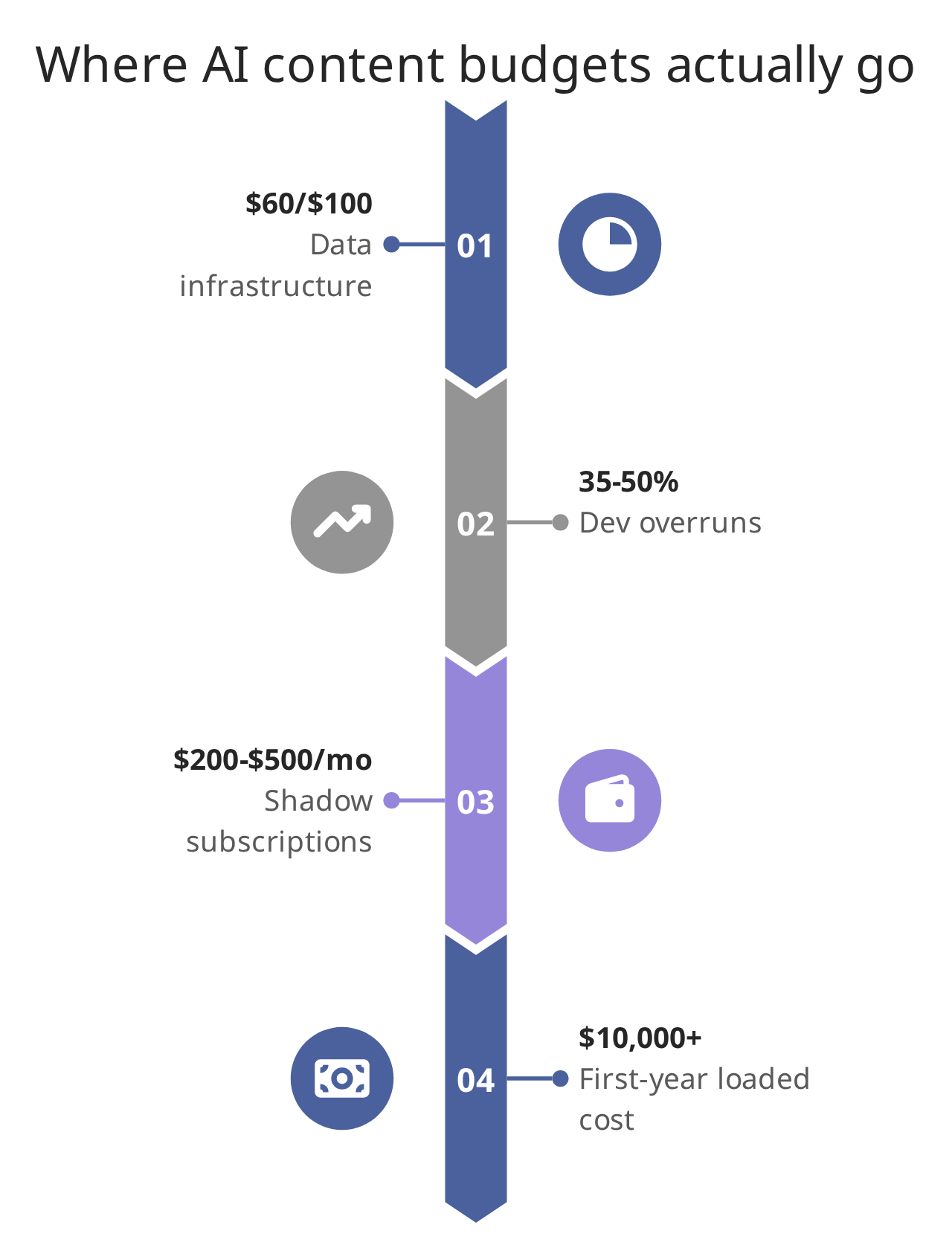
The quote covers license or build. It seldom covers making the tool work inside your business. The Tech.us review of AI budget overruns reports development costs consistently running well above initial quotes.[3]
Data readiness dominates. Legacy systems were not built for permission-aware retrieval, and wiring them safely takes real engineering time, which is why data infrastructure is repeatedly named as a cost leaders underestimate when they budget for AI [4]. Clean, access-controlled context is not a one-time setup; it is an ongoing line item.
Data Preparation and Infrastructure
Models need clean, non-contradictory context with correct access controls. Duplicate pricing PDFs, conflicting FAQs, and open drive permissions produce confident errors.
Cleanup means deduplication, ownership, update cadence, and retrieval testing. Four weeks of source hygiene often improves output more than a model upgrade.
The Swivel Chair Integration Tax
Author Andreas Welsch describes the cost most companies miss as swivel-chair integration, where people copy between disconnected tools, fix formatting, and restore lost context.[5] The cost moves from software to payroll.
Signs include pasting from chat into docs into CMS, re-adding links and metadata, and re-explaining the brief in every tool.
API Usage at Scale
Chat pricing does not equal production pricing. Once research, outlining, and revisions are included, a multi-stage generation pipeline consumes far more tokens than a single prompt. In one research setup, a multi-stage long-form pipeline used roughly six times the tokens of plain generation, most of it from the extra context each stage carries [17]. At volume, that turns the monthly model bill into a real line item before any labor is counted.
Add logging, evaluation, retries, and image or search calls. Metered inputs make volume the budget driver.
Time Debt: When Automation Slows You Down
For many content types, AI creates time debt. Minutes saved in drafting are repaid with interest in editing, fact-checking, and voice alignment.
The pattern is consistent for nuanced, brand-specific, or research-heavy pieces. Generic explainers and data summaries fare better. Opinion, customer stories, regulated advice, and original analysis fare worse.
The human should be a curator, not a babysitter. Most implementations force the latter: short prompts, vague outputs, long repair loops, repeat.
The Editing and Fact-Checking Loop
AI drafts often look finished before they are accurate. Structure and fluency arrive first. Sourcing, caveats, numbers, and chronology need verification.
Actionable guardrails:
- Require sources for every factual claim before the draft enters review
- Separate research passes from writing passes
- Reject drafts with uncited statistics rather than repairing them
Brand Voice Alignment
Voice is more than tone words. It is sentence length, evidence habits, what you do not claim, and how you handle uncertainty.
Without examples and counter-examples, outputs default to a flat middle. Editors then rewrite openings, conclusions, and transitions, the parts readers remember.
The Opportunity Cost of Prompt Engineering
Prompt iteration is skilled work. Brief refinement, example selection, and output testing take hours that could have gone to interviews or analysis.
Track it. Log prompt time, edit time, and review rounds per article for one month. If total time exceeds manual drafting, the workflow loses for that content type.
| Workflow | Where time goes | When it wins |
|---|---|---|
| Manual drafting | Research, interviews, drafting, editing | Opinion, original research, regulated topics, strong voice |
| AI-only generation | Prompting, fixing errors, reformatting, approval chasing | Rarely for customer-facing content; high rework and risk |
| Hybrid with tight brief and sources | Source prep, one AI draft, expert edit, short approval | Data summaries, product updates, FAQs, first drafts with citations |
Human-in-the-Loop Burden Becomes the Bottleneck
AI collapses creation time. It does not collapse approval time. Craig Elimeliah, chief creative officer at Lippe Taylor, put it plainly to Digiday: AI collapses the time it takes to make content, but does nothing to collapse the time it takes to approve it [7].
That mismatch is the bottleneck. Ten drafts waiting on legal, brand, and product review are inventory, not output.
The Approval Bottleneck
Approvals stall when reviewers receive long, unsourced drafts with unclear changes. Each round adds context-switching for people whose time costs more than tokens.
Reduce rounds by sending a sourced outline first, then a full draft with tracked sources and open questions flagged up front.
The Quality Control Penalty
Thin content has a revenue cost. The BestMarketing Singapore review of hidden AI costs reports SMEs that deployed AI without quality controls saw customer acquisition costs climb over a year as generic pages converted worse.[8]
Quality control is therefore mandatory, not optional. Budget reviewer hours per asset class before scaling volume.
Cognitive Capitulation and Prompt Fatigue
Constant verification is tiring. Heavy reliance on AI output can quietly weaken a reviewer’s checking habits: the drafts look polished, so people start skimming what they should be reading. The erosion is gradual and easy to miss until a wrong number ships.
Rotate reviewers, limit daily review batches, and keep writers doing primary research. Skill maintenance is part of operating cost.
AI Finishes Only a Fraction of Real Projects
Expectations drive staffing mistakes. Teams cut headcount for full automation, then overload the people left with prompting, repair, and accountability.
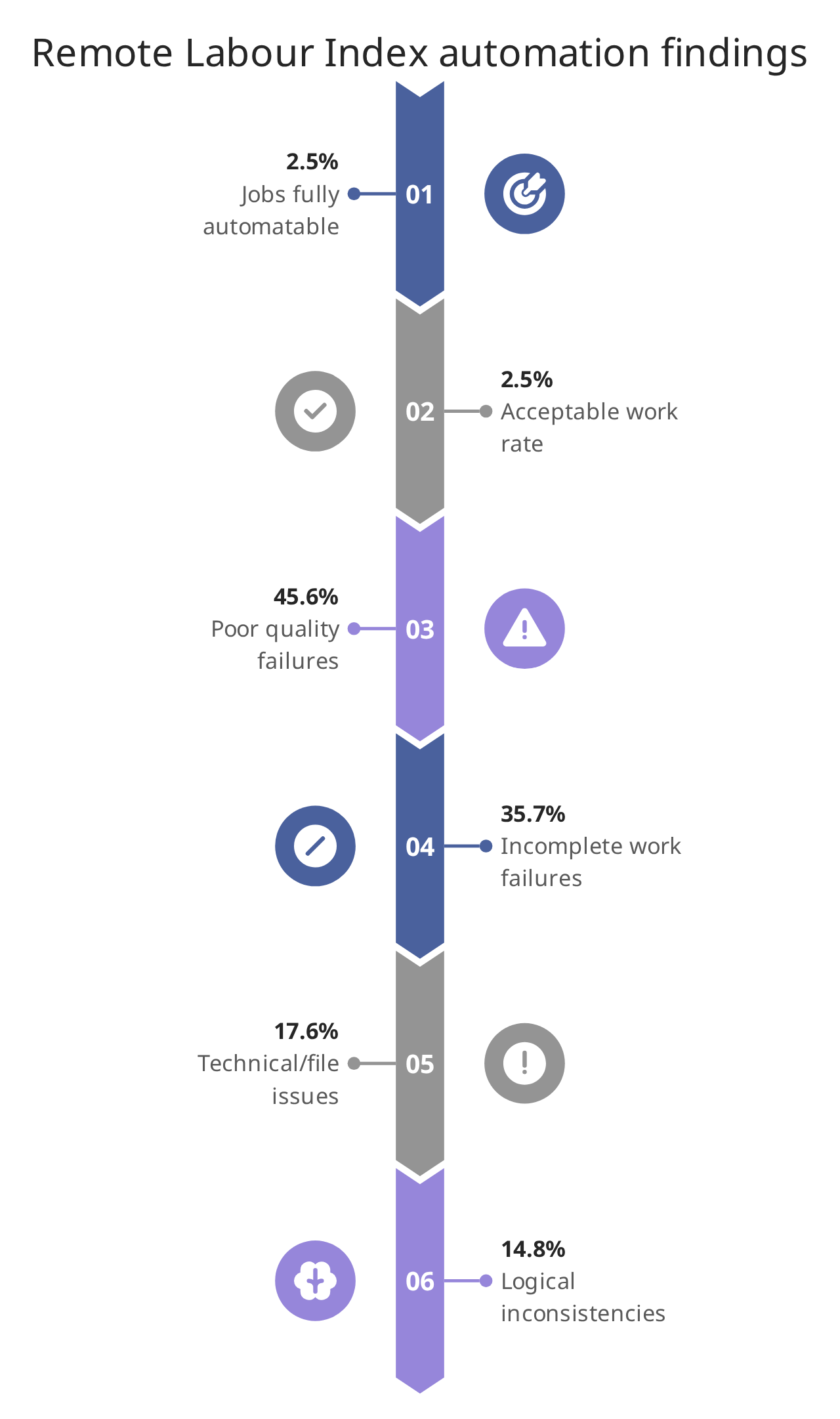
The Remote Labor Index, a 2025 benchmark from the Center for AI Safety and Scale AI, tested leading AI agents on 240 real freelance projects worth over $140,000. The best system completed just 2.5% of them to an acceptable end-to-end standard [10]. The common failure modes were poor quality, incomplete work, file problems, and logical inconsistencies, the gaps a human has to close before delivery [10]. Agents have improved on that benchmark since, but end-to-end autonomy remains the exception, not the rule.
The Expectation Gap
AI plus workload means fewer people managing more machine output. Prompting, exception handling, and final sign-off concentrate on senior staff.
If review hours rise while publish quality stays flat, staffing assumptions were wrong. Restore owner capacity before adding volume.
AI as Collaborator, Not Replacement
For the overwhelming majority of tasks in that framing, the model is a collaborator, not a replacement.[10] That reframes budgeting: pay for collaboration design, not headcount removal.
The Forbes Tech Council review of AI costs and value makes the same point for operators: redesign work around savings and growth rather than headcount removal alone.[11]
Technical Debt, Sprawl, and the CAC Penalty
Uncoordinated buying creates AI sprawl. Marketing buys one writer, content buys another, sales adds AI seats in prospecting tools. Subscriptions overlap while data stays siloed.
The BestMarketing Singapore review notes that businesses routinely waste money on shadow subscriptions: trials never cancelled or duplicate tools doing the same job.[8] Integration is larger still: a modest monthly tool that needs dozens of hours of team time to wire in can cost many times its license in first-year loaded cost.[8]
Shadow Subscriptions
Audit quarterly. List owner, use case, monthly tokens, and last value delivered. Cancel anything without an owner and a measured outcome.
Centralize two or three approved paths for drafting, research, and publishing rather than one tool per team.
Model and API Drift
Models change. A provider update can alter formatting, citation behavior, or instruction following and break prompts. The AI Empire Media review notes re-testing and re-tuning prompts every 6 to 12 months as a recurring labor cost.[6]
Version prompts, pin model versions where possible, and keep regression examples for voice, structure, and citations.
Integration Complexity and FinOps
Content touches CRM, CMS, analytics, and consent systems. Without FinOps discipline, usage spreads invisibly. The 2X white paper on the true cost of AI argues most firms underprice usage, visibility, and governance because seat prices hide tokens, compute, and oversight.[12]
Track tokens per workflow, cost per accepted article, and reviewer minutes per article. Those three numbers reveal whether scale helps.
Moving From Exploration to Operation
Operators pick one workflow, fix the process, and measure for 90 days before scaling. Explorers add tools and hope.
Start with content where evidence is structured: release notes, product comparisons from spec sheets, FAQ updates from tickets, and reports from internal data. Defer memoir-style leadership pieces and net-new research until sourcing improves.
Autoriax fits this operator pattern on the audit side. It automates SEO audits, crawl, scoring, and reporting, compressing a manual pass from hours to minutes, with management for up to 10 brands per account, native-tuned reports in 6 languages (plus more via a multilingual template) and one-click PDF export, and a traceable methodology built for agencies and freelancers.
Define Clear Use Cases
- Good fit: templated updates, summaries with provided sources, multilingual formatting of approved copy
- Poor fit: original viewpoints, customer narratives without interviews, regulated guidance without expert sign-off
- Rule: no source pack, no AI draft for external publication
Optimize Human-in-the-Loop Workflows
Design for curation. One researcher assembles sources. One drafter runs a constrained draft. One expert edits for accuracy. One approver clears risk.
The LinkedIn analysis by Chris Eversley on hidden AI expenses warns that inconsistent processes automated at speed become expensive chaos, and that process cleanup often beats tool shopping.[14]
Implement FinOps and Auditing
Budget five lines, not one: usage, visibility, governance and security, training and prompt engineering, and human review. The BestMarketing Singapore review estimates it takes substantial ramp-up time per team member to learn a new tool effectively, plus ongoing quality control that can dwarf license fees.[8] Its Singapore SME example shows a modest monthly tool budget growing into a far larger real annual cost once integration, training, and review are counted.[8]
The Cost-Per-Accepted-Article Formula
One number settles most of these arguments. Track cost per accepted article, not cost per draft, because drafts that fail review cost you twice. Compute it per content type:
Cost per accepted article =
  ( model/API cost per draft
  + (reviewer minutes × loaded hourly rate ÷ 60)
  + (rework passes × average rework cost) )
  ÷ acceptance rate
Fill it with your own logged numbers, not a vendor’s. The acceptance rate in the denominator is what punishes low-quality automation: at a 50% acceptance rate you pay for two drafts per published piece, so review and rework effectively double. Run the formula beside your manual baseline, the fully loaded cost of a human writing the same piece. If the AI-assisted number is higher for a content type, that type loses, and no amount of prompt tuning changes the verdict until the acceptance rate climbs. Re-run it monthly: the acceptance rate, not the token price, is the figure that moves.
Conclusion
Pick one high-friction workflow and run a 90-day trial with honest accounting. Record tokens, reviewer minutes, rounds, and accepted-output cost per published piece. Keep the manual baseline beside it.
Leave volume targets open until the numbers settle. Questions worth holding: which briefs produce one-pass drafts, who owns factual sign-off, and what triggers a human rewrite instead of another prompt. Teams that answer those move from exploration to operation. The rest keep paying for speed with time.
Sources
- [1] The CMO Survey 2026, Topline Report (Duke Fuqua / Deloitte / AMA), AI projected to drive more than half of marketing activity within three years — https://cmosurvey.org/wp-content/uploads/2026/03/The_CMO_Survey-Topline_Report-2026.pdf
- [2] SIAI, AI Costs More Than Human Labor, For Now — https://siai.org/briefing/2026/04/202604290859
- [3] Tech.us, Why AI Costs More Than You Planned: 7 Hidden Budget Killers — https://tech.us/blog/hidden-costs-of-ai-development
- [4] TechTarget, The hidden costs of AI: What leaders must budget — https://www.techtarget.com/it-strategy/feature/The-hidden-costs-of-AI-What-leaders-must-budget
- [5] Andreas Welsch, The AI Cost Most Companies Miss — https://intelligencebriefing.substack.com/p/the-ai-cost-most-companies-miss-beyond-subscriptions
- [6] AI Empire Media, Hidden Cost of AI 2026: The Real Business Expense — https://aiempiremedia.com/hidden-cost-of-ai-2026
- [7] Digiday, Agency bosses say the AI gap with clients is only getting wider (Craig Elimeliah, Lippe Taylor) — https://digiday.com/marketing/agency-bosses-say-the-ai-gap-with-clients-is-only-getting-wider/
- [8] BestMarketing Singapore, The Hidden Costs of AI in Marketing and How to Avoid Them — https://www.bestmarketing.com.sg/blog/hidden-costs-ai-marketing/
- [10] Remote Labor Index (arXiv:2510.26787), Center for AI Safety & Scale AI, best agent completed 2.5% of 240 real freelance projects end-to-end (Oct 2025) — https://arxiv.org/abs/2510.26787
- [11] Forbes Tech Council, The Hidden Costs and Value of AI — https://www.forbes.com/councils/forbestechcouncil/2025/10/01/the-hidden-costs-and-value-of-ai
- [12] 2X, The True Cost of AI: Why Most Companies Get AI Cost Wrong — https://2x.com/white-paper/true-cost-of-ai-in-business
- [14] Chris Eversley (LinkedIn), AI Tool Costs: The Hidden Expenses That Sink Projects — https://www.linkedin.com/posts/chriseversley_do-you-know-what-it-costs-to-run-your-ai-activity-7495243733769129984-GswQ
- [15] WitnessAI / The Harris Poll, 2026 Enterprise AI Risk Survey, only 9% say more than three-quarters of AI initiatives delivered a measurable financial return — https://witness.ai/wp-content/uploads/2026/07/WitnessAI_2026_Enterprise_AI_Risk_Survey-1.pdf
- [16] Comviva, Global CMO Survey Report 2026, 79% of marketers rely on estimates rather than precise measurement of AI results — https://www.comviva.com/resources/research/global-cmo-survey-report-2026/
- [17] Frankentext (arXiv:2505.18128), multi-stage long-form generation used roughly 6x the tokens of plain generation — https://arxiv.org/abs/2505.18128
Try Autoriax free — no credit card required
Get your first article in minutes. See the research depth before you commit.
Get 3 free articles3 articles free • No credit card • Cancel anytime