· Autoriax · Updated
Google's Spam Update vs. AI Content: How to Win
AI content SEO after Google's 2026 spam updates: why scaled abuse lost and how human-led structure wins rankings.

Google did not ban AI writing in 2026. It enforced its scaled content abuse policy against mass-produced pages built to rank, not to help. For teams invested in AI content SEO, that distinction changes everything about how to draft, edit, and structure articles.
The promise of content at scale led many brands to run fully automated pipelines — the trap that scaling production without losing brand voice is built to avoid. Thousands of near-identical posts went live with little checking, little original data, and no clear author. Critics called the output AI slop, and the 2026 reporting on the March, June, and August updates shows why the approach collapsed.[2]
The 2026 analyses published by Kaizenaire and Macroblu describe the same pattern: traffic fell hardest on sites that published high volumes of unedited AI text across programmatic templates.[1][2] Google’s message, repeated in its spam policies and AI-content guidance, is that the production tool does not decide the outcome. The output signal does: does the page help a reader in a way existing results do not.[19]
This post explains what the updates actually targeted, why some AI-assisted sites kept rankings, and how to shape drafts so both readers and answer engines can use them.
The Reality of the 2026 Spam Updates
The August 2026 update removed entire clusters of low-value pages at once, not just single URLs. Between August 18 and 21, programmatic sites saw top-10 URLs fall beyond position 100.
Independent analyses of the August update describe a sharp, concentrated drop: a large share of previously top-10 URLs on programmatic sites fell beyond position 100, with volatility well above non-update weeks.[3] One documented case saw a site with over a million URLs lose the bulk of its traffic after site-wide classifiers flagged scaled abuse,[12] and a separate YMYL site lost rankings across a very large query set after publishing unedited programmatic templates.[3]
The Scale of the Impact
Volatility was concentrated, not random. Thin comparison pages, location pages with swapped place names, and question-and-answer pages with paraphrased introductions moved together.
The forensic playbook published by Almcorp in 2026 recommends building a timeline of publishes, template changes, and update dates before assuming a penalty, then segmenting losses by template.[7] That step matters because scaled abuse is often template-level: one weak pattern repeated 10,000 times.
Scaled Content Abuse Defined
Google defines scaled content abuse as creating large volumes of content primarily to manipulate rankings, whether written by people, scripts, or AI models.[5] The March 2024 spam-policy announcement on the Google Search blog framed the same idea as keeping the lowest-quality content out of Search.[5]
The 2026 coverage by DMNews stressed that the August enforcement was not broadly aimed at AI prose, but at mass-generated SEO spam with no added value.[9] The August 2026 analysis by SEO-Hacker reached the same finding: intent and value decide, not the tool.[10]
| Signal Google weighs | Abuse pattern | Compliant pattern |
|---|---|---|
| Purpose | Publish because a keyword exists | Publish because a reader question remains unanswered |
| Differentiation | Paraphrase of top results | New data, test, quote, or step |
| Accountability | No author, no sources | Named author, cited sources, dated updates |
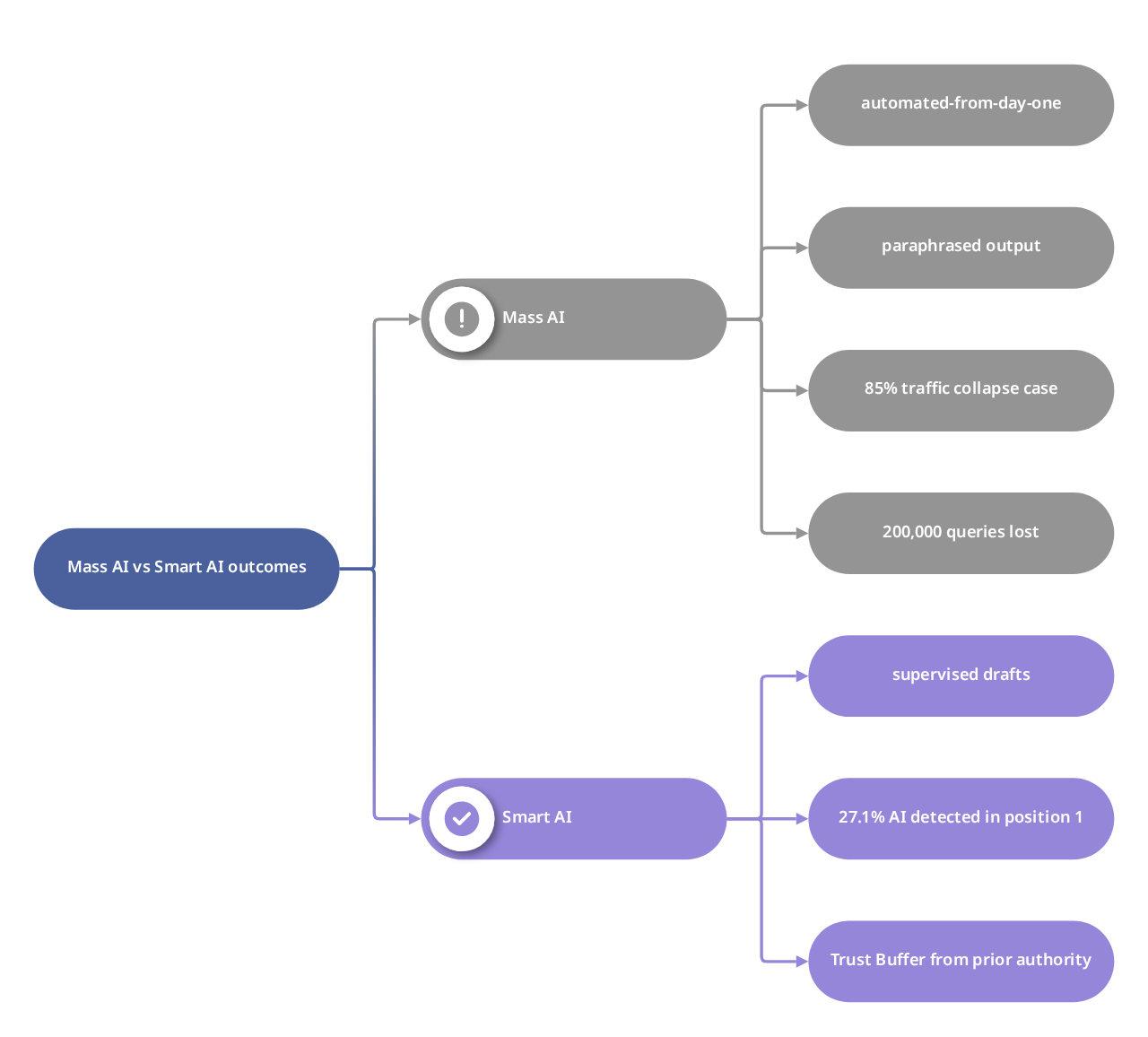
Why Mass AI Failed While Smart AI Won
AI-assisted pages still rank when they add something new. An analysis by Frase found detected AI content present across top positions, including position one — detection alone does not block ranking.[4]
The difference is prior trust and information gain. Sites with years of original, human-checked work kept more visibility when they added supervised AI drafts. Sites built entirely on automation often left the index.
The Detection Paradox
The September 2026 review by Maintouch describes a Trust Buffer: established domains that earned authority through manual work had more room to use AI responsibly, while automated-from-day-one domains were dropped entirely in some cases.[14] The August 2026 report by Truelogic makes the same point about human oversight shielding established publishers.[18]
That buffer is not protection for thin work. It only delays judgment until Google has enough crawl data to classify the new pattern.
The Sameness Problem
Most failed drafts suffer from synthetic sameness: fluent paragraphs that restate what already ranks. Google’s semantic systems now look for coordinated similarity across clusters, not just single-page quality.[10]
The 2026 analysis by Ken Ashe on the AI SEO content factory notes the decision is made before drafting: teams that start from what top pages omit do better than teams that ask for a post about X and publish the result.[11] The fix is research first, drafting second.
The E-E-A-T Moat: Your Only Defense
E-E-A-T — Experience, Expertise, Authoritativeness, Trustworthiness — now works as a filter for AI-assisted publishing. Without it, efficiency gains turn into risk.
Trust sits at the center. The Evergreen Media guide to E-E-A-T explains that Experience, Expertise, and Authority carry little weight if a page looks manipulative or unhelpful.[16] That matches Google’s developer guidance on AI content from 2023, which judges helpfulness regardless of production method.[19]
The Power of Experience
The second E, Experience, added in December 2022, is the hardest to fake.[16] A model can sound expert. It cannot have installed the part, called the client, or measured the result.
Winning pages in 2026 use first-party material: sales-call notes, support tickets, product analytics, photos from the job, and numbers from internal tests.[14] Specific referents beat generic claims. One example cited in the March 2026 Kaizenaire review contrasts vague contractor copy with a page that names HDB resale work in the Queenstown-Clementi corridor and a three-week turnaround.[1]
Trust as the Core
Trust shows in verifiable details: accurate bylines, credentialed author pages, dates, corrections, cited studies, and original images. The SEO Sherpa review of AI penalties notes that named authorship and clear sourcing help readers — and classifiers — separate assistance from abuse.[13]
Structure for the Win: Optimizing for 2026 Search
Modern ranking rewards pages that answer machines can extract and cite. Depth, clear structure, and visual cues decide whether a good draft gets quoted.
One 2026 GEO analysis reported that longer, comprehensive pages earned far more AI citations than thin ones, and that AI Overviews now appear on a large share of queries. Length alone does not cause citations; complete coverage with clear hierarchy does.
Macro-Structure: Depth and Comprehensiveness
Build one authoritative page per entity, not ten overlapping posts. Use a table of contents, descriptive H2s, and H3s that each resolve a sub-question.
Clear hierarchy helps parsers map scope and reduces the need for users to open five tabs to assemble an answer.
Meso-Structure: Self-Contained Passages
Break the page into self-contained passages that each answer one sub-question. The September 2026 Maintouch review recommends stating the answer in the first sentence, then supporting it, rather than delaying the point.[14]
Each passage should stand alone if quoted: define terms inside it, give any figure with its source, and avoid pronouns that point three paragraphs back. There is no target word count — write to the question, not to a block size.
Frequently Asked: How long should each answer passage be?
As long as it takes to answer one question cleanly and no longer, usually a short paragraph. Lead with the answer so an extractive system can quote it without pulling surrounding filler.
Micro-Structure: Visual Cues
Use bold for terms a reader would scan for, bullets for multi-part steps, and callouts for warnings or rules. These cues mark cite-worthy passages for both people and crawlers.
Generative Engine Optimization and the Technical Shift
With a large share of searches now ending without a click, ranking without citation leaves value on the table. Generative Engine Optimization shifts the goal from position to inclusion in the generated answer.
Information gain is the core: add a perspective, number, or relationship that is not already in training data or top results.[10] Provenance matters because answer engines run consensus checks across credible domains before repeating a claim.
Transitioning to GEO
Replace loose topic clusters with entity hubs. Map brand, authors, products, and places as related entities with JSON-LD schema, then link them consistently.
Attribute every non-obvious claim to original research or a named study, with dates. Consensus without provenance reads as repetition.
Modern Technical SEO Requirements
Two files deserve attention in 2026:
- robots.txt: confirm GPTBot, PerplexityBot, and other answer-engine crawlers needed for visibility are not blocked.- llms.txt: optional at best. Google has said it does not use it for ranking or AI Overviews, so treat it as a convenience for agents navigating a complex site, not a visibility lever.
Blocking those bots may protect crawl budget in the short term and erase brand presence from answers in the longer term.
The Human-in-the-Loop Editorial Workflow
The compliant model treats AI as a drafter inside a human-led process. AI proposes structure and phrasing; people supply facts, judgment, and accountability — the human editing gate that raw AI drafts fail without.
The 2026 Kompozy guide to surviving spam updates frames the workflow as research, drafting with constraints, expert review, and structuring for extraction.[8] The August 2026 Truelogic report adds that sites which kept rankings paired AI drafts with subject-matter review and original visuals.[18]
Step 1: AI Draft Generation
Start from gaps in top results, not from a keyword list. Give the model sources to work from, a fixed outline, and a ban on filler phrases.
The September 2026 Maintouch review lists tell-tale filler such as “in today’s digital age,” “stresses,” and “complex” as signs of unedited output worth removing during review.[14]
Step 2: Human Editorial Enhancement
Editors add what the model lacks: first-party numbers, client quotes, counter-examples, photos, and corrections. Every factual claim gets checked against a primary source.
Step 3: Structuring for AI Search
Split the reviewed draft into answer-first units, add descriptive headings, and mark key terms and steps. Validate schema and internal entity links before publish.
- Add one first-party fact, quote, or test result to each AI draft before publish
- Name author with credentials, date, and sources cited for every factual claim
- Rewrite generic intro into 40-word answer-first summary with the main finding
- Split page into self-contained, single-question passages, answer first
- Replace stock images with original screenshots, photos, or process diagrams
- Check robots.txt allows the AI crawlers you want (GPTBot, PerplexityBot, …)
Case Study: Recovery Through Human Oversight
A YMYL publisher lost rankings across a very large query set after scaling programmatic AI templates without editing.[3] Traffic fell across comparison and advice templates first, then site-wide as classifiers updated.
The recovery took about four months and centered on fewer, stronger pages. Thin clusters were merged into single guides with redirects, expert reviewers were named on each guide, and original tables replaced paraphrased summaries. The team also allowed needed AI crawlers and added structured summaries for answer engines.[7][12]
Reported gains recovered much of the lost traffic in that case pattern, with remaining losses tied to pages that still lacked distinct data. The lesson is narrow: consolidation without new evidence rarely moves classifiers; consolidation plus provenance does.
Step-by-Step: The Recovery and Growth Playbook
Recovery takes months because classifiers need repeated crawls to relearn a changed pattern. Plan for three to six months of steady fixes, not a single cleanup week.
The Almcorp recovery playbook stresses timelines over totals: map publishes and technical changes against Search Console drops before editing anything.[7] The Kurums August 2026 guide adds that site-wide drops point to policy-level issues, while template-specific drops point to weak patterns worth merging or rewriting.[12]
Phase 1: The Forensic Audit
Export Search Console clicks and impressions by page and query for the March 5–20 and August 18–21 windows. Tag each falling URL by template, author, publish method, and word count.
Look for coordinated loss: same template, same publish week, same thin structure.
Phase 2: Content Remediation
Merge overlapping thin pages into one authoritative resource and redirect the rest. Rewrite survivors with new evidence, not new adjectives. Remove pages that exist only because a keyword exists.[7]
Phase 3: Rebuild Trust
Earn references from sources answer engines already cite, fix author pages, add corrections policy and contact details, and publish original data others will quote. Track citation rate and assisted conversions alongside rankings, since AI-referred visits tend to convert at higher rates than standard search clicks — the model has already pre-qualified the need.
Common Pitfalls to Avoid After the Update
The fastest way to extend a penalty is to react with scale again. Deleting everything, republishing the same text with light edits, or blocking AI crawlers all create new problems.
- Do not delete all AI-assisted posts. Audit first; many can be kept after adding evidence and structure.[8]
- Do not publish without review. Unchecked scale is the defined violation, regardless of tool.[5]
- Do not use generic prompts. Vague briefs produce paraphrase, which semantic systems now group and suppress.[10]
- Do not hide from answer engines. If GPTBot and PerplexityBot are blocked, citation cannot happen.
Frequently Asked: What does a GrandRanker review tell you?
Reviews of automated generation tools like GrandRanker show they can speed drafting but cannot supply oversight, original data, or accountability. Treat any such tool as a first-draft aid inside human review, or its output risks classification as scaled abuse.
Future-Proofing Your Content Strategy
Quality over quantity now means measured information gain per publish. One page with a new table, quote set, or test beats ten pages of restated advice.
Invest in repeatable sources of difference: customer research, product logs, field photos, and expert review slots booked before the content calendar. Encode those assets as entities with schema so both search and answer engines resolve who did what. The August 2026 SEO-Hacker analysis warns that without such differentiation, even well-written AI prose blends into the cluster it copies.[10]
Autoriax offers automated SEO audits including crawl, scoring and reporting, with management for up to 10 brands per account with separate histories. Its methodology is traceable and customer-friendly, built for agencies and freelancers.
Conclusion
Audit templates against the March and August windows, merge thin clusters, and assign each survivor an owner who can add evidence. Ship fewer pages with named authors, original visuals, and answer-first blocks sized for extraction.
Open questions remain: how consensus checks will weight small publishers, which crawler permissions will matter most, and how citation metrics should guide budgets when clicks fall but assisted conversions rise. Teams that log provenance, structure, and citation outcomes now will have the data to answer those questions while competitors restart the content factory.
Sources
- [1] Google’s March 2026 Spam Update: Why Mass AI Content Got Crushed - kaizenaire.ai — https://kaizenaire.ai/aeo/google-march-2026-spam-update-ai-content
- [2] Google’s August Spam Update Targeted AI-Generated SEO Content: What You Need to Know | Macroblu — https://macroblu.com/article/googles-august-spam-update-targeted-ai-generated-seo-content-what-you-need-to-know
- [3] The August spam update didn’t penalize AI. It penalized scaled content. | Mintec Blog — https://mintec.co/blog/spam-update-agosto-2026-no-es-ia
- [4] Does Google Penalize AI Content? What the Data Shows — https://www.frase.io/blog/does-google-penalize-ai-content-no-but-it-punishes-this
- [5] New ways we’re tackling spammy, low-quality content on … — https://blog.google/products-and-platforms/products/search/google-search-update-march-2024/
- [7] almcorp.com — https://almcorp.com/recovering-from-google-spam-update-case-study-playbook/
- [8] How to make AI content that survives Google’s spam … — https://kompozy.io/how-to/make-ai-content-survive-google-spam-update
- [9] Google’s spam update isn’t broadly targeting AI content — reports point to mass-generated SEO spam — https://dmnews.com/dmn-googles-spam-update-isnt-broadly-targeting-ai-content-reports-point-to-mass-generated-seo-spam
- [10] Google’s August 2026 AI Spam Update: Is Your Content at Risk? — https://seo-hacker.com/googles-august-2026-spam-update
- [11] Google’s spam update and the AI SEO content factory - Ken Ashe | AI Optimist — https://kenashe.ai/blog/2026-08-25-googles-spam-update-and-the-ai-seo-content-factory
- [12] Google’s August 2026 Spam Update Targeted Scaled AI Content: What Marketing Teams Must Fix Now — https://kurums.com/googles-august-2026-spam-update-targeted-scaled-ai-content-what-marketing-teams-must-fix-now
- [13] Does Google Penalize AI Content? What You Need to Know — https://seosherpa.com/does-google-penalize-ai-content/
- [14] Google AI Content Penalties: September 2026 Truth — https://maintouch.com/blogs/does-google-penalize-ai-generated-content
- [16] evergreen.media — https://www.evergreen.media/ratgeber/google-eat/
- [18] Google August Spam Update Targeted AI Content | Truelogic — https://www.truelogic.com.ph/blog/google-spam-update-ai-content
- [19] Google Search’s guidance about AI-generated content — https://developers.google.com/search/blog/2023/02/google-search-and-ai-content
Try Autoriax free — no credit card required
Get your first article in minutes. See the research depth before you commit.
Get 3 free articles3 articles free • No credit card • Cancel anytime