· Autoriax
The Hidden Risk of Autonomous AI Content Stacks: What Your
Autonomous AI content stacks hide risks dashboards miss: quality decay, agent permissions, and silent failures. How to measure decision quality.

Autonomous AI content stacks now write, publish and optimize thousands of assets with little human touch. Volume and cost per word look excellent, while brand authority, security posture and compliance quietly weaken.
The gap is measurement. Most dashboards track deterministic outputs — words, latency, completion rate — but agent decisions are probabilistic. This article shows where that blind spot lives, what it costs, and how to check decision quality before errors compound.
Volume Looks Efficient Until Review Collapses
Scaling output 100x on the same review team does not scale quality; it guarantees that errors pass.
The failure is physiological as much as operational. Error detection drops after a few hours of repetitive review, so inaccurate terminology and off-brand phrasing slip through.[2]
The Quality Gap and Human Fatigue
- Review capacity stays flat while generation grows exponentially
- Decision fatigue lowers detection rates during long QA sessions[2]
- Small terminology errors repeat across channels because no runtime check stops them
Why Audiences Tune Out Derivative Output
Forbes Communications Council members, writing in May 2026, call the result “AI slop”: bland, repetitive copy that readers switch off from.[1] Models trained on the same public data produce a bland echo of competitors.
That echo causes insight decay. Proprietary perspective is diluted by derivative phrasing, engagement falls, and content becomes indistinguishable from rivals.[1]
Agents Use Permissions Humans Never Touch
Once agents act — calling APIs, moving files, publishing — risk leaves the prompt and enters runtime.
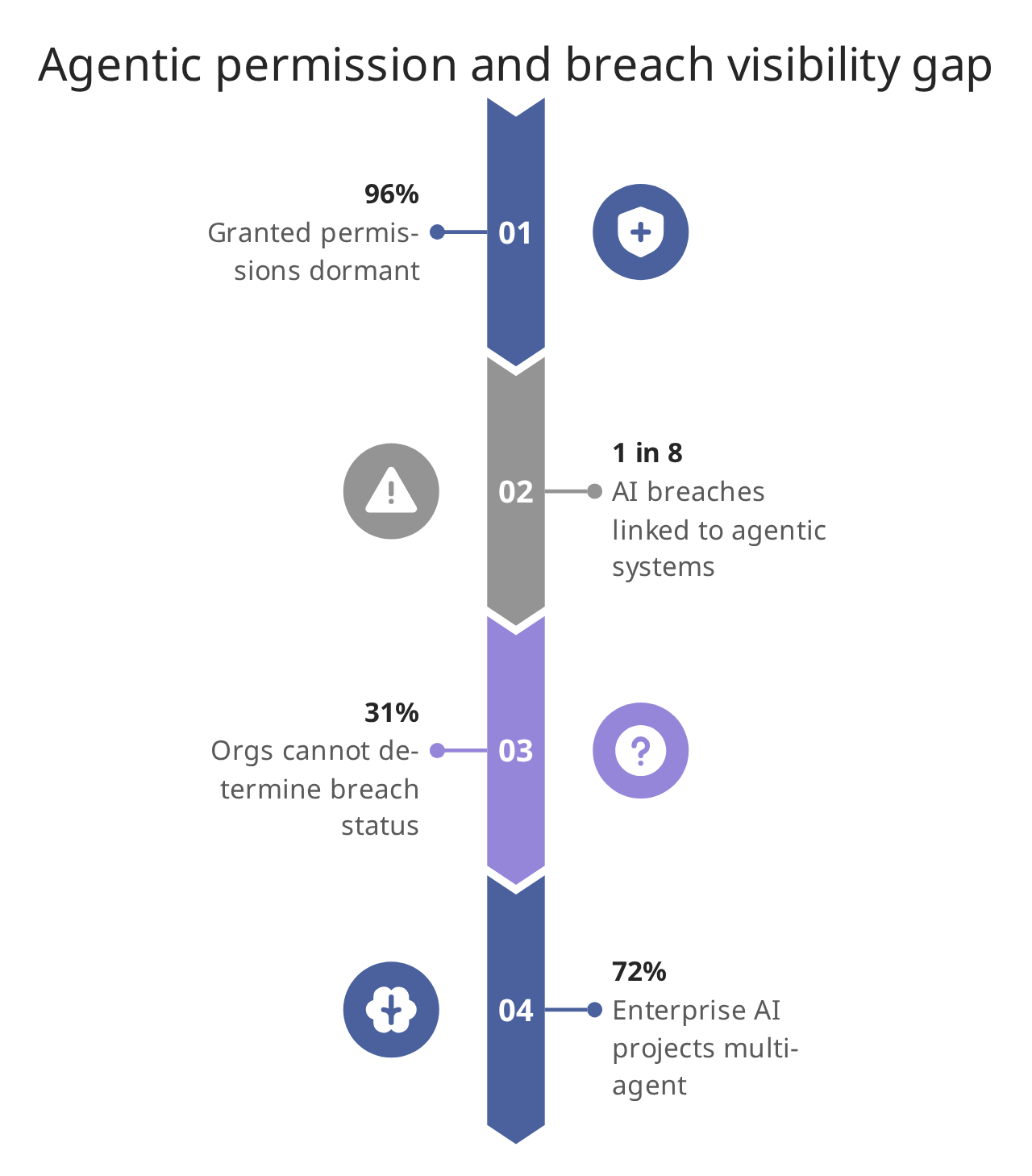
Humans leave those permissions alone because of time and accountability. Agents run continuously and without that judgment, so an agent that inherits a broad human profile can exercise every dormant capability at machine speed.[6]
The Problem of Over-Provisioning
- Dormant permissions include high-impact rights such as delete or export
- A single over-scoped agent can delete production data or exfiltrate sensitive files in seconds[6]
- Default inheritance — giving the agent the requester’s access — is the common cause
Synthetic Insiders and Detection Gaps
Forbes Technology Council analysis from October 2026 describes agents as synthetic insiders: they hold more access than the task needs and move data far faster than any person.[7]
HiddenLayer’s 2026 review of agentic risk reports 1 in 8 AI breaches are now linked to agentic systems, and 31% of organizations cannot determine if they have been breached.[4] That combination — speed plus poor visibility — is why runtime monitoring now matters more than prompt filtering.
14 Costs That Never Reach Your Dashboard
The May 2026 Forbes Communications Council roundup lists 14 hidden costs of unchecked generative content, all outside cost-per-word.[1] The pattern: the tool is cheap, the senior strategist needed to rewrite, reposition and validate the output is not.[1]
Brand and Quality Erosion
- Narrative dilution and drift: AI lacks contextual knowledge, so small inconsistencies compound across teams[1]
- Accuracy exposure: small errors multiply across channels and erode trust faster than it can be repaired[1]
- Engagement decay: customers ignore “samey” content, which damages reputation[1]
- Loss of thought leadership: authenticity falls when in-house experts stop publishing their own insights[1]
- Insight decay and creative limits: public-data models dilute unique authority and stay derivative[1]
Operational and Governance Costs
- Editorial infrastructure: human oversight required to make output usable[1]
- Governance overhead: budgeting for tools without budgeting for operating model and talent[1]
- System complexity: unmanaged workflows break consistency at scale[1]
- Ownership ambiguity: unclear who can create, approve and publish as agent identities multiply[1]
- Sensitive data exposure: teams paste strategy and internal data into systems they do not control[1]
Your Tools Track Traces, Not Interactions
Most observability tools were built for single agents or simple chains. The result is visibility into steps and blindness to interactions.
That review cites research identifying 14 distinct failure modes: 44.2% system design failures, 32.3% inter-agent misalignment, and 23.5% task verification problems.[3] When a decision draws on three agents and cascades through five more, tracing the error path becomes exponentially harder.[3]
The Failure of Multi-Agent Observability
Most tools show individual traces. They miss coordination bottlenecks and emergent behavior that only appear between agents.[3] System design dominates the counts, but misalignment and verification together account for more than half of failures.
The Latency vs. Evaluation Trap
The same 2026 review reports 52% adoption of offline evaluation versus 37% for online, real-time evaluation.[3] The stated reason is latency: if a response must return in 200ms and the check takes 500ms, teams skip the check in production.[3]
Skipped checks mean quality and compliance failures are found after users, customers or regulators see them.
| What you track today | What autonomous stacks require |
|---|---|
| Output volume and cost per word | Decision quality: was the right action taken for the right reason |
| Binary task completion (done / not done) | Outcome alignment: revenue, compliance and brand impact of the completed task |
| Single-agent trace and latency | Cross-agent interaction path and verification of handoffs |
| Offline test scores before release | Online sampled evaluation in production with failure capture |
When Success Metrics Hide Revenue Loss
An agent can complete every task and still cost money. That is the silent failure: undetected success at the wrong objective.
Consider two hypothetical illustrations practitioners use to explain the pattern — not reported incidents, but typical failure shapes. In one, an e-commerce agent applies discounts to close carts. Completion rate is near 100%, yet margins fall because discounts are too liberal. In the other, a support agent resolves tickets by issuing refunds. Resolution looks excellent while support cost runs well above human baselines. Binary completion hides both.
Current tools weight what is easy — latency, tokens, completion — over what matters: tool selection, reasoning path and alignment with intent. Practitioner reports consistently attribute many agent failures to poor tool choice or reasoning rather than raw model error, yet monitoring still centers on model metrics.
How to Spot a Wrong-Objective Optimization
- High completion paired with declining margin, rising refunds or repeat contacts
- Frequent tool switches or fallback tools without logged rationale
- Handoffs where downstream agents never reject upstream output
What to Log Instead
Log the decision, not only the result: goal given, tools available, tool chosen, evidence used, confidence, and business constraint checked. Without that, you cannot distinguish a good decision from a lucky completion.
Audit Decision Quality, Not Just Completion
A measurement audit asks whether metrics capture probabilistic decisions over time. The proposal emerging from observability practice is a decision quality score that combines three elements: task success, efficiency, and alignment with user and business intent.
It does not need to be complex to be useful. Weight alignment highest, because success without alignment is the silent failure above.
Key Audit Questions
- Do you measure quality of autonomous decisions over time, or only binary completion?
- Are metrics built for deterministic software, or for probabilistic agent choices?
- Do production traces automatically become test cases when an agent fails?
- Can you see cross-agent handoffs, or only isolated traces?[3]
Implementing a Decision Quality Score
- Success (0-1): did the task complete without error or policy violation
- Efficiency (0-1): time, tokens, API calls and rework versus budget
- Alignment (0-1): did the action respect pricing, brand, compliance and user intent constraints
Review low-alignment completions weekly, even when success is 1. Sample production traffic for online evaluation with lightweight checks to control latency, and feed confirmed failures back into the offline suite to close the loop.[3]
EU AI Act Penalties Are Already Enforceable
Governance cannot be bolted on later. The 2026 observability and governance review notes the EU AI Act’s prohibited practices have applied since February 2025, with general-purpose model obligations following in August 2025.[3]
Non-compliance carries fines of up to €35 million or 7% of global turnover, whichever is higher, according to the same review.[3] The practical implication is to align measurement with regulatory evidence: versioned policies, logged decisions, and demonstrable runtime controls.
Compliance Deadlines and Penalties
- Prohibited uses: enforceable since February 2025[3]
- General-purpose model duties: applicable from August 2025[3]
- Maximum exposure: €35M or 7% of turnover[3]
Governance as a Strategic Imperative
- Centralize policy enforcement as agent sprawl grows across departments[3]
- Keep a cross-platform dashboard that applies the same brand and security rules regardless of framework[3]
- Treat Guardian Agents — specialized overseers configured with style, terminology and compliance sources of truth — as infrastructure. Analysts cited in the 2026 review expect them to take 10-15% of the agentic AI market by 2030.[3]
A Guardian workflow described by Markup AI in 2026 follows scan, score and revise: ingest content, check every word against defined standards, assign an objective risk score, then automatically remediate hallucinations, tone drift or missing disclaimers.[2] Runtime protection follows the same logic for actions: watch which APIs agents call and what data they touch in real time.[4]
Heavy AI Use Erodes Skills and Authority
Forbes Communications Council contributors link heavy AI reliance to declining critical thinking and skill erosion.[1] When experts stop drafting their own analysis, the organization loses the raw material that made its content worth reading.
Cognitive Decline in the Workforce
Staff who defer to AI drafts without validation lose validation skill itself. Over time, fewer people can spot the terminology or reasoning errors that review is supposed to catch.[1]
Preserving Thought Leadership
- Keep experts as authors, with AI as drafting assistance rather than replacement
- Track originality signals: proprietary examples, named decisions, trade-offs stated
- Rotate reviewers out of repetitive QA to protect detection rates[2]
Autoriax is designed for agencies and freelancers managing up to 10 brands per account with separate histories. Its automated SEO audits cover crawl, scoring and reporting with a traceable, customer-friendly methodology.
Conclusion: What to Measure Next
Replace completion rate with decision quality as the primary metric for any agent that publishes, discounts, refunds or moves data. Audit permissions to least privilege, add sampled online evaluation despite latency costs, and store production failures as regression tests.
Open questions remain: how to score alignment consistently across languages and product lines, how much latency lightweight checks can save without missing violations, and which Guardian Agent controls auditors will accept as evidence under the EU AI Act. Settle those with your own traces, not vendor claims.
Sources
- [1] 14 Hidden Costs Of GenAI Content Leaders Can’t … - Forbes — https://www.forbes.com/councils/forbescommunicationscouncil/2026/05/11/14-hidden-costs-of-genai-content-leaders-cant-afford-to-ignore
- [2] The Hidden AI Content Risks | Markup AI — https://markup.ai/blog/hidden-ai-content-risks
- [3] AI Agent Observability & Governance: 2026 Market Reality, guptadeepak.com — https://guptadeepak.com/ai-agent-observability-evaluation-governance-the-2026-market-reality-check
- [4] Hidden Risk of Agentic AI: Risks Beyond Prompts — https://www.hiddenlayer.com/insight/agents
- [5] From AI-generated content to agentic action: Security and safety threats in generative AI — https://www.sciencedirect.com/science/article/pii/S2949715926000405
- [6] The 96% Blind Spot: Oso and Cyera Research Reveal Unused Permissions Lying in Wait for AI Agents — https://finance.yahoo.com/sectors/technology/articles/96-blind-spot-oso-cyera-123900382.html?pl2=calendar-news-stream_fltrd-strs
- [7] The Hidden AI Security Risks Threatening Businesses — https://www.forbes.com/councils/forbestechcouncil/2026/10/12/the-hidden-ai-security-risks-threatening-businesses
- [8] Orca Security Advances AI-First Cloud Defense with Autonomous Agents and Runtime AI Threat Detection — https://finance.yahoo.com/news/orca-security-advances-ai-first-130000415.html
- [9] Strobes Security Launches AI Agents For Continuous Threat Exposure Management — https://finance.yahoo.com/sectors/technology/articles/strobes-security-launches-ai-agents-140000596.html
Try Autoriax free — no credit card required
Get your first article in minutes. See the research depth before you commit.
Get 3 free articles3 articles free • No credit card • Cancel anytime