· Autoriax
Structuring Your Marketing Team for the AI-Search Era
How to Structure Your Marketing Team and Budget for the AI-Search Era: pods, 15-20% reallocation, PR targets and citation KPIs that keep you visible.

How to Structure Your Marketing Team and Budget for the AI-Search Era starts with a hard fact: buyers now get answers without clicking. AI assistants such as ChatGPT, Perplexity, Gemini and Google’s AI Overviews summarize, compare and recommend before a result page is ever opened.[3][13]
This guide synthesizes practitioner reporting on team design, budgeting and measurement for that answer-led environment. The takeaway for the first third of the article: reassign at least 15-20% of current content or digital spend to AI-search visibility, put one cross-functional pod in charge of citations, and replace rankings with citation rate as the operating KPI.[3][9]
Digiday’s reporting on AI-search infrastructure notes that nearly one in five consumers have already replaced traditional research with AI.[2] The response is not another SEO tactic. It is a move from SEO to Generative Engine Optimization (GEO) and Answer Engine Optimization (AEO), and a rewire of who owns what and how money is tracked.[18][19]
Answers Have Replaced Blue Links
The operating fix is to optimize for being cited in the answer, not for ranking on the page. Analysis of the shift by Seovendor.co finds AI systems often summarize and compare sources before a user clicks.[1] Search Engine Journal’s 2026 playbook for the AI-search era puts it directly: if your brand is not mentioned in the generated answer, you may never enter the consideration set.[3]
That changes measurement. Traffic still matters, but presence in the synthesis matters first.
The new discovery pattern
Discovery is compressed. A buyer asks a full question, receives a sourced summary, follows up inside the assistant, and only then — if at all — visits a site. Thrivestack.ai research on AI-search budgets reports that 56% of AI-influenced visits arrive through branded search, as users read an AI answer and then search for the brand directly.[10]
Implication for structure: awareness, consideration and conversion cannot live in separate silos with separate messages. Fragmented messaging is hard for models to interpret or trust.[1]
Why siloed teams miss citations
Authoritytech.io analysis of B2B budgets for 2026 reports that 84% of cited links in AI answers come from sources brands neither own nor pay for, such as journalism, Wikipedia and Reddit.[9] A team focused only on the corporate blog and paid ads is structurally absent from the layer buyers use.
Traditional org charts mirror the old funnel: SEO owns rankings, content owns volume, paid covers gaps.[3] In an answer engine, that split produces inconsistent entities and thin content — both reasons to be left out.
The AI Answerability Pod Owns Citations End to End
The replacement is a small cross-functional unit that owns AI-search performance for one area from entity cleanup to published evidence to citation tracking. It replaces handoffs between SEO, content and PR with shared accountability for connected outcomes.[1][3]
Start with three roles. No new headcount is required to pilot it.
Roles within the pod
- AI Search Lead (evolved SEO lead). Owns the question “where do we get cited” rather than “where do we rank.” The job is entity management across LinkedIn, G2, Crunchbase, Reddit and directories, plus crawlability and schema.[3]
- Content strategist. Owns information gain and extraction. Publishes fewer pieces with original data, named outcomes and expert commentary, formatted with tables and explicit Q&A so models can parse and cite them.[3][13]
- Data analyst. Owns citation rate, share of AI voice and LLM-referred traffic, using GA4, UTMs and AI-monitoring tools.[10][9]
Pod autonomy and accountability
Give the pod a dedicated budget slice and two KPIs: citation rate on target queries and share of AI voice versus named competitors.[9][20] Pilot on a single product line while the rest of the team operates as a control.[3] Scale only where citation lift and assisted pipeline move together.
A recurring example used through this article: a mid-market B2B software firm pilots the pod on one product, fixes five conflicting company descriptions, ships two evidence-led guides with pricing tables and Q&A schema, and earns two trade-press mentions. The pod owns all four steps.
Split SEO Into Technical and Content Answerability
One SEO generalist cannot cover both machine readability and source worthiness. Split the function into two accountabilities that report to the same lead.
Searchmantra Inc.’s review of the answer-engine era defines the content side as information gain — whether a page adds novel data or perspective absent from the model’s training set.[13] The technical side makes that gain extractable.
Technical answerability
Entity fragmentation is the first fix. When descriptions differ across LinkedIn, G2, Crunchbase, directories and the corporate site, models treat one firm as several weak ones.[3] Standardize name, description, founding year, location and product taxonomy everywhere.
Then make pages extraction targets: clean crawl paths, stable URLs, Schema.org markup including Q&A and Dataset where valid, data tables in HTML rather than images, and concise definitions models can quote.[3][13]
Content answerability
Trade volume for proof. Replace eight generic posts per month with two to three pieces that contain something citable: original survey cuts, usage data, implementation timelines, named customer results, or a practitioner quote that takes a position.[3]
Structure each piece for parsing: a direct answer in the first 60 words, followed by method, limits and a table. State what the evidence does not show. Models reward agreement across independent sources, so align claims with what trade press and reviewers say.[3]
Move 15-20% of Spend From Clicks to Citations
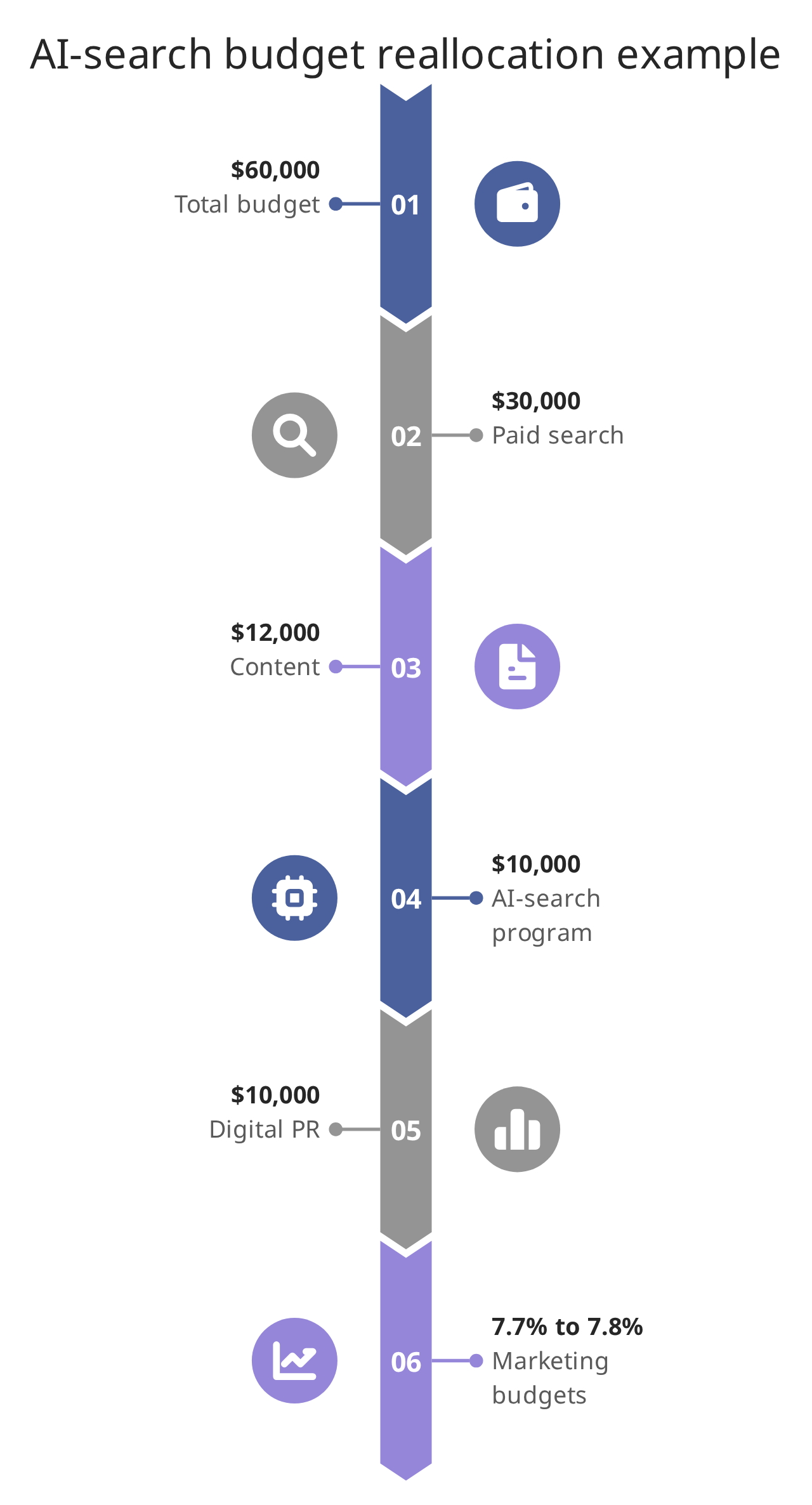
Marketing budgets as a share of revenue remain flat at about 7.7% to 7.8%, according to Thrivestack.ai research.[10] AI-search funding therefore comes from reallocation, not new money.
The working rule from Search Engine Journal and Authoritytech.io reporting is to reallocate at least 15% to 20% of current content or digital spend toward AI-search visibility.[3][9]
Where to cut
Trim paid search to fund visibility. Paid search still captures intent but cannot earn AI citations.[3][9] Reduce content volume to fund proof. Fewer pieces with heavier evidence cost less to produce in aggregate than a high-volume calendar and perform better as citation sources.[3]
Where to invest
Create an explicit AI-search program line for entity cleanup, structured data and AI-specific measurement.[3][13] Increase digital PR with quarterly citation targets, since independent mentions now do the work backlinks did a decade ago.[3]
A $60,000 monthly example described in Search Engine Journal’s playbook illustrates the math: paid search from $30,000 to $24,000; content from $12,000 to $10,000 focused on proof; a new $10,000 AI-search program; digital PR at $10,000 with citation targets.[3]
Apply a 40-30-20-10 Model, Adjusted by Stage
Our proposal for allocating the AI-search envelope is 40% tooling and data, 30% content atomization, 20% training and enablement, 10% citation tracking. Treat it as a starting ratio, not a standard. It forces balanced spend across the value chain: findability, source worthiness, skill and proof that it worked.
Similarweb’s guidance on adapting SEO budgets for AI search recommends allocating 5% to 15% of the marketing budget for training and experimentation with emerging AI channels.[5] LinkedIn analysis of 2026 AI marketing budgets puts serious transformation enablement for a 10-25 person team at $450,000 to $900,000 per year, which explains why the training share cannot be zero.[4]
Tooling and data (40%) and atomization (30%)
Tooling covers AI-monitoring platforms, LLM API costs for testing prompts, analytics instrumentation and data subscriptions for competitor citation analysis.[9][10] Atomization turns one evidence asset into Q&As, comparison tables, snippets and directory updates, each structured for extraction.[13]
A startup might run 25-40-25-10, weighting training higher because generalists need fluency fast. An enterprise might run 45-25-15-15, weighting tooling and tracking to cover multiple business units.
Training and tracking (20% and 10%)
Training builds GEO/AEO fluency: prompt testing, schema basics, sourcing standards and human review of AI drafts.[4][5] Tracking funds dashboards for citation rate, share of voice, sentiment in summaries and LLM-referred traffic.[2][20][10]
New specialist titles are appearing — AI workflow designer and AI content editor — centered on human-in-the-loop systems where people set direction and check quality while AI drafts in the middle.[7][17]
Choose Centralized, Pod-Based or Hybrid by Team Size
The right choice depends on size and coordination cost.
Hiring data points in one direction: fewer junior execution roles for drafting and manual pulls, more senior generalists who orchestrate systems, with premiums for strategic judgment and AI fluency.[8][7][15] Structure should reflect that rectangle, not the old pyramid.[8]
When to hire and when to upskill
Hire a dedicated AI-search specialist when no one owns GEO/AEO, the query set is large, and you need a pilot lead within weeks.[7] Upskill when SEO and content staff show aptitude and budget is tight. For teams under eight, upskilling plus one pod pilot is faster and cheaper than a requisition.[15]
Expert Marketing Advisors’ guidance on modern team building favors pod-based execution with AI absorbing routine work underneath, freeing small groups for judgment-led tasks.[17]
Which model fits
- Centralized. All marketers report to one leader. Best under eight people to keep entity and message consistent during early adoption.[15]
- Pod-based. Cross-functional groups own a vertical end to end. AI handles routine execution inside the pod.[15][17]
- Hybrid. Analytics and brand sit centrally; pods execute by segment. Best for scaling after a pilot proves citation lift.[15]
| Model | Best for | Ownership | Trade-off |
|---|---|---|---|
| Centralized | Teams under 8, early AI adoption | One leader owns entity, brand and priorities | Consistent but slow as query coverage grows |
| Pod-based | One to three product lines or verticals | Cross-functional pod owns citations end to end | Fast learning but needs shared KPIs to avoid duplication |
| Hybrid | Mature B2B, multiple units | Central analytics and brand, distributed execution pods | Scales well but requires explicit entity governance |
Treat Digital PR as Acquisition and Measure Citations
Digital PR is now a primary acquisition input because models reward agreement across independent sources.[3] Mentions in trade publications and review platforms function like citations, not vanity coverage.
Hold PR to quarterly citation targets in ChatGPT, Perplexity, Gemini and Google AI Mode, not clip counts.[3] Pitch original data and named practitioner commentary to raise the odds of being quoted.[3][9]
New metrics that replace rank reports
Track citation rate (share of target answers mentioning the brand), share of AI voice versus competitors, sentiment and description accuracy in summaries, and LLM-referred traffic isolated in GA4 with custom UTMs.[9][20][10][2]
Tie incentives to these numbers. Reward teams for earning citations from independent sources, not for publishing volume. Make one dashboard visible across marketing and sales that pairs citation lift with inbound deals mentioning AI tools.[3]
Run a 90-Day Pilot Before Reorganizing
De-risk the change with a phased pilot rather than a full reorganization.[1][3] The same B2B software example from above illustrates the sequence: audit, pilot on one product, then compare and scale.
Phase 1: Baseline and audit (weeks 1-4)
Test your top 20 buyer queries across ChatGPT, Gemini, Perplexity and Google AI Mode. Record every citation, answer and competitor named.[3] Fix entity fragmentation across domains, profiles and directories before publishing anything new.[3]
Phase 2 and 3: Pilot, compare, scale (weeks 5-12)
Launch one AI answerability pod on a single product line with a slice of PR budget; keep the rest as control.[3] In weeks 9-12, measure citation rate on test queries, referral traffic from assistants and inbound deals mentioning AI tools, then move budget where the evidence points.[3]
For illustration only, teams that execute this loop often describe gains in citation mentions within one quarter after adding schema and Q&A formats. Treat any such vendor example as directional until you replicate it on your own query set with your own dashboard.
Agencies and freelancers managing multiple clients can reuse the same audit template across accounts to keep histories separate. Autoriax offers automated SEO audits including crawl, scoring and reporting with a traceable methodology, and is designed for agencies and freelancers.
Conclusion
Audit your top 20 queries this month and assign one pod with budget and citation KPIs. That pilot tells you whether to shift the full 15-20% and which model — centralized, pod-based or hybrid — fits your size.
Open questions remain: how citation influence splits between earned press, reviews and owned structured data by category, and how durable any single citation is as models retrain. Answer those with your own tracking, not industry averages.
Sources
- [1] Marketing Team AI Search - Restructure Your Marketing Team For The AI Search Era — https://seovendor.co/restructure-your-marketing-team-for-the-ai-search-era
- [2] digiday.com — https://digiday.com/marketing/by-the-numbers-how-marketers-are-building-the-infrastructure-for-ai-search/
- [3] searchenginejournal.com — https://www.searchenginejournal.com/how-to-restructure-your-marketing-team-budget-for-the-ai-search-era/586153/
- [4] 2026 AI Marketing Budgets: What to Fund, What to Fix, and How to Structure Your Team — https://www.linkedin.com/pulse/2026-ai-marketing-budgets-what-fund-fix-how-structure-hema-dey-r7erc
- [5] How to Adapt Your SEO Budget for AI Search Optimization — https://www.similarweb.com/blog/marketing/geo/adapt-seo-budget-for-ai-search
- [7] How to Restructure Your Marketing Team in the AI Era — https://e-m-marketing.com/blog/how-to-restructure-your-marketing-team-in-the-ai-era/
- [8] 3searchexecutive.com — https://www.3searchexecutive.com/resources/blog/8-practical-insights-to-rebuild-your-marketing-team-for-the-ai-era/
- [9] authoritytech.io — https://authoritytech.io/blog/b2b-marketing-budget-ai-search-visibility-2026
- [10] thrivestack.ai — https://www.thrivestack.ai/research/ai-search-marketing-budget
- [13] searchmantrainc.com — https://www.searchmantrainc.com/blog/ai-and-the-future-of-search-marketing-thriving-in-an-answer-engine-era/
- [15] Marketing Team Structure 2026: Roles, Org Charts & Models — https://www.marketingmary.ai/blog/marketing-team-structure
- [17] expertmarketingadvisors.com — https://www.expertmarketingadvisors.com/resources/blog/building-the-modern-marketing-team-in-the-ai-era/
- [18] Amsive Expands Proven Search Capabilities with Answer Engine Optimization (AEO) to Navigate the AI Search Era — https://finance.yahoo.com/news/amsive-expands-proven-search-capabilities-150000692.html
- [19] SEO in the AI Era: Lithos Digital Earns Hall of Fame Status in the UK — https://finance.yahoo.com/news/seo-ai-era-lithos-digital-181000135.html
- [20] New Clutch and Conductor Data Reveals 87% of Content Marketers Increasing Budgets in 2026 as SEO Expands Into AI Search — https://finance.yahoo.com/news/clutch-conductor-data-reveals-87-150200900.html
Try Autoriax free — no credit card required
Get your first article in minutes. See the research depth before you commit.
Get 3 free articles3 articles free • No credit card • Cancel anytime