· Autoriax · Updated
Performance Marketing Fragility: Why Dashboards Mislead
The Hidden Fragility of Performance Marketing in an AI-Generated Content World: why dashboards mislead, AI floods signals, and how to build antifragile…

Dashboards look healthy. Impressions climb, click-through rates hold, lead targets are met, yet revenue does not follow. The Hidden Fragility of Performance Marketing in an AI-Generated Content World starts here, in that gap between measured activity and banked cash.
The 2026 State of Performance Marketing Report, covered by Yahoo Finance, described this gap as the Marketing Data Mirage [11]. In that report, two-thirds of senior marketing leaders said their dashboards frequently show success that never reaches the bottom line. AI-generated content widens the gap. It can mimic the signals performance systems reward — clicks, views, form fills — without creating the belief that makes someone buy and stay.
This article sets out why short-term metrics are easy for AI to exploit, what breaks first when agents mediate discovery, and which brand assets hold up under that pressure.
The Measurement Trap in Performance Marketing
Most leaders see success on screen that fails in finance, and only a minority of intent signals become qualified opportunities. The 2026 State of Performance Marketing Report, covered by Yahoo Finance, put both patterns on record, with the majority of organisations reporting unreliable or inflated intent signals [11].
The problem is not measurement itself. A 2026 analysis by Martech.org traced the phrase “what gets measured gets managed” to a warning about over-measurement, not a call to measure more [1]. Marketing kept the slogan and dropped the caution. Teams now steer by proxies — ROAS, CAC, CTR — and tune creative and bidding to move those proxies.
That produces a plateau the Martech.org analysis named the plateau of indifference [1]. Existing demand is harvested efficiently. New demand is not created. The dashboard stays green while the brand thins out.
The Origin of the Measurement Warning
The warning behind the slogan was about distortion. When a proxy becomes the target, people improve the number rather than the outcome. Marketing ignored that part and built operating models around quantified proxies that are easy to game [1].
The Marketing Data Mirage
The Yahoo Finance coverage of the 2026 report gave the mirage a shape: plenty of intent, little pipeline [11]. If only about one in four intent signals converts to a qualified opportunity, bidding harder on more of the same signals does not fix growth. It buys more noise.
Why Efficiency Can Break a Brand
Cutting unmeasurable brand spend to lift short-term efficiency removes the buffer that keeps demand alive when platforms change. The 2026 Martech.org analysis framed this with Nassim Taleb’s distinction between fragile, robust and antifragile systems [1].
Meaning is the buffer. A brand with meaning has an orbit. When an algorithm shifts or an AI assistant reroutes discovery, customers still look for it by name. A brand without meaning drifts with each auction and update [1].
The Buffer of Meaning
Meaning does not show up cleanly in last-click reports, which is why it gets cut first. Historical performance suggests that cut is expensive. During the Great Depression, Post reduced advertising to protect efficiency while Kellogg’s doubled spend and backed new assets including Rice Krispies, with profits up 30% by 1933 [1].
A Porcelain Vase Midcourt
The Martech.org analysis compared a meaning-free, efficiency-tuned brand to a porcelain vase midcourt during the NBA playoffs [1]. The image fits. Everything looks fine until contact happens. Then there is no structure to absorb it.
The AI Content Paradox: Scale Without Distinction
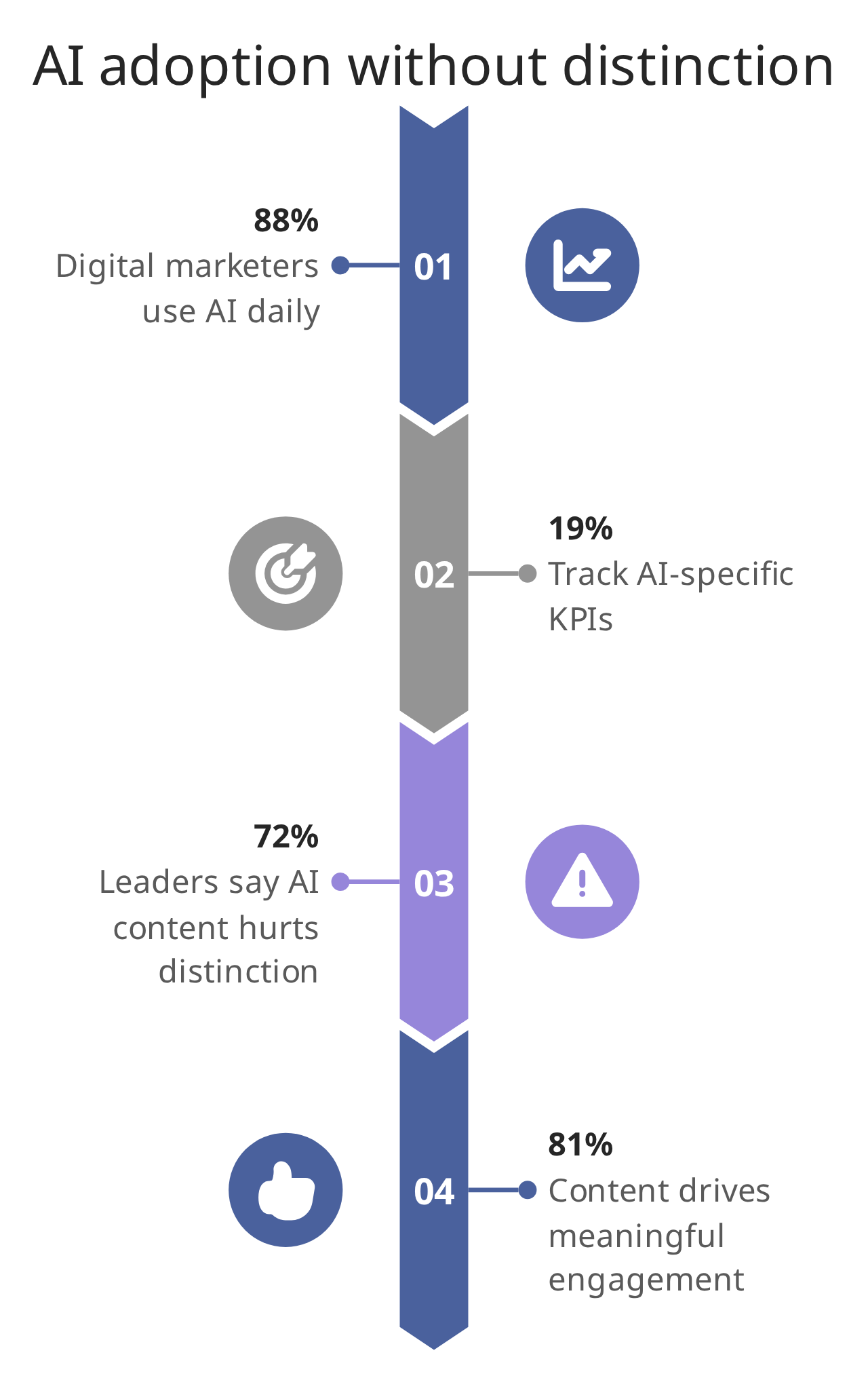
More content now produces less distinction. Industry compilations report that most digital marketers now use AI daily, yet only a small fraction track AI-specific KPIs [10]. Output rises. Accountability for what that output does to the brand does not.
The same body of research helps explain the result. The 2026 State of Performance Marketing Report, covered by Yahoo Finance, found a large majority of leaders say AI-generated content hurts brand distinction, and most report that half or less of their content drives meaningful buyer engagement [11]. Systems built on averages produce average work at scale.
The Failure of Average Content
A March 2026 analysis by Sword and the Script tracked an experiment across 20 sites and 2,000 AI-generated articles [16]. Indexing came first. Results did not follow: about 1,381 clicks over 16 months, roughly one click for every two articles. The piece argued that large language models predict the likely middle of the internet, so they rarely supply the viewpoint or lived detail that moves a buyer [16].
The Visual Perception Gap
A working paper from the Technical University of Munich studied 16 billion ad impressions and found AI ads work best when viewers cannot tell they are AI-made [4]. Ads perceived as human-made earned higher CTRs. Certain styling choices, such as overly vivid colour, acted as tells that lowered response. The lesson for testing is narrow: measure perceived humanness alongside CTR, because the tell itself changes the click.
Agentic AI and the Collapse of the Attention Economy
When software does the browsing, human impressions stop being the unit of commerce. A 2026 in-depth analysis by Klover.ai described agentic systems that book travel, compare specifications and manage portfolios without direct human clicks [8].
An agent does not pause on a banner. Emotional appeals do not register. Structured facts — price, availability, specs, delivery terms — decide. That logic points toward zero-click commerce, where the recommendation happens inside the agent and the human sees only the checkout [8].
Zero-Click Commerce
The Klover.ai analysis linked this shift to pressure on impression-based revenue [8]. If discovery is resolved machine-to-machine, platforms that sell human attention lose inventory that matters, even while impression counts look intact elsewhere.
Intent Obfuscation and Machine-to-Machine Mayhem
The same 2026 Klover.ai analysis described privacy-preserving agents that emit adversarial noise and use differential privacy, making it statistically hard to reverse-engineer identity from signals [8]. Programmatic pools fill with degraded traces. The analysis also warned that by 2026 AI agents could overtake human error as a leading cause of data breaches, a condition it called machine-to-machine mayhem [8].
From SEO to AEO: The Discovery Shift for Performance Marketing
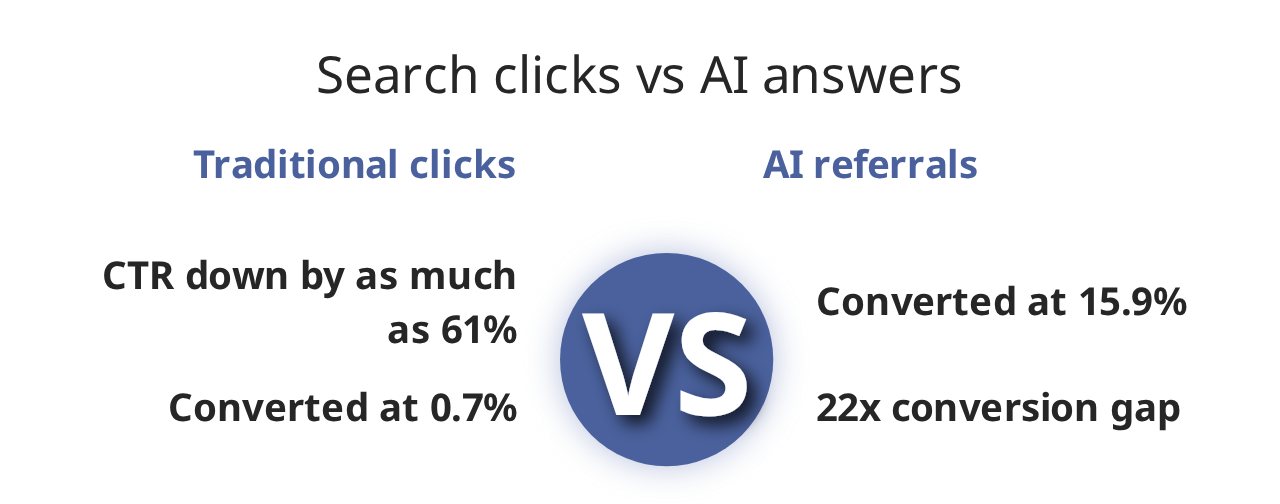
Ranking links matters less; being the cited answer matters more. Industry compilations report that organic click-through on queries with AI Overviews has fallen sharply, while referrals from AI assistants convert at far higher rates than traditional Google clicks [10].
That gap reflects pre-qualification. A user who arrives from a chat has often already formed a shortlist from the model’s answer and clicks to verify. Performance budgets still tuned for link position miss where the choice was actually made.
The Conversion Difference
Industry compilations put the contrast plainly: AI referrals convert at far higher rates than ordinary Google clicks [10]. The click is no longer the persuasion. The cited answer is.
Building Machine-Readable Authority
Three moves recur in the research:
- Entity authority: become a recognised entity in knowledge graphs so models resolve the brand correctly [10].
- Original data: publish proprietary findings that models must cite to stay accurate [10].
- Agent payment rails: prepare for machine-to-machine exchange, including the HTTP 402-based x402 protocol described in the 2026 Klover.ai analysis for agents paying for gated content on a user’s behalf [8].
The Feedback Loop: How AI Exploits Performance Metrics
Last-click attribution and short-term ROI give AI content farms a clear target. Optimisers learn from fast signals. AI can produce thousands of variations at near-zero marginal cost, each tuned to lift CTR or clear a ROAS threshold without adding belief.
The Hidden Fragility of Performance Marketing in an AI-Generated Content World is that its own scoreboard becomes the attack surface. CPC, CTR and ROAS invite simulation: plausible pages, plausible clicks, implausible customers. The March 2026 Sword and the Script analysis showed the end state of volume without viewpoint — mass indexing, minimal clicks [16]. The Yahoo Finance coverage of the 2026 report showed the middle state — plenty of intent signals, few qualified opportunities [11].
The Attack Surface of Metrics
Short windows favour what is easy to fake. A farm can test headlines faster than a brand team can interview customers. The metric rises. Memory does not.
The Race to the Bottom
As average quality falls, bids must rise to hold position. Everyone pays more for attention worth less. Trust in the numbers then erodes, which is the deeper break: teams stop believing the dashboard and have nothing agreed to replace it.
The Cost of AI Content: Efficiency vs. Effectiveness
Production gets much cheaper while persuasion gets rarer. Industry compilations report steep cost reductions from AI-assisted production, yet very few marketers trust raw, unedited AI output [10].
That is the trade in one line. Unit cost falls. Review, correction and differentiation costs rise. Brands that skip the second half publish into the sea of sameness and then wonder why pricing power softens.
The Trust Deficit
That near-absence of trust in raw output is not caution about new tools [10]. It reflects repeated exposure to confident, generic copy that fails checks with buyers, sales teams and support logs.
The Hidden Cost of Sameness
Sameness has a price that never appears in cost-per-asset math. Voice flattens, claims blur, and the brand becomes interchangeable in the exact moment an agent compares structured fields. Effectiveness leaks first. Efficiency reports arrive later.
The Role of Brand Marketing in an AI World
Emotional meaning and lived proof are harder to synthesise than variations. The 2026 Martech.org analysis argued that durable brands hold position on ideas, with media and data in support rather than command [2].
Performance still matters for capture. It cannot create the preference it harvests. Teams that treat brand as the demand engine and performance as the collection system get more from both.
The Antifragile Brand
Volatility rewards recognition. The Kellogg’s record from the 1930s remains instructive because the mechanism is current: invest in meaning when others retreat, and recall carries into recovery [1].
Integrating Brand and Performance
A workable split is explicit. Brand defines the promise and the proof. Performance tests messages, routes and offers against that promise. When performance drifts from the promise to chase a weekly ROAS print, the brand desk holds the line.
Building an Antifragile Marketing System for AI-Generated Content
Resilience comes from governance, original evidence and channel breadth, not from more variants. With AI now woven through most of global advertising spend, the marketer’s work sits above bidding logic, in identity, experiment design and creative renewal [18].
Practical moves drawn from the research:
- Pair AI velocity with human edit. Industry compilations link that pairing to markedly lower bounce rates versus unedited AI content [10].
- Replace ROAS-only reads with incrementality tests that isolate causal lift [18].
- Detect creative fatigue before the slump and rotate human-curated assets on purpose [18].
- Rebuild first-party identity for a cookieless environment rather than renting proxies [18].
- Check legal exposure early. A 2026 Bennett Jones analysis noted that AI output without substantial human authorship may lack copyright protection in the US and that brands remain responsible for accuracy, a sharp point in regulated categories [12].
| Fragile performance setup | Antifragile brand setup |
|---|---|
| Optimises last-click ROAS week to week | Tests incrementality and reads ROAS with context |
| Buys intent signals, only a minority of which qualify per the 2026 report [11] | Builds first-party relationships and original data that agents must cite |
| Publishes average AI output at scale, ~1 click per two articles in the 20-site test [16] | Pairs AI drafts with human edit, linked to lower bounce [10] |
| Chases link rank as AI Overviews cut organic CTR sharply [10] | Builds entity authority for AI answers that convert at far higher rates [10] |
Case Studies: Brands That Thrive vs. Those That Break
The same shock rewards meaning and punishes its absence. Two records, ninety years apart, show the pattern.
Historical Example: Kellogg’s vs. Post
During the Great Depression, Post cut advertising to defend efficiency while Kellogg’s increased spend and introduced new products, ending with profits up 30% by 1933 [1]. Post saved money and lost presence for decades. Kellogg’s bought memory when attention was cheap and kept it when incomes returned.
Modern Example: 2,000 Articles, 1,381 Clicks
The March 2026 Sword and the Script analysis of 20 sites publishing 2,000 AI articles found scale without pull: 1,381 clicks across 16 months [16]. Indexing is not demand. Without a distinct point of view, distribution becomes storage.
Conclusion
Audit where demand would come from if paid social and search cost 30% more next quarter or if an agent answered the category without showing ads. Shift a share of budget from variant volume to cited evidence: one proprietary dataset, one knowledge-graph cleanup, one incrementality test per quarter.
What remains open is pricing in a machine-mediated market. If agents negotiate and pay via rails like x402, value will move to structured truth and enforceable guarantees rather than slogans [8]. Teams that learn to sell to the agent without losing the human will set the terms. The rest will optimise dashboards while demand is decided elsewhere.
Sources
- [1] martech.org — https://martech.org/the-hidden-fragility-of-performance-marketing/
- [2] 5 Principles For Making Programmatic Creative Work — https://martech.org/5-principles-making-programmatic-creative-work/
- [4] How AI-generated ads’ visual cues shape consumer … — https://www.msl.mgt.tum.de/dm/aktuelles/article/new-working-paper-ai-in-disguise/
- [8] Digital Advertising: Fragility in the Era of Agentic … — https://www.klover.ai/digital_advertising_fragility_in_the_era_of_agentic_ai_indepth_analysis_2026/
- [10] thestacc.com — https://thestacc.com/blog/ai-content-marketing-statistics/
- [11] The 2026 State of Performance Marketing Report — https://finance.yahoo.com/news/2026-state-performance-marketing-report-130000046.html
- [12] The Implications of AI on Performance Marketing — https://www.bennettjones.com/Insights/Blogs/The-Implications-of-AI-on-Performance-Marketing
- [16] Study finds AI-generated content performs poorly in search — https://www.swordandthescript.com/2026/03/ai-generated-content/
- [18] AI in Performance Marketing: From Data to Optimization — https://www.aidigital.com/blog/ai-performance-marketing
Try Autoriax free — no credit card required
Get your first article in minutes. See the research depth before you commit.
Get 3 free articles3 articles free • No credit card • Cancel anytime