· Autoriax · Updated
How to Measure Marketing ROI in Zero-Click Discovery
How to Measure Marketing ROI When AI Owns Content Discovery: track citation share, brand lift, and ROCS with a practical framework.

Learning How to Measure Marketing ROI When AI Owns Content Discovery starts with accepting that clicks no longer equal influence. Prospects now evaluate vendors inside ChatGPT, Perplexity, and Google AI Overviews, often without opening a single brand site. The 2026 Martech analysis of AI-mediated discovery describes this as a top-of-funnel takeover, where answers replace visits[1].
That creates a reporting gap. Traffic falls, yet pipeline holds. Teams that still report sessions and bounce rate look weaker on paper while actually shaping more decisions. This article gives you a replacement: a composite AI Influence Score, five intent-weighted KPIs, and an attribution approach that proves incremental value to finance.
The most useful answer up front: stop defending volume. Track whether AI answers mention you, whether branded search rises afterward, and whether the visitors who do arrive behave like buyers. Those three signals predict revenue better than raw sessions in an AI-first journey.
Traffic Is Down, Influence Is Not
Websites in AI-heavy categories have lost a meaningful slice of organic click-through traffic even as awareness and revenue held flat or grew. The traffic disappeared, the influence did not. Your dashboard needs to reflect that split.
The cause is structural. The 2026 HubSpot analysis of AI search behavior reports that around 60% of Google searches now end without a click to an external site[6]. AI Overviews answer informational queries on the results page. If ROI math divides revenue by sessions, the denominator shrinks for reasons unrelated to performance.
Legacy analytics also cannot see inside the conversation. The 2026 Martech analysis notes that private chatbot answers and walled-garden summaries leave no referrer, no UTM, no cookie trail[1]. You get the outcome — a branded search three days later, a demo request — without the path.
The Zero-Click Reality
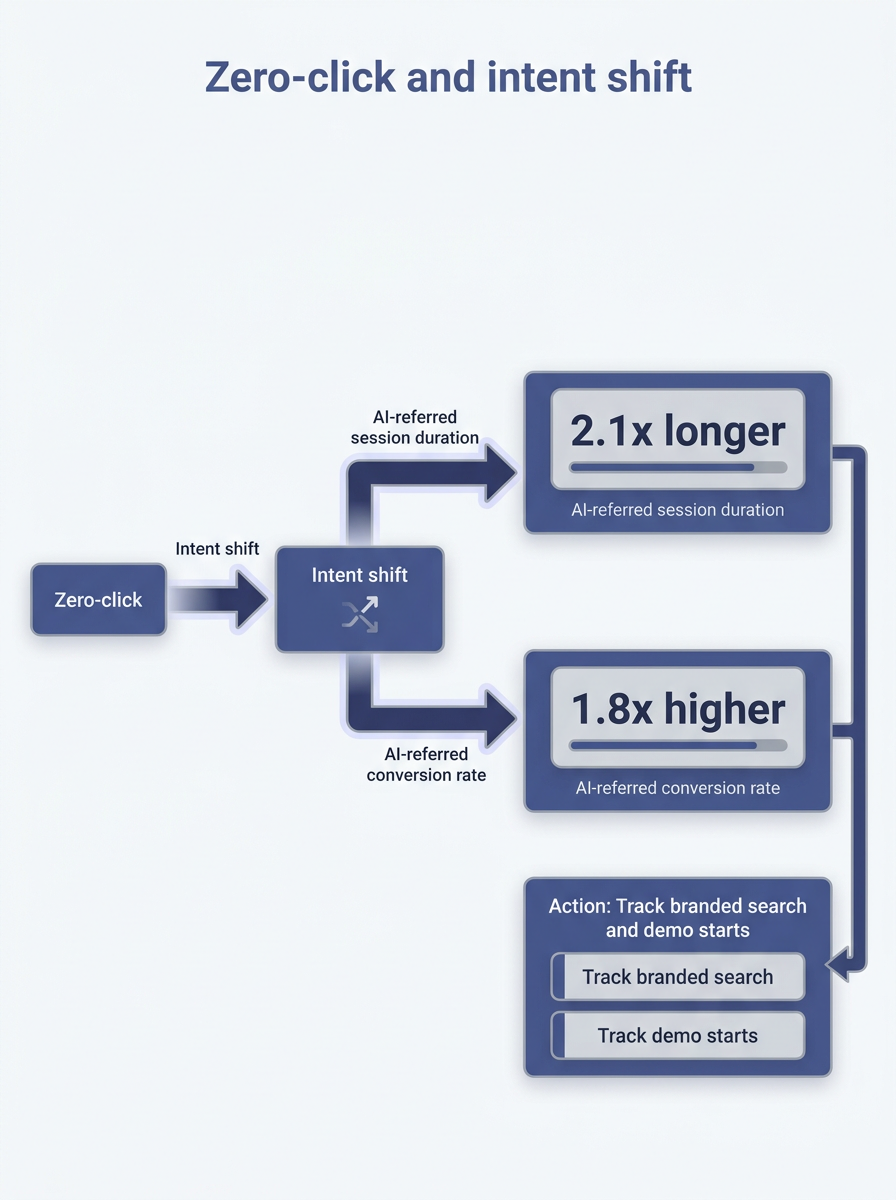
Zero-click does not mean zero effect. A buyer asks for “best onboarding tools for SOC 2 startups,” reads three AI summaries, then searches your name directly. No click is attributed to you, but the mental shortlist changed.
What to do:
- Separate informational from commercial traffic in reporting. Expect the former to keep falling.
- Report consideration separately from sessions, using branded search and direct demo starts.
- Stop targeting “what is” keywords for traffic alone. Keep them only if they feed AI citations.
The Higher-Intent Filter
AI acts as a pre-qualifier. Visitors who arrive after AI research skip primers and go to pricing, docs, and comparisons, a pattern noted in both the 2026 Martech and HubSpot analyses[1][6].
That is why volume misleads. Fewer arrivals can mean better arrivals: visitors who come after AI research tend to stay longer and convert better than undifferentiated organic traffic, because the AI step already filtered out the merely curious. Measure depth, not just doors opened.
The AI Influence Score in One Number
No single click metric captures machine-mediated demand, so combine three proxies into one trend line: citation presence, branded-search lift, and engagement quality of AI-influenced visits. The 2026 Partnerize guide to turning AI visibility into ROI recommends the same layered view — visibility plus engagement plus revenue impact — rather than one traffic chart[10].
Think of the score as a leading indicator. When it rises for four to six weeks, branded pipeline usually follows. When it falls, future demos soften even if current traffic looks stable.
Weight it to your model. A SaaS team might weight 40% citation share, 30% branded-search lift, 30% engagement depth. A services firm might weight engagement higher because one deep read matters more than ten mentions.
Components of the Score
- Citation presence: share of test prompts where AI answers name you.
- Branded-search lift: indexed growth in company and product-name queries.
- Engagement quality: pages per session, return rate, and high-intent events for AI-influenced cohorts.
How to Calculate and Apply It
Pick 20-30 buying prompts, run them monthly across two to three assistants, and record mentions. Pull branded impressions from Search Console. Pull depth metrics for visitors who land on pricing, comparison, or technical pages. Normalize each to 100, apply weights, track the trend.
Use the trend to direct work. Low citations but strong engagement means invest in answer-ready content. Strong citations but flat branded search means your mentions lack distinctiveness — tighten positioning and proof points.
Brand Search and Citation Share Show Awareness
AI recommendations often carry no link. Interest surfaces later as a direct search for your name, a pattern highlighted in the 2026 Martech analysis[1]. That makes brand search volume the most durable top-of-funnel signal when discovery happens off-site.
Citations are the other half. In AI answers, a mention is the new rank. The 2026 Stackmatix guide to AEO ROI defines citation share of voice as your mentions divided by total brand mentions for a set of category queries[7].
Tracking Branded Searches Without Noise
Use Search Console for brand impressions and clicks, split by exact company name, product name, and misspellings. Exclude paid brand terms when judging organic lift. Annotate launches, PR hits, and TV or CTV flights — the 2026 BrightEdge data covered by The Current shows CTV can lift brand-related AI searches, so offline spikes are real confounders.
Look for a specific sequence: citation uptick in week one, branded-search lift in weeks two to four. That lag is normal for AI influence.
Benchmarking Citation Share Against Rivals
Run the same prompt set for you and three competitors. Record not only whether you appear, but how: named as option, linked as source, or described without naming. A bare description without your name builds category demand you do not capture.
Specialized AEO monitors can automate this across models, as described in the 2026 HubSpot analysis[6]. For baseline site health underneath, Autoriax provides automated SEO audits including crawl, scoring, and reporting, designed to cut audit time from approximately five hours to under five minutes, with management for up to 10 brands per account[11]. Use audits to fix the foundations — indexation, duplicates, schema errors — before judging citation gaps.
Capture Rate and Session Depth Predict Revenue
Answer Capture Rate tells you whether machines can extract your content. The 2026 Stackmatix guide defines it as the share of priority queries where you hold featured snippets, People Also Ask, or knowledge panels[7]. High capture does not guarantee AI citations, but low capture almost guarantees weak citation potential.
Engagement tells you whether the right people arrived. Prioritize return rate, pages per session, and time on high-intent templates over total users.
Measuring Answer Capture
Track 50-100 priority queries in an SEO tool for snippet and PAA ownership. Review monthly. A falling capture rate with steady rankings often precedes citation loss — your page still ranks, but machines no longer quote it.
Improvements that help extraction:
- Lead with the answer in 40-60 words, then expand.
- Use explicit headings that mirror buyer phrasing.
- Keep facts consistent across site, LinkedIn, and review profiles like G2, a consistency point stressed in the 2026 HubSpot analysis[6].
Defining Engagement Worth Reporting
Set separate benchmarks for AI-influenced cohorts. If your site average is 1:40 and 1.8 pages, an AI-influenced cohort will often run noticeably deeper — benchmark it on its own trend rather than against the site mean.
Report downstream events, not just time:
- Pricing calculator use
- Integration guide downloads
- Comparison-page views and return visits within 14 days
Feed those events into lead scoring. A visitor with two comparison views plus a pricing interaction outranks five blog readers.
Attribution Must Leave Last Click Behind
Last-click credits the final form fill and erases the chatbot conversation that put you on the shortlist. The 2026 Forbes Communications Council review of AI marketing metrics argues for impact over motion — bookings and pipeline influenced, not views counted[8]. That requires a hybrid model.
No model is exact. Multi-touch spreads credit, self-reported attribution catches what pixels miss, and controlled tests measure incrementality. Use all three, and say what each cannot show.
Multi-Touch for the Long Window
Apply a position-based or time-decay model over 30, 60, and 90 days. Give early touches partial credit when a later branded search or direct visit closes. The 2026 guide to AI marketing ROI and dashboards recommends this windowed view for fragmented journeys[12].
Keep the model stable for at least two quarters. Changing weights monthly makes every channel look volatile and teaches finance to ignore the report.
Self-Reported Attribution Catches the Dark Funnel
Add “How did you hear about us?” as free text on demo and contact forms. A large share of leads now cite sources analytics cannot see — often phrased as “ChatGPT recommended you,” the dark funnel the 2026 Martech analysis of AI-mediated discovery describes[1]. That sentence is worth more than another UTM cleanup sprint.
Review responses monthly, code them into AI-mentioned, peer-mentioned, and content-mentioned, and attach them to opportunities in the CRM. Sales will trust pipeline data more when their own call notes match the field.
| Attribution method | What it credits | Limitation to state openly | | Last-click | Final page before conversion | Ignores AI mentions and early research with no referrer | | Multi-touch over 30-90 days | Early and middle touches plus closer | Spreads credit by rule, does not prove cause | | Self-reported “How did you hear about us?” | Dark-funnel sources like chatbot tips and Slack threads | Free text needs coding, recall is imperfect | | Geo-lift test | Incremental lift in test vs control regions | Requires clean regions and enough volume to read |
Finance Understands ROCS, Not Sessions
To hold budget, translate influence into money with Return on Content Spend. The 2026 Relato guide to content ROI frames it parallel to ROAS[4]:
ROCS = ((Revenue Influenced by Content − Cost of Content) / Cost of Content) × 100
“Cost” means fully loaded cost: staff time, freelancers, tools, and review. “Influenced” means any closed-won deal that touched the asset in the window you defined. Pick the rule, document it, and do not change it mid-year.
The 2026 Forbes review makes the same motion-to-impact point: report bookings influenced and sales-cycle effects, not output counts[8]. Pair ROCS with pipeline velocity — days from first touch to qualified opportunity — to show AI discovery shortens work, not just fills the top.
Efficiency Gains Are Not the Whole Story
Time saved matters, but speed without outcomes is theater. The 2026 Writer ROI calculator distinguishes task speed from value created, and the distinction holds for discovery work[9].
Report both layers:
- Efficiency: hours saved per audit, brief, or localization pass.
- Strategic: campaigns launched sooner, markets entered, win rate on AI-influenced deals.
One caution from operations research: only 22% of marketers have fully integrated AI search and SEO, according to the 2026 Semrush operational-gap study, and that group is pulling ahead[9]. If ownership for answer-engine work sits across SEO, content, and PR with no owner, ROCS will understate potential because no one ships the fixes — how to structure your marketing team for the AI-search era covers who should own it.
Make Content Easy for Machines to Quote
AI models quote clear, sourced, structured passages — the structural playbook behind generative-search SEO. The 2026 Keyrus analysis of the shift from Google to LLMs finds discovery now rewards clarity, entity consistency, and direct answers over keyword density[2]. Write for extraction first, style second.
Original evidence earns mentions. AI engines preferentially quote first-hand data — original statistics, named benchmarks, expert-bylined analysis — over repackaged claims, because provenance is easier to verify. Publish one survey, one benchmark, or one teardown per quarter rather than ten summaries.
Structure That Earns Snippets and Citations
- Answer in the first paragraph, then add method and limits.
- Use tables for comparisons, lists for steps, and named entities throughout.
- Quote operators, not just marketers — CTO, head of support, customer engineer.
- Date the data and note coverage, so models treat it as current.
Technical Signals That Support Visibility
Schema does not guarantee citation, but missing schema guarantees extra work for machines. Mark up products, reviews, and organization entities. Keep names, pricing tiers, and integration lists identical across your domain and major profiles.
For teams managing multiple clients or sub-brands, Autoriax reports in 6 languages with one-click PDF export and keeps separate histories for up to 10 brands per account, which helps agencies show per-brand audit progress without manual slide work[11]. Its methodology is described as traceable and customer-friendly, a useful trait when you need to explain fixes to non-technical stakeholders[11].
Conclusion
Shift one budget line this quarter from low-intent informational production to answer-ready evidence and citation tracking. Assign a single owner for AI visibility, freeze your ROCS and attribution rules for two quarters, and run one geo-lift test on a region where you increase original research plus structured updates.
What remains open is measurement inside closed assistants. Referrer-free answers, personalized summaries, and shifting model versions mean citation share will stay sampled, not censused. Treat it as a directional leading indicator, validate with branded search and self-reported source, and let controlled tests — not dashboards — settle budget arguments.
Sources
- [1] Martech – How to measure marketing when AI owns discovery — https://martech.org/how-to-measure-marketing-when-ai-owns-discovery/
- [2] Keyrus – The AI search revolution: how the shift from Google to LLMs is reshaping — https://keyrus.com/uk/en/insights/the-ai-search-revolution-how-the-shift-from-google-to-llms-is-reshaping
- [3] Skift – AI Is Deciding Which Hotels Get Considered — Hospitality Revenue Leaders Need a Budget Response — https://skift.com/2026/07/31/ai-driven-travel-discovery-hotel-visibility/
- [4] Relato – Content marketing ROI: how to measure and track it (2026) — https://www.relato.com/blog/content-marketing-roi
- [6] HubSpot – AI search behavior — https://blog.hubspot.com/marketing/ai-search-behavior
- [7] Stackmatix – AEO Marketing ROI: How to Measure & Prove Your AI Search Investment — https://www.stackmatix.com/blog/aeo-marketing-roi
- [8] Forbes Communications Council – Beyond AI adoption: the marketing metrics that measure real impact — https://www.forbes.com/councils/forbescommunicationscouncil/2026/09/03/beyond-ai-adoption-the-marketing-metrics-that-measure-real-impact/
- [9] Semrush – Only 22% of marketers have fully integrated AI search and SEO. They’re pulling ahead. [Study] — https://www.semrush.com/blog/the-operational-gap-ai-seo-study/
- [10] Partnerize – How to Turn AI Search Visibility Into Measurable Marketing ROI — https://partnerize.com/resources/blog/ai-search-visibility-marketing-roi
- [11] Autoriax — https://autoriax.com/
- [12] TheHovi – How to Measure AI Marketing ROI: Metrics, Attribution & Dashboards — https://thehovi.com/blog/ai-marketing/how-to-measure-ai-marketing-roi-metrics-attribution-dashboards
Try Autoriax free — no credit card required
Get your first article in minutes. See the research depth before you commit.
Get 3 free articles3 articles free • No credit card • Cancel anytime