· Autoriax · Updated
Why Mass-Produced Content Fails Without a Strategic Workflow
Why mass-produced AI content fails without a strategic workflow — and what HITL, E-E-A-T, and governance look like for brands in 2026.

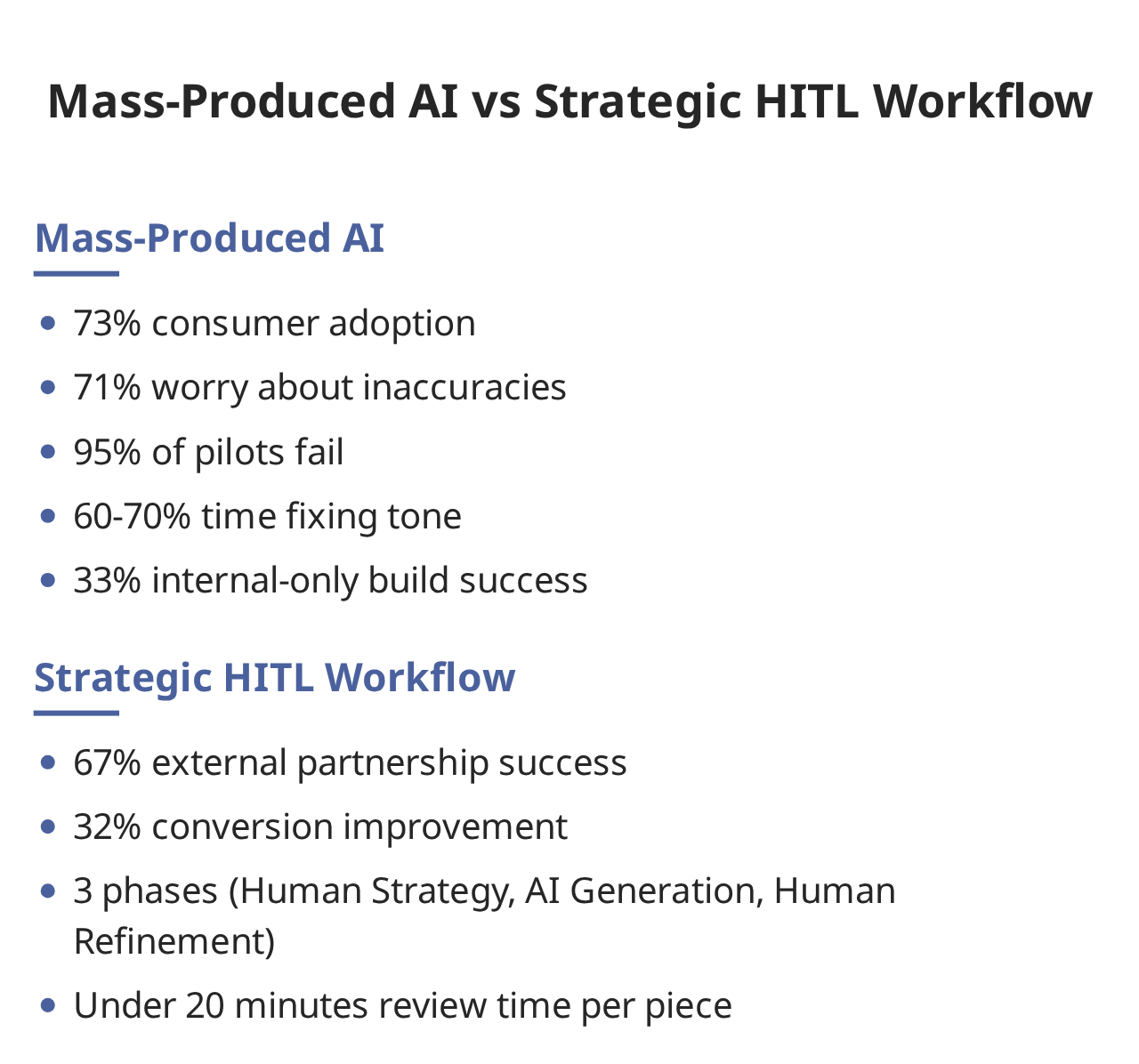
The promise of generative AI was seductive: infinite content at the touch of a button. For many organizations, the logic seemed sound—if AI can produce a blog post, a product description, or a social media update in seconds, then scaling content should lead to a corresponding scale in traffic, leads, and revenue. Yet in 2026, the cracks in that logic have widened into a chasm. Adoption has climbed to 73% among consumers, but excitement is cooling as AI shifts from a novelty to a mere utility.[1] More alarmingly, the corporate world is confronting an ROI crisis: recent data from MIT’s NANDA initiative reveals that a staggering 95% of generative AI pilots fail to deliver measurable impact on profit and loss.[2][3]
The problem is not the technology itself. Today’s AI models are more capable than ever. The failure lies in the workflow. Organizations are attempting to solve 2026-level problems with “prompt-and-pray” methods that ignore strategic integration and human oversight. Mass-produced AI content fails because it lacks the structural foundation, expert insight, and organizational alignment required to turn output into outcomes. Understanding this distinction is the first step toward building a content engine that actually performs.
Quick Facts: Why Mass-Produced AI Content Fails Without a Strategic Workflow
- 73% of consumers have adopted AI tools, yet 71% now worry about AI-driven inaccuracies.[1]
- 95% of enterprise generative AI pilots fail to deliver measurable P&L impact.[2][3]
- External AI deployment partnerships succeed 67% of the time, versus only 33% for internal-only builds.[2][3]
The Volume Trap: Why More Content Means Less Value
The first mistake most organizations make is confusing velocity with value. When content production becomes a commodity, volume stops being a competitive advantage and starts becoming a liability.[4] This has fueled the proliferation of “AI slop”—mass-produced, low-quality material designed for algorithms rather than people.[5]
The Rise of AI Slop
AI slop is often grammatically correct and polished on the surface, but it lacks original thinking, lived experience, and brand personality. Consumers are becoming increasingly skeptical: 71% of users now worry about AI inaccuracies and misinformation, and roughly 62% express frustration when companies remove human support entirely.[1] The “human touch” is becoming more valuable precisely because it is becoming rarer. When every competitor can generate the same generic article in seconds, the only differentiator left is perspective, voice, and verifiable expertise—none of which a raw prompt can produce.
The Editing Paradox
Many teams adopt AI to move faster, only to find themselves trapped in the “Editing Paradox.” Because initial AI output is generic or contains hallucinations, teams spend 60–70% of their time fixing tone, removing filler, and adding specificity.[4] In many cases, correcting a weak AI draft takes longer than writing from scratch, resulting in zero net time savings. Worse, the mental fatigue of endlessly patching machine output often produces content that is competent but joyless—a mirror of the input it was given.
Key Takeaway: Volume without strategy is not efficiency; it is overhead. The cost of fixing bad AI output frequently exceeds the cost of starting from a strong human-led brief.
The GenAI Divide: Adoption vs. ROI
Consumer adoption of AI has been near-vertical, but the corporate ROI curve has flattened. This gap—widely described as the “GenAI Divide”—is the defining tension of enterprise AI in 2026.[1]
The Pilot-to-Production Chasm
The distance between a successful demo and a successful deployment is where most enterprise AI initiatives die. This is often called the “Pilot-to-Production Chasm.”[6] A startling finding from MIT is that external partnerships for AI deployment succeed about 67% of the time, while internal-only builds succeed only 33% of the time.[2][3] External experts bring the mileage of dozens of implementations, helping organizations avoid common pitfalls like data fragmentation and cultural friction.
Misaligned Investment
About 50–70% of AI budgets are currently funneled into sales and marketing because the use cases are easy to imagine.[2][3] However, the most significant ROI is emerging in “un-glamorous” back-office functions like procurement, finance, and operations.[2][6] By chasing visibility over value, content-driven brands are missing the deeper pools of productivity.
Key Takeaway: High adoption rates mask low success rates. Without a deployment workflow, most AI initiatives never escape the demo stage.
The Strategic Chasm: Why Pilots Stall
Even when budgets are committed and tools are licensed, many organizations stall. The reason is structural: AI is being treated as a bolt-on tool rather than a core business capability.[7]
Tool vs. Capability
A tool is added to a process; a capability changes how work is done. Organizations that achieve real value from AI are nearly three times more likely to have redesigned their workflows entirely around the technology.[7] This is not a matter of installing better software. It is a question of redefining roles, handoffs, and review gates so that AI augments human judgment instead of bypassing it.
The Learning Gap
Unlike human employees, generic AI models like ChatGPT do not naturally adapt to a specific business context or retain feedback over time.[8] Without a workflow that feeds proprietary data and previous corrections back into the system, the AI remains a static science project rather than an evolving asset. This is why many “AI content engines” produce the same bland output six months in as they did on day one.
Key Takeaway: A workflow that does not feed the AI your proprietary context will keep producing generic output. Capabilities require loops, not just licenses.
The SEO and AEO Reality Check
For years, the SEO model was simple: pick a keyword and publish a blog. In the age of AI search—Answer Engine Optimization (AEO)—that model is dying. Google and AI answer engines like Perplexity now prioritize E-E-A-T: Experience, Expertise, Authoritativeness, and Trustworthiness.[4][9]
The Penalty of Scale
Google has been consistent: scaled content abuse is a violation of policy. In 2025, Google began issuing manual actions against sites mass-publishing AI-generated content without added value.[9] These sites often see a “Mt. AI” effect—a brief spike in traffic followed by a total collapse in visibility as quality thresholds kick in. The penalty is not theoretical; it is algorithmic, and it is accelerating.
The Move to Entities
In the new search landscape, brands must move from keyword focus to entity focus. This means structuring data so AI agents can recognize a brand as a verified authority. If an AI agent cannot find facts on a site, it will hallucinate them from elsewhere.[9] Brands that fail to architect their data infrastructure are essentially invisible to the bots that now guide consumer decisions.
Key Takeaway: Search engines and AI agents reward structured, verifiable, entity-rich content—and penalize scaled output that lacks it.
The Human-in-the-Loop (HITL) Workflow
The brands winning in 2026 are not using AI to replace humans; they are using it to empower “super-producers.”[9] The most effective framework is the Human-AI-Human workflow, which separates strategic thinking from execution.[4]
Phase 1: Human Strategy (The Input)
Before any AI tool is touched, a human must define the “North Star.” This involves identifying the specific reader objection or question, providing a unique point of view based on lived experience, and mapping content to a topical cluster rather than a single keyword.[4][9] AI accelerates clarity, but it cannot create it. The quality of AI content is determined entirely by the human input in this phase.
Phase 2: AI Generation (The Execution)
Once the strategy is set, AI is used as a production support tool. It handles draft generation, structural expansion, keyword clustering, metadata generation, and scaling product descriptions based on checked and approved data.[4][10]
Phase 3: Human Refinement (The Validation)
This is the non-negotiable step where trust is built. A human expert must inject trust anchors such as specific case studies or first-party data, verify technical accuracy against a single source of truth, and ensure the brand voice remains distinct and empathetic rather than generic.[4][11] This hybrid approach consistently outperforms pure AI publishing on content conversion.[4]
Key Takeaway: Strategy must come from humans, execution from AI, and validation from humans again. Skipping any phase collapses trust and performance.
Frequently Asked: Can a single editor realistically manage an HITL workflow at scale?
Yes, provided the workflow is templated. Editorial standards, fact-check checklists, and brand-voice rubrics can be encoded so that review time per piece stays tightly bounded even at high volume. The key is treating the workflow as a product, not a one-off process.
Organizational Readiness: Beyond the Technology
Scaling AI content requires more than just a subscription to an LLM. It requires a shift in leadership, governance, and culture.
Accountability and Decision Rights
One of the most persistent challenges is “diffused accountability.” When AI influences a decision—whether it is a content topic or a loan approval—someone must own the outcome.[7] Clear decision rights define who can override the AI and who is responsible when the system drifts.
The Need for External Expertise
External partnerships for AI deployment succeed about 67% of the time, while internal-only builds succeed only 33%.[2][3] External experts bring the mileage of dozens of implementations, helping organizations avoid common pitfalls like data fragmentation and cultural friction. For many SMBs, this is the difference between a stalled pilot and a production-grade system.
Cultural Change
Many organizations suffer from “Shadow AI,” where employees use personal AI accounts because official tools are too brittle or disconnected from their real workflows.[2][6] Leaders must empower line managers to shape AI adoption rather than relying on a central control group. Technology change is fundamentally cultural change, and workflows that ignore that reality will fail regardless of model quality.
Key Takeaway: Governance, accountability, and culture determine whether an AI investment compounds or collapses.
The YouTube Policy Shift: A Symptom, Not the Cause
In July 2025, YouTube updated its monetization policy to explicitly demonetize “mass-produced and repetitious content.”[9][12] The policy was a direct blow to AI farms that churn out dozens of videos per day on identical keyword clusters.
The Policy Details
Channels whose output is deemed repetitious, low-effort, or template-driven now risk losing Partner Program eligibility. YouTube’s enforcement focuses on patterns—same format, same structure, same talking points—rather than specific tools, which means even human-led assembly-line content can be flagged.[12]
The Underlying Problem
Platforms are reacting to audience fatigue and trust erosion. The cure is not compliance theater; it is a curation workflow that filters for novelty, authority, and genuine user intent. YouTube’s policy is a symptom of a broader collapse in trust across every content surface—from search to social to commerce.
Key Takeaway: YouTube’s monetization shift is a warning shot for every platform. Volume-only strategies are no longer just inefficient; they are actively penalized.
Auditing Your AI Content Pipeline for Mass-Produced Risk
Before platform crackdowns arrive, content teams should audit their pipelines for the warning signs of mass-produced output.
Checklist for Risk
Ask whether the team is publishing on the same keyword clusters repeatedly, whether there is a human review step for tone and accuracy, and whether a uniqueness filter exists against existing content on the site.[9][10] If the answer to any of these is “no,” the pipeline is at risk of being classified as scaled content abuse.
Metrics to Monitor
Bounce rate and time-on-page serve as leading quality indicators, while topical authority growth over time shows whether the content is compounding or cannibalizing itself. Stop measuring success by how many articles are published and start ranking content by conversion events and trust signals.[4][9]
Key Takeaway: Audit for repetitiveness, not just volume. The risk of scaled content abuse is structural, not editorial.
Case Studies: Success vs. Failure
Failure: The AI Farm
One SEO agency documented a client that churned out more than 50 articles per day using a pure-AI pipeline. Traffic spiked briefly, then collapsed after a Google manual action removed the site from index for scaled content abuse.[9] There was no recovery path because the entire operating model was built on volume without validation.
Success: The Human-AI-Human Workflow
The opposite pattern pairs AI drafting with strict editorial gates, original research inputs, and a uniqueness filter. Sites that run this way tend to hold traffic rather than spike and collapse, stay eligible for monetization, and convert better than a pure-AI baseline, because every published piece carries something a model alone cannot supply.[4][9]
| Dimension | Mass-Produced AI Pipeline | Strategic HITL Workflow |
|---|---|---|
| Editing Time | A large share of production time spent fixing AI drafts[4] | Review compressed by templated checklists |
| Search Performance | Brief spike followed by collapse (“Mt. AI” effect)[9] | Sustained traffic and topical authority growth |
| Conversion Impact | Baseline or negative[4] | Higher conversion than pure-AI publishing[4] |
| Platform Risk | Manual actions, demonetization[9][12] | Eligible for monetization and citation by AI agents |
| Data Inputs | Generic prompts, no proprietary context[8] | First-party research, verified sources, single source of truth |
Key Takeaway: The difference between collapse and compounding is not the model—it is the workflow that surrounds it.
The Future of AI Content: From Volume to Value
AI content will continue shifting from mass production to strategic integration. Brands that invest in workflows, governance, and human creativity will outperform those that treat AI as a writing shortcut.
The Evolution of Search
AI answer engines will increasingly prioritize E-E-A-T and entity authority. Content must be structured for AI agents to cite, which means investing in schema, original data, and clear authorship signals.[4][9]
The Role of Human Creativity
AI handles execution; humans provide strategy and empathy. The human touch becomes more valuable as it becomes rarer. In a world where “average” content is free, the only remaining competitive moat is the operating model that surrounds the technology.[9]
Key Takeaway: The future of AI content belongs to teams that treat AI as a system, not a substitute.
Conclusion: Building a Strategic Workflow
Mass-produced AI content fails without strategic gates. The evidence is unambiguous: 95% of pilots fail, 71% of consumers worry about AI accuracy, and platforms are actively penalizing volume-only strategies.[1][2][3] The fix is not better prompts; it is a better operating model.
For content teams ready to move beyond the failure rate, the path forward is concrete. Redesign the workflow so human judgment sits at the strategy and validation gates. Focus on data hygiene so AI is grounded in verified inputs. Audit for impact, not volume. Invest in non-commodity content—original research, contrarian takes, and expert insight—that AI platforms will cite and audiences will trust. For organizations managing multiple brands or limited internal capacity, platforms like Autoriax that automate research, fact-checking, and publishing with traceable methodology can compress the operational burden of running a true HITL workflow from days into hours, without sacrificing the editorial discipline that makes the workflow work in the first place.
AI writes. Humans think. Systems scale. Authority wins.
Sources
- [1] Martech.org — AI Use and Fatigue Growing Among Consumers — https://martech.org/ai-use-and-fatigue-growing-among-consumers/
- [2] Forbes — Why 95% of AI Pilots Fail, And What Business Leaders Should Do Instead — https://www.forbes.com/sites/andreahill/2025/08/21/why-95-of-ai-pilots-fail-and-what-business-leaders-should-do-instead/
- [3] Fortune — MIT report: 95% of generative AI pilots at companies are failing — https://fortune.com/2025/08/18/mit-report-95-percent-generative-ai-pilots-at-companies-failing-cfo/
- [4] izwiq — AI-Driven Growth Strategy: Why AI Content Isn’t Converting — https://izwiq.com/blogs/ai-for-content/ai-driven-growth-strategy/
- [5] SellerShorts — What Is AI Slop? Why Low-Quality AI Content Is Destroying Trust and SEO in 2026 — https://sellershorts.com/resources/blog/what-is-ai-slop-and-why-low-quality-ai-content-is-destroying-trust-and-seo-in-2026
- [6] Fair Observer — Why 95% of Enterprise AI Projects Fail: The Pattern We’re Not Breaking — https://www.fairobserver.com/business/technology/why-95-of-enterprise-ai-projects-fail-the-pattern-were-not-breaking-part-1/
- [7] Boston University Questrom — Moving Beyond AI Pilots: What Organizations Get Wrong — https://www.bu.edu/questrom/blog/moving-beyond-ai-pilots-what-organizations-get-wrong/
- [8] Mind the Product — Why Most AI Products Fail: Key Findings From MIT’s 2025 AI Report — https://www.mindtheproduct.com/why-most-ai-products-fail-key-findings-from-mits-2025-ai-report/
- [9] Search Engine Journal — Scaling AI Content Is The #1 Enterprise Priority: How Do You Scale Without Penalty? — https://www.searchenginejournal.com/scaling-ai-content-is-the-1-enterprise-priority-how-do-you-scale-without-penalty/574518/
- [10] Modern Marketing Today — Why AI-Generated Product Content Fails When the Workflow Behind It Is Still Manual — https://modernmarketingtoday.com/why-ai-generated-product-content-fails-when-the-workflow-behind-it-is-still-manual
- [11] Aspiration Marketing — The Human in the Loop: Why AI Content Still Needs an Expert — https://blog.aspiration.marketing/en/the-human-in-the-loop-why-ai-content-still-needs-an-expert
- [12] TechTimes — YouTube Wiped 35M Subscribers Over AI Slop: Now It’s Judging Your Taste — https://www.techtimes.com/articles/320629/20260715/youtube-wiped-35m-subscribers-over-ai-slop-now-its-judging-your-taste.htm
Try Autoriax free — no credit card required
Get your first article in minutes. See the research depth before you commit.
Get 3 free articles3 articles free • No credit card • Cancel anytime