· Autoriax · Updated
From Keyword Lists to Topical Maps: Finding Content Gaps
From keyword lists to topical maps: how AI finds content gaps humans miss, from citation gaps to intent shifts, with tools and a practical workflow for…

From Keyword Lists to Topical Maps: How AI Tools Find Content Gaps Humans Miss is the shift from counting phrases to mapping meaning. A list tells you which words to include. A map tells you which questions, entities and follow-ups a topic requires before search engines and answer engines treat you as authoritative. For teams working on AI content generation, that difference decides whether content ranks, gets cited, or gets ignored.
The most useful answer in this article sits early: most missed opportunities are not missing keywords. They are missing relationships — subtopics, entities, intents and evidence that connect a query to a complete answer. AI tools surface those relationships at a scale manual review cannot match.
Google now rewards entities, not keyword density
The overlap between Google’s top 10 organic results and the sources AI answer engines cite fell from 75% in 2025 to as low as 17% in 2026, according to 2026 analysis by SingleGrain.[12] A page can hold a first-page ranking and still stay invisible in ChatGPT, Claude or Perplexity because it lacks the structure those systems need to trust and reuse it.
Google has moved toward entity-based understanding, where brands, people, places and concepts form nodes in a knowledge graph rather than strings to match — the shift at the heart of generative-search SEO, as described in 2026 explainers by Seoxport.[11] If your site is not recognised as a node inside a topic cluster, added keyword mentions do not fix the problem.
Why a list cannot carry authority
A keyword list records demand in isolation: volume, difficulty, current rank. It does not record whether you cover the prerequisites, variants and next questions that define a topic.
Topical maps organise that context in three layers, as outlined in PageOptimizer Pro’s 2026 guide to topical maps:[10]
- Grandparent: the broad discipline, for example “B2B invoicing software”
- Parent: focused tasks, for example “recurring billing,” “dunning,” “tax compliance”
- Grandchildren: specific support pages that answer narrow questions and link upward
What changed in 2025-2026
Search became an answer task. Wellows’ 2025 guide to AI content gaps defines the gap plainly as the distance between what searchers want and what a site provides, then splits it into keyword, topical, format and intent gaps.[1] In 2026, a fifth gap dominates planning: the citation gap, where an AI model answers from a competitor because that page supplied clearer data and structure — and measuring citation share is how you see it happening.[5]
The structural signal AI looks for
Pages built for retrieval use semantic HTML, explicit definitions, original data points, named authors and schema that labels what each block is — the same retrieval-first structure that search-everywhere optimization demands across platforms. Appinventiv Digital’s 2026 review of agentic search notes that autonomous assistants look for machine-readable blueprints and original, citation-worthy data rather than keyword repetition.[9]
The citation gap costs answers, not just clicks
Content with clear expert attribution can gain up to 41% more visibility in AI answers, according to 2026 reporting summarised by SingleGrain.[12] That figure does not mean authorship alone causes citation. It means attribution correlates with the traits models reuse: verifiable claims, named responsibility and consistent entity references.
The citation gap differs from a classic keyword gap. You can rank for a term and still lose the answer because a competitor supplied the missing bridge — the definition, comparison value, date, method or limitation the model needed to quote safely.
How a citation gap looks in practice
Wellows’ 2025 analysis describes brands that are mentioned in AI surfaces but not cited, often because the page states a conclusion without showing its basis.[1] Slate’s 2026 roundup of gap tools calls this citation optimisation: diagnosing why a model preferred a rival page for the same query.[5]
Common patterns:
- a statistic without a date, sample or source
- a how-to without prerequisites, errors or alternatives
- a comparison without test conditions or thresholds
- a definition that never names the entity’s relations
Information gain decides who gets reused
Research summarised by Slate in 2026 found that content offering unique information gain ranks three times higher in AI responses than restated consensus.[5] Surferseo’s 2025 gap guide makes the same operational point: do not copy the competitor, look for where rival coverage is shallow, dated or unsupported, then add what is missing.[6]
Freshness and maintenance matter more now
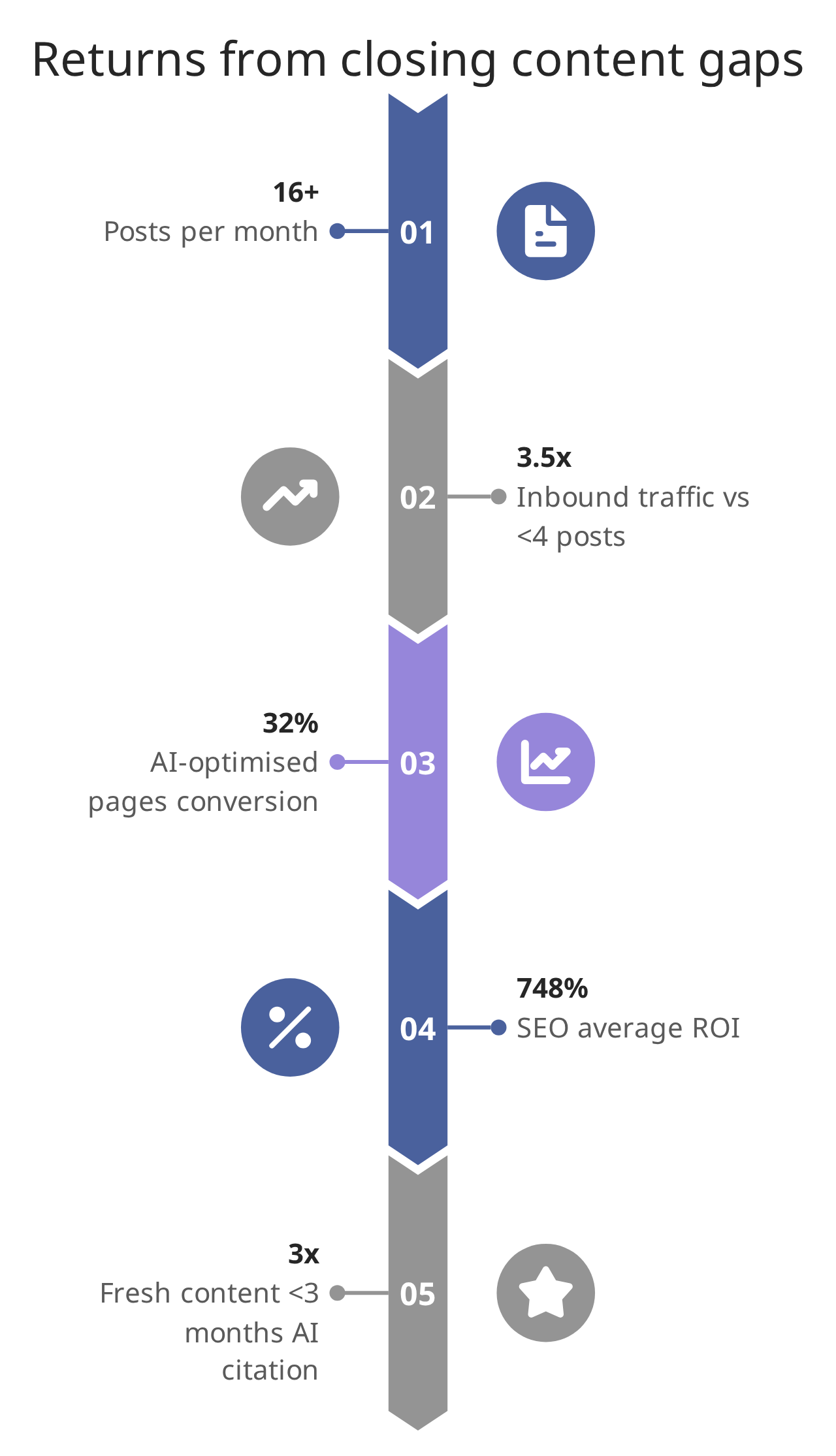
The 2026 benchmarks report by Averi found that content under three months old is three times more likely to be cited by AI agents than older pages.[2] The lesson is maintenance, not churn. Update dates, replace superseded figures, add what changed and keep URLs stable where intent has not shifted.
Manual research misses most of the question space
A skilled consultant might review three to five competitors and about 100 pages in a week of spreadsheet work, as described in HashMeta’s 2025 review of AI gap detection.[4] That pace forces choices: which rivals, which queries, which pages. Whatever falls outside the initial list stays invisible.
Manual lists also under-sample long-tail, question and entity-variant demand — the kind of queries that never surface from the seed terms an analyst starts with.
Where humans narrow the field too early
Manual work usually starts from seed terms an analyst already knows. That introduces three biases:
- Lexical bias: variants with different wording but identical meaning get missed
- Volume bias: low-volume, high-intent questions get filtered out before review
- Format bias: video, checklist or calculator intent gets forced into a blog template
Exploding Topics’ guide to keyword lists shows the starting point well: build, clean and prioritise lists by volume and difficulty.[16] The method is sound for harvesting demand. It was never designed to test whether a topic is completely answered.
What scale changes
AI systems compare hundreds of competitors at once, process millions of queries and cluster by meaning across languages, according to HashMeta’s 2025 assessment.[4] SeobotAI’s 2025 review of AI agents adds that agents can work through Search Console exports to flag high-impression, low-click queries that signal intent mismatch.[7]
In mature niches, most gaps are semantic — missing entities, relations and subtopics — rather than missing exact-match phrases. That share rises where rivals already cover the head terms and compete on completeness.
The high-intent, low-volume opportunity
The queries manual methods discard first are often the ones closest to action: version-specific errors, integration limits, compliance thresholds, migration steps. They show little volume, carry clear intent and rarely attract broad competitors. AI clustering finds them because it groups by task and entity, not by volume band.
A B2B software site — an illustrative pattern, not a client claim — might group 50 such queries (migration errors, permission edge cases, report limits) into four parents under one grandparent. Conversions from those clusters compound because each page answers one job and links to the next step. The gain comes from fit and internal linking, not from any single multiplier.
How AI maps meaning instead of matching strings
AI gap tools do not count words. They place passages in a vector space where similar meanings sit near each other, then look for competitor clusters with no equivalent on your site. Agentive AI Agents’ 2026 guide describes this embedding step as the basis for detecting missing semantic chunks.[15]
That approach finds “missing bridges”: relational sentences that must appear on the page for a retriever to connect concept A to outcome B. LinkedIn’s 2025 overview of AI gap analysis puts it simply: the system reads relations between concepts, not just term overlap.[11]
Vector embeddings and retrieval checks
RAG-style pipelines split pages into chunks, embed each chunk and run nearest-neighbour searches against rival coverage. Where a competitor owns a neighbourhood — for example, “dunning retry logic for SEPA” — and you own nothing nearby, the tool flags a topical hole even if you mention “dunning” elsewhere.
This is why two pages can share keywords and still differ in retrieval. One states relations explicitly. The other implies them.
Clustering by intent, not spelling
Keyword Cupid’s 2025 upgrade added live SERP analysis and finer clusters that group terms by algorithmic intent rather than surface similarity, according to Yahoo Finance sector reporting.[8] NeuralText and similar systems build the same kind of topical silos: one parent intent, many lexical variants, one canonical page per job.
Practical result: “invoice reminder schedule,” “when to send second payment reminder” and “dunning email timing” belong to one cluster. Without clustering, teams publish three thin pages that cannibalise each other. With it, they publish one complete parent with three targeted sections.
Prediction from weak signals
Models trained on forums, social posts, changelogs and news can flag rising tasks before they appear in keyword volumes, as HashMeta reported in 2025.[4] A new API limit, a policy change or a recurring error thread often precedes search demand by weeks. Teams that publish the first complete answer collect the early links and citations that later entrants must displace.
Questions competitors have not answered
People Also Ask trees, support forums and YouTube transcripts reveal phrasing your rivals ignored. Surferseo’s 2025 framework recommends mining PAA trees and Search Console mismatches together: PAA shows the question space, Search Console shows where your page was shown but not chosen.[6] AI agents speed this by grouping thousands of variants into answerable parents.
Which tool method fits which gap type
No single tool covers all five gaps well. Keyword systems supply raw demand. Visibility systems show where AI mentions without citing. Semantic graders judge clarity. The choice depends on the gap you need to close first.
Wellows unifies Search Console data with AI visibility signals to prioritise pages that earn impressions in AI surfaces but lose citations, per its 2025 guide.[1] Search Atlas pairs a Topical Dominance score with Scholar, a semantic grader that assesses clarity and human effort, per its 2025 guide.[13] Semrush’s 2025 AI SEO overview positions AI features as assistants for intent classification and brief building, with human review still required for accuracy.[14]
Match the method to the missing piece
- You lose head terms to known rivals: start with Ahrefs or Semrush keyword-gap exports, then cluster before writing.[5][14]
- You rank but AI cites others: run citation and page-vs-page comparisons in Slate or RivalFlow AI to find the missing data point or explanation.[5]
- Your coverage looks thin in places: visualise structural holes with a knowledge-graph view such as Infranodus.[5]
- Your map drifts: re-cluster quarterly and prune overlaps that split intent.[13]
Read comparisons as methods, not winners
Tool roundups agree on one caution: volume without intent validation produces traffic that does not convert, a point Wellows stresses for gap prioritisation.[1] Madwriter’s 2026 survey of gap software reaches a similar verdict — the differentiator is whether the tool groups by meaning and ties gaps to business fit.[17]
| Gap type | What the tool must do | Example signal to act on |
|---|---|---|
| Keyword gap | Export rival-ranked terms you lack, then filter by intent and fit | Competitor ranks for 40 migration-error queries; you rank for none [5] |
| Topical / semantic gap | Cluster embeddings and map parents to grandchildren | Parent “dunning” has no child on retry timing or SEPA rules [8][10] |
| Citation gap | Compare your page against the cited rival chunk by chunk | Rival supplies sample size and date; your page states only the result [5] |
| Intent / format gap | Classify SERP intent and preferred format before briefing | PAA asks for steps and thresholds; your page offers an opinion post [6] |
From map to published authority
A map becomes authority only when each gap gets one owner, one intent and one measure of done. Surferseo’s five-step sequence — audit, competitor information-gain review, semantic check, prioritisation and briefed production — remains a practical spine.[6] SeobotAI adds the agent layer: let software do the grouping and evidence gathering, keep people for judgment and verification.[7]
Audit against the journey, not the sitemap
Group existing pages by awareness, consideration and decision, then look for thin themes rather than thin pages. Search Atlas’ 2025 guide recommends mapping coverage to journey stages before deciding what to write next.[13] A cluster with three awareness posts and no decision page leaks the demand it creates.
Score each candidate on impact, effort, confidence and fit with current authority, the four weights Surferseo recommends.[6] A low-volume error page that unblocks trials can outrank a high-volume glossary term on expected value.
Brief for retrieval, then verify like a publisher
A strong brief names primary intent, the SERP pattern to match, the unique evidence to add and the schema to include.[6] Draft from multiple independent sources, keep dates and samples attached to every figure and have a subject owner check relations before publishing. Semrush’s 2025 guidance is direct on this point: AI accelerates drafting, people remain responsible for factual accuracy.[14]
- include the definition and its entity relations in the first screen
- add one original element: measurement, test, sample or worked threshold
- mark dates, versions and limits where they affect the answer
- link each grandchild to its parent with descriptive anchors
When closing gaps pays, and what it costs to wait
The 2026 benchmarks report by Averi found that 94% of marketers planned to use AI for content creation in 2026, up from 35% two years earlier.[2] Adoption alone proves little. Output quality and maintenance explain the return.
That same 2026 Averi benchmarks report found that companies publishing 16 or more substantive posts per month generated 3.5 times more inbound traffic than those publishing fewer than four, and that purpose-built content engines cut effective cost per article by 85-95% versus traditional agency production.[2] Onrec’s 2026 review of AI SEO tools reported AI-optimised landing pages converting 32% better than traditional pages.[3] Averi’s 2026 benchmarks also placed SEO first among ROI channels with an average 748% return, ahead of paid social and email.[2]
Read the numbers with care
The traffic and ROI figures come from vendor-adjacent benchmark reports, principally Averi’s 2026 benchmarks.[2] They describe averages across varied samples, not promises for a single site. Weight them below controlled tests, above anecdote. The freshness finding — under-three-month content cited three times as often — fits how retrievers favour current evidence, but it argues for scheduled updates, not daily rewriting.[2]
Pitfalls that erase the gain
- Volume without fit: high-traffic terms outside your entity graph dilute topical dominance.[1][13]
- Thin AI drafts: Scholar-style graders penalise low-effort text that adds no information gain.[13]
- Cannibalisation: without one page per intent, new pages compete with old ones.[10]
- Stale evidence: AI search prefers current data; review citation-winners quarterly.[9][2]
Autoriax offers automated SEO audits including crawl, scoring and reporting, with management for up to 10 brands per account with separate histories. Its methodology is traceable and designed for agencies and freelancers handling gap work across portfolios.
Conclusion
Pick one cluster where losing the answer costs revenue, run a semantic audit against three rivals, brief a single parent plus its missing grandchildren and ship the smallest complete map — then set a 90-day review for freshness, cannibalisation and citation capture. What remains open is measurement: citation share, retrieval visibility and assisted conversions are still settling into standard definitions, and vendors count them differently. Agree those definitions before you scale, or each new report will move the target.
Sources
- [1] How to Use AI to Find Content Gaps for SEO Visibility in 2025 — https://wellows.com/blog/how-to-use-ai-to-find-content-gaps/
- [2] averi.ai — https://www.averi.ai/blog/the-state-of-ai-content-marketing-2026-benchmarks-report
- [3] 10 Best AI SEO Tools to Automate Your Strategy in 2026 — https://www.onrec.com/news/news-archive/10-best-ai-seo-tools-to-automate-your-strategy-in-2026
- [4] How AI Identifies Hidden Topical Gaps in Your Content … — https://hashmeta.com/blog/how-ai-identifies-hidden-topical-gaps-in-your-content-strategy
- [5] 12 Best Content Gap Analysis Tools for AI Search in 2026 — https://slatehq.com/blog/best-content-gap-analysis-tools
- [6] 5-Step Content Gap Analysis: How to Identify and Fill the … — https://surferseo.com/blog/content-gap-analysis/
- [7] AI Agents in SEO: Content Gap Identification — https://seobotai.com/blog/ai-agents-in-seo-content-gap-identification/
- [8] Keyword Cupid Upgrades Its Semantic Keyword Clustering Tool With Live SERP Analysis and Finer Keyword Clusters — https://finance.yahoo.com/sectors/technology/articles/keyword-cupid-upgrades-semantic-keyword-173200745.html
- [9] appinventivdigital.com — https://www.appinventivdigital.com/blog/seo-in-the-age-of-agentic-search/
- [10] Strategic keyword research strategies for a topical map — https://www.pageoptimizer.pro/blog/strategic-keyword-research-strategies-for-a-topical-map
- [11] seoxport.com — https://www.seoxport.com/entity-based-seo-why-structured-knowledge-graphs-matter-more-than-keywords/
- [12] How AI Content Gap Analysis Finds What Competitors Miss — https://www.singlegrain.com/content-marketing-strategy-2/how-ai-content-gap-analysis-finds-what-competitors-miss
- [13] Content Gap Analysis: Full Guide & 5 Best Tools for 2025 — https://searchatlas.com/blog/content-gap-analysis/
- [14] 11 ways to use AI for SEO (+best practices & challenges) — https://www.semrush.com/blog/ai-seo/
- [15] Best AI Content Analysis Tools for Topic Gaps 2026 — https://agentiveaiagents.com/ai-content-analysis-topic-gaps
- [16] How to Build SEO Keyword Lists to Drive Results — https://explodingtopics.com/blog/how-to-make-a-list-of-seo-keywords
- [17] 11 AI Content Gap Analysis Software Tools That Actually … — https://blog.madwriter.pro/ai-content-gap-analysis-software/
Try Autoriax free — no credit card required
Get your first article in minutes. See the research depth before you commit.
Get 3 free articles3 articles free • No credit card • Cancel anytime