· Autoriax · Updated
Personalization at Scale in Automated Content Funnels
Content personalization at scale needs empathy checkpoints: detect strain, branch journeys, and keep humans in control of key moments.

Content personalization now decides whether automated marketing feels helpful or hollow. Most funnels can insert a first name, adjust a subject line, and follow up at the right hour, yet response stays flat. The reason is structural: empathy was treated as wording, not as a decision in the system.
This article argues for a different design. Empathy checkpoints — defined pauses where automation reads emotional and behavioral signals, then selects a different path — turn content personalization from a message layer into an operating rule. Readers will get the psychology behind why some AI content earns shares and some needs proof, how the 2026 funnel splits work between machine and person, and a practical method to add checkpoints without rebuilding the stack.
Content Personalization Fails When Empathy Is Only Tone
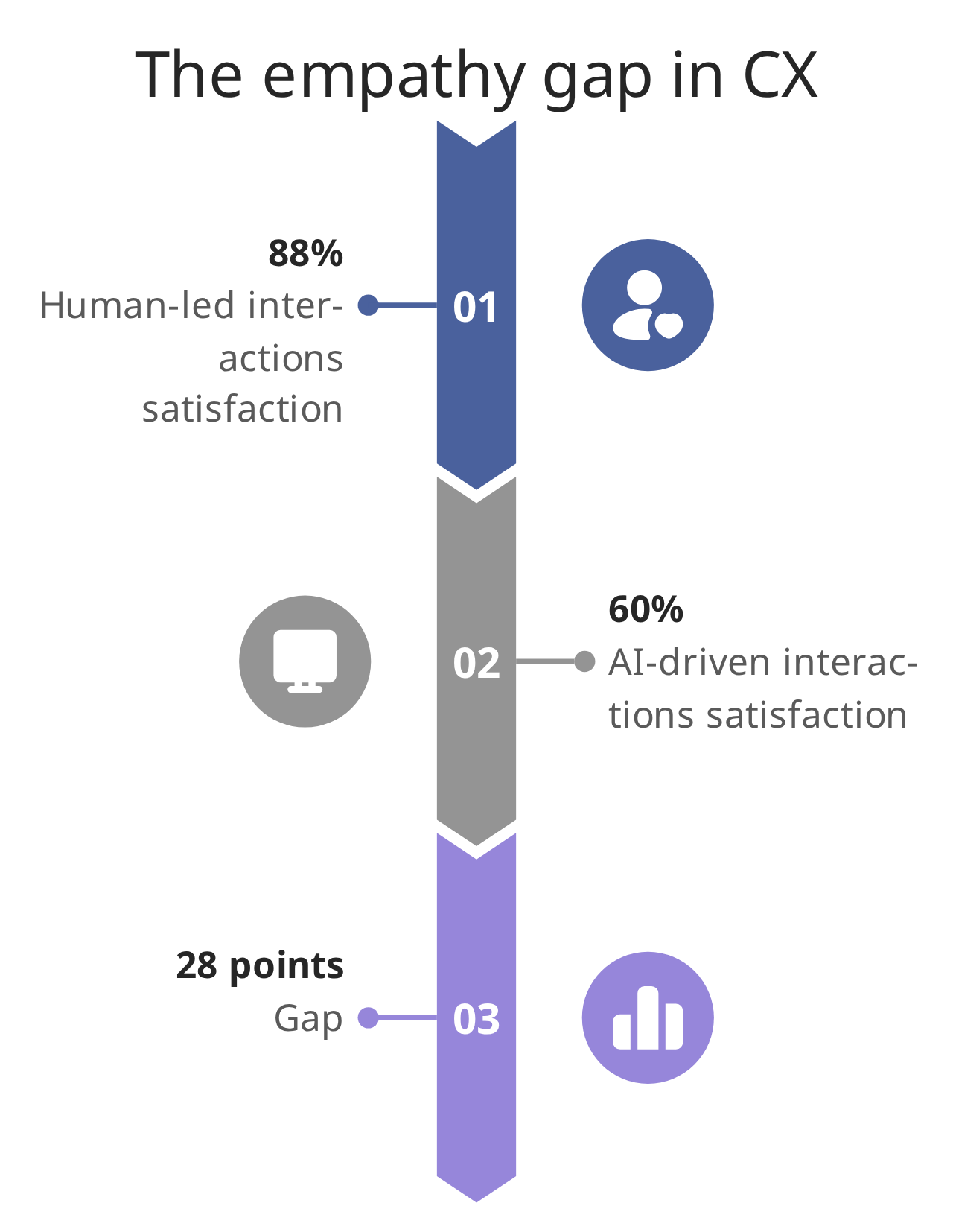
The 2025 Yahoo Finance report on the AI empathy gap found 88% of consumers satisfied with interactions handled mostly or fully by humans, compared with 60% for AI-driven interactions.[23] That 28-point difference explains why efficiency gains inside the team do not translate into trust outside it.
Tone fixes cannot close that difference. A warmer chatbot greeting still follows the same linear sequence. What changes outcomes is a branch: when frustration, confusion, or high stakes appear, the funnel stops pushing and offers a slower, human-shaped alternative.
Three structural shifts support this view:
- From attributes to decisions. Sentiment scores and first-name tokens describe output. A checkpoint decides input to the next step.
- From linear funnels to playgrounds. Author Ashley Faus, in a 2025 interview on human-centered marketing, describes a Content Playground where buyers explore by concept and use case rather than forced stages.[11] People feel recognized when they can choose direction.
- From volume to timing. The 2026 personalization analysis published by involve.me shows coordinated, behavior-driven flows lift response because the message arrives after a signal, not on a schedule.[8]
Why structure beats sentiment editing
Sentiment editing polishes one email. Structure changes which email sends at all. A reader who stalls on pricing after two visits needs a comparison guide or a short call offer, not a more enthusiastic nudge.
Where teams misplace effort
Teams often audit copy and leave logic untouched. Audit logic first: list every automated send, then mark where a negative signal currently has no alternative path.
What a checkpoint does
A checkpoint has one job. It reads a signal, applies a rule, and routes to a fitting next action, including doing nothing for a period.
Content Personalization Value Splits by Functional and Hedonic Paths
The 2025 peer-reviewed study on AI-generated marketing content published in PMC found two distinct routes to engagement: functional value works through cognitive empathy, hedonic value works through affective empathy.[1] In plain terms, useful content asks to be understood, enjoyable content asks to be felt.
The same study reported hedonic value drives higher emotional and behavioral engagement such as likes and shares, while functional content depends more on credibility.[1] Low credibility weakens functional content sharply, while strong hedonic content can sustain engagement even when authenticity questions arise.[1]
That finding sets the first routing rule for content personalization. Do not send both types through identical proof and disclosure logic.
Functional guides need proof to earn action
Tutorials, comparisons, reviews, and how-to sequences persuade when the reader grasps the reasoning. The PMC authors link this effect to cognitive empathy, the capacity to follow another perspective and predicted behavior.[1]
Practical moves:
- Place method, sample size, limits, and date near the claim
- Link to primary materials, not only to summaries
- Keep steps testable, with inputs and expected output stated
Hedonic stories earn shares through felt response
Brand narratives, customer stories, and creative concepts travel when readers mirror the emotion. The PMC study ties this to affective empathy, experiential mirroring of emotional states.[1]
Practical moves:
- Keep one emotional thread per asset
- Use specific detail rather than adjectives
- End with an invitation to respond, not only to click
Frequently Asked: Should AI disclosure differ by content type?
Yes. The 2025 PMC study found a paradoxical effect: disclosing AI origin strengthens functional content by signaling objectivity and logical efficiency, but weakens hedonic content because readers doubt machine emotional depth.[1] The 2025 Tatvic review of AI in marketing reaches a similar caution on disclosure and trust.[4] Label functional drafts clearly; reserve hedonic moments for human authorship or close human revision.
Content Personalization in the Augmented Funnel From Signal to Close
The 2026 Vegavid analysis of AI-human sales collaboration discusses blended teams.[3] The model is described as Centaur: a human seller supported by an AI co-pilot, not replaced by it.[3]
For content personalization, the split is clear. Machines own pattern detection and volume. People own ambiguity, stakes, and repair.
Top of funnel: score intent before you write more
The Vegavid 2026 analysis describes predictive intent scoring across technology changes, hiring moves, and research behavior to surface accounts before they raise a hand.[3] The 2026 Cience review of AI in B2B marketing and the 2025 Vested analysis of automation in sales both point to AI lead scoring as the way to cut data collection time and focus effort on pipeline.[2][10]
Actions that hold up:
- Score across channels, not only form fills
- Suppress low-fit accounts from high-frequency sequences
- Route high-intent topics to deeper assets, not to generic newsletters
Middle of funnel: hand off with context intact
The 2025 Tatvic review and the 2025 CDP.com guide to personalization describe a move from scripted bots to agentic systems that manage multi-step sequences, answer technical questions, and schedule meetings.[4][25] The risk is a cold handoff where history is lost.
Fix the handoff:
- Pass last three behaviors plus inferred goal to the next step
- Use zero-party data from quizzes and preference centers to set the next asset, a practice detailed in the 2026 involve.me personalization analysis and the 2025 CDP.com guide.[8][25]
- Trigger human review when stakes rise: pricing objections, security questions, deadline pressure
Bottom of funnel: let people carry trust
The Vegavid 2026 analysis reserves closing conversations for human judgment around deadlines, internal politics, and trade-offs, with AI providing live conversation intelligence and competitive points in the background.[3] That division matches buyer preference in the empathy-gap data cited above.[23]
Content Personalization Checkpoints: Signals, Paths, and Learning
Checkpoints work when three parts are defined in advance: detection, selection, and learning. Without all three, personalization reacts once and forgets.
Detection reads sentiment and behavior together. Selection chooses among human-written options, AI-generated variants, or a pause. Learning updates the rule based on what happened next.
Detect triggers worth branching on
Use signals the customer knowingly produced, supplemented by observed behavior:
- Explicit signals: quiz answers, preference selections, support tags, reply text
- Behavioral signals: repeat views on one objection, stall after pricing, rapid scroll with no click
- Emotional signals: frustration phrases, confusion loops with a bot, repeated help requests
The 2025 CDP.com guide warns against inferring private life events from passive data; relevance should rest on data the customer supplied or clearly generated in context.[25]
Select the response path by value type and stakes
Build a small library, not an infinite generator:
- Functional stall: send proof asset, checklist, or worked example with sources
- Hedonic opportunity: send human-written story or founder note, lightly edited
- High stakes or distress: offer human contact with stated response time, pause automation for 24 to 72 hours
- Low stakes and clear intent: continue automated sequence
The 2024 MarketingProfs framework for human-ready marketing recommends this division explicitly: assign emotionally complex work to people, delegate routine execution to systems.[17]
Learn after the interaction
Close the loop in the same record:
- Log which path fired and why
- Track recovery, reply quality, and downstream conversion, not only opens
- Retire paths with high opt-out or low resolution
The 2026 involve.me analysis shows why this matters: coordinated cross-channel recovery, such as in-app nudge followed by push at T+2 hours and email at T+24 with social proof, often doubles recovery versus email alone.[8] A subscription brand using a taste-profile quiz reduced churn by 12% by fixing wrong-product fit early.[8] Those gains came from orchestration and memory, not from louder copy.[8]
graph TD
    A[Entry: Behavior + Zero-Party Data] --> B{Empathy Checkpoint: Detect Signal}
    B -->|Functional stall| C[Send Proof Asset + Disclosure]
    B -->|Hedonic opportunity| D[Send Human-Written Story]
    B -->|Distress / High stakes| E[Pause Automation + Offer Human Contact]
    B -->|Clear intent / Low stakes| F[Continue Automated Sequence]
    C --> G[Log Outcome + Update Profile]
    D --> G
    E --> G
    F --> G
    G --> B
Content Personalization for GEO and Answer Search in 2026
The 2025 Tatvic review defines the current search shift as Generative Engine Optimization and Answer Engine Optimization: GEO earns citation in large language model summaries, AEO earns direct answers in featured and voice results.[4] The 2026 Bullseye Internet guide to AI marketing agencies frames the same change as structure-first publishing.[14]
Content personalization must therefore serve two readers: the person and the model that summarizes for the person. Clear headers, direct answers, FAQ schema, and visible author credentials support Google E-E-A-T expectations noted in the Tatvic review.[4]
Structure answers so machines can quote them
- Open sections with the finding, then support it
- Keep one idea per heading
- Add concise definitions for contested terms like GEO and AEO
Keep authorship visible
The Tatvic 2025 review recommends human-guided drafts: AI handles research and first assembly, people add voice, nuance, and fact checks.[4] The DMEXCO analysis of empathetic marketing makes the control point explicit: people must govern AI output where trust is at stake.[6]
Frequently Asked: What should a grandranker review cover on empathy?
A useful grandranker review answers whether the platform supports branching on emotional and behavioral signals, depth of sentiment analysis, and human-in-the-loop controls for high-stakes steps. Include evidence from a trial: which signals triggered which path, and how recovery and opt-out changed.
When Content Personalization Backfires and How to Set Limits
The June 2025 Gartner press release on personalization reports that poorly timed or overly narrow tactics can triple the likelihood of customer regret at key journey points.[24] Automation that overwhelms choice or presses too soon creates second-guessing, not loyalty.
Limits are part of content personalization, not an exception to it. The 2025 Salesforce review of the empathy equation reports 91% of customers are more likely to stay loyal to companies that show understanding and care.[19] Understanding includes restraint.
Avoid robotic persistence
The 2025 IDX guide to AI in digital marketing and the 2025 Vested analysis both note chatbots miss humor, sarcasm, and layered emotion.[5][10] If a customer rephrases twice, route out. Do not send a third paraphrase.
Rules worth writing down:
- Two failed bot turns trigger a human option
- No more than one recovery push per stall without new information
- Every automated apology includes a path to a person and a time window
Avoid surveillance cues
The 2025 CDP.com guide distinguishes relevance from intrusion: use what the customer knowingly shared, not what was inferred about private life.[25] A skincare quiz answer can shape recommendations. A guessed life event should not open an email.
Keep voice consistent across handoffs
The DMEXCO analysis and the Ashley Faus interview both warn that a warm AI voice followed by a distant human reply breaks trust.[6][11] Align templates, names, and response times before adding volume. The 2026 Robotic Marketer trends review and the CustomerThink analysis of empathy at scale in CRM make the same point for lifecycle mail: cadence and tone must match across app, push, and email.[21][15]
Agencies managing multiple clients need audit output that stays traceable across accounts. Autoriax offers automated SEO audits including crawl, scoring and reporting, with management for up to 10 brands per account with separate histories and reports in 6 languages with one-click PDF export.
Conclusion
Start with one funnel and three checkpoints: a functional stall that routes to proof, a distress signal that pauses automation and offers a person, and a preference moment that stores zero-party data for the next step. Assign owners, write the branch rules in plain language, and review recovery and regret signals weekly.
What remains open is measurement. Perceived empathy shapes response, but teams still lack shared thresholds for when to pause, when to disclose AI origin, and when a human-written line outperforms a generated variant. Treat those thresholds as research questions inside your own data, tested path by path, rather than settled defaults.
Sources
- [1] Value-dependent and empathy-mediated: how artificial intelligence-generated marketing content influences customer engagement, and when to disclose its origin — https://pmc.ncbi.nlm.nih.gov/articles/PMC12829478
- [2] 8 Ways AI Transforms B2B Marketing (2026) — https://www.cience.com/blog/artificial-intelligence-in-b2b-marketing/
- [3] Blending AI Assistance with Human Sales Efforts in 2026 — https://vegavid.com/blog/ai-human-sales-collaboration
- [4] How AI Is Reshaping Marketing in 2025: Trends, Tools & … — https://www.tatvic.com/blog/ai-in-marketing-2025-trends-tools-tactics/
- [5] How to Use AI in Digital Marketing (Without Losing the Human Touch) – IDX — https://www.idx.inc/newsroom/how-to-use-ai-in-digital-marketing
- [6] Empathetic marketing: Why we need people to control AI — https://dmexco.com/stories/empathetic-marketing-why-we-need-people-to-control-ai
- [8] involve.me — https://www.involve.me/blog/marketing-personalization-statistics
- [10] AI vs. Human Touch: How to Blend Automation with Personalization in Sales — https://www.vested.marketing/blog/ai-blending-automation-with-personalization-in-sales
- [11] Human-Centered Marketing in an Automated World | Ashley Faus — https://thoughtleadershipleverage.com/human-centered-marketing-in-an-automated-world-ashley-faus
- [14] AI Marketing Agency Guide: Strategies for 2026 — https://bullseyeinternet.com/ai-marketing-agency-complete-guide/
- [15] customerthink.com — https://customerthink.com/how-empathy-at-scale-will-redefine-crm-customer-experience-in-2026/
- [17] ‘Human-Ready Marketing’: The Power of Human-AI Synergy — https://www.marketingprofs.com/articles/2024/52051/human-ai-marketing-collaboration-human-ready-marketing-organization
- [19] The Empathy Equation: How AI Can Make Marketing More Human - Salesforce — https://www.salesforce.com/eu/blog/how-ai-can-make-marketing-more-human
- [21] roboticmarketer.com — https://www.roboticmarketer.com/personalization-at-scale-ai-marketing-trends-for-2026/
- [23] AI and the Empathy Gap: Finding the Balance between AI and Human First Customer Experience — https://finance.yahoo.com/news/ai-empathy-gap-finding-balance-130000732.html
- [24] gartner.com — https://www.gartner.com/en/newsroom/press-releases/2025-06-03-gartner-survey-reveals-personalization-can-triple-the-likelihood-of-customer-regret-at-key-journey-points
- [25] cdp.com — https://cdp.com/articles/what-is-driving-the-future-of-personalization-in-digital-marketing/
Try Autoriax free — no credit card required
Get your first article in minutes. See the research depth before you commit.
Get 3 free articles3 articles free • No credit card • Cancel anytime