· Autoriax · Updated
Why Your AI Content Needs a Human Editor
Raw AI drafts fail Google's helpful content test. Learn the human editing gate for facts, experience, and intent that protects rankings.

AI can produce a draft in seconds. That speed has changed publishing, and it has also changed what ranks. Readers now skim past generic text, and search systems discount it. The fix is not to abandon AI, but to place a person in charge of what it claims. This article shows where that oversight matters most, with a repeatable way to turn a machine draft into helpful content that earns trust.
A site that publishes unchecked output trades short-term volume for long-term risk. Google rewards pages built around real use, verified facts, and a clear reader task. The sections below explain how that standard took shape, why raw drafts fail it, and what editors should change first.
The AI Content Paradox: Volume Is Now a Liability
Reporting by aibusinessweekly.net found that nearly all marketers now use AI in content workflows, while trust in raw AI output remains very low and only a minority report a mature strategy.[10] Adoption is near universal. Confidence is not.
That gap defines the paradox. When anyone can publish 50 pages overnight, publishing more proves nothing about knowledge.
From Adoption to Trust Collapse
The flood of similar articles trained readers to spot filler. Vague advice, repeated definitions, and confident errors make people leave. Editors regain confidence by cutting claims that lack proof and adding detail only someone close to the work would know.
The Strategic Gap
Most teams have a tool, not a process. A mature workflow names who verifies facts, who checks intent, and who signs off. Without those gates, errors compound across dozens of URLs.
How Google Judges AI Text Now
Google’s February 2023 guidance on AI-generated material said method does not decide quality; pages made mainly for search violate spam policy even if a person typed them.[19] That rule still anchors how the core ranking system treats machine text.
The wording moved in late 2023 from “written by people” to “created for people,” as documented by analysts covering the September 2023 revision.[15] In March 2024 the separate quality system was folded into core ranking, so every core update now weighs page quality.[5] Reporting on that integration cites a substantial reduction in low-quality, unoriginal results by early 2026.[5]
The Created-for-People Shift
The test is outcome, not origin. A page must solve the query, show its work, and reflect E-E-A-T: expertise, experience, authoritativeness, and trustworthiness.[1] Google Search liaison Danny Sullivan put the same point in plainer terms in a 2022 interview with Business Insider, advising teams to write for readers first.[20]
Integration Into Core Ranking
Because the check lives in core ranking, there is no quiet period between updates. Thin sections can suppress a whole directory, including stronger pages nearby.[5] Consistency matters more than one-off cleanup.
Why Raw AI Drafts Fail in Search
Analysis published by ClickRank in 2026 describes raw LLM output as mathematically average: fluent and far faster than human drafting, yet repetitive and short on new insight.[7] Speed is real. Originality is not automatic.
Google’s SpamBrain system looks for scaled abuse, where large sets of low-value pages target queries without adding value.[7] A second filter is behavioral. When visitors bounce back to results, that pogo-sticking tells the system the page did not help.[7]
Algorithmic Suppression and SpamBrain
SpamBrain detects template patterns across sites, a point also made in Google’s 2023 guidance on scaled abuse.[19] Site-wide effects follow. One batch of filler can pull down the visibility of solid pillar pages until the low-value URLs are improved or removed.[7]
The Information Gain Deficit
If a draft only restates the current top three results, it adds no information gain. Editors pass that test by contributing something the sources lack:
- a result from a test you ran
- a number from your own records, with method noted
- a constraint or exception learned on the job
- a decision rule for when not to follow generic advice
Experience Is the Moat Humans Hold
Google added Experience to E-A-T in December 2022, a change covered by Jasper’s summary of the guidelines and by SemiHuman’s 2026 review.[1][12] The extra E asks whether the writer has used, tested, or handled the subject.
A model can describe a brake-pad change. It has never felt a seized caliper bolt or heard a customer describe fade on a descent. That difference shows in specifics.
What Experience Means for Google
Pages that reflect direct involvement rank more reliably for task-based queries, according to ClickRank’s 2026 optimization review and DEV Community tracking data.[7][3] Show the work: conditions, tools, sample size, what failed.
Where to Insert Experience Signals
Place proof where doubt is highest, not in a separate bio box:
- Intro: one line on hands-on context for the task
- Steps: notes on what went wrong and the workaround
- Media: original photos, screenshots, or short clips with captions
Consider a small auto-parts retailer. Raw draft: “Replace brake pads regularly for safety.” Edited version: “On a 2018 hatchback with 62,000 miles, the inner pad wore to 2 mm while the outer still showed 5 mm; the slider pin had seized, so cleaning and re-greasing the pins was part of the job.” The second version carries weight because it could only come from the bay.
What Six Months of Tracking Shows
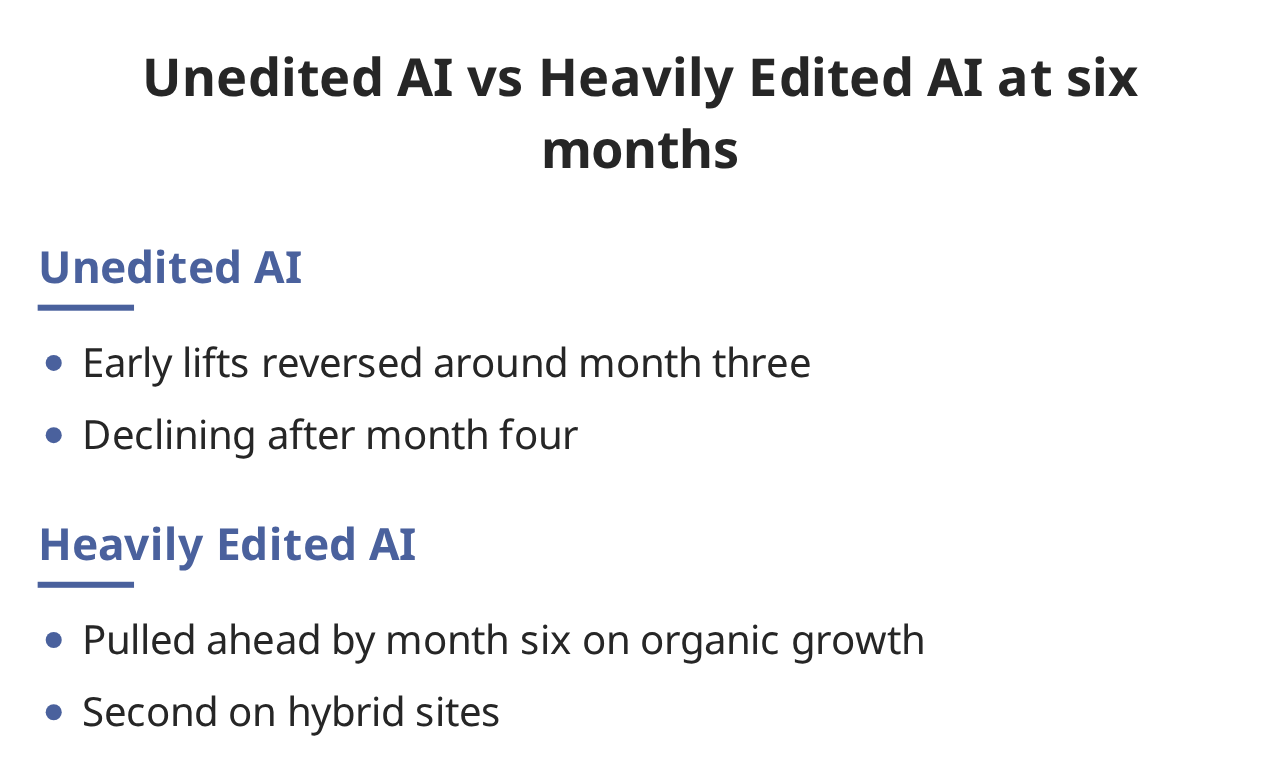
One practitioner’s multi-month tracking of client sites in the UK, US, and Canada, reported on DEV Community, found heavily edited AI drafts pulling ahead of minimal-edit AI over time on organic growth.[3] Human-written pages still led on hybrid sites, with heavily edited AI second and minimal-edit AI declining.[3]
Early lifts from untouched AI often reversed around month three as stronger pages consolidated and weaker duplicates lost visibility.[3] The author attributed the gap to specificity: grounded scenarios and original analysis held, generic summaries faded.[3]
The Volatility of Unedited AI
Unedited batches behave like a sugar rush. A few URLs spike, then sink together when quality signals catch up. Internal competition makes it worse, with near-duplicate AI pages splitting clicks until one cannibalizes the rest.[3]
The Winning Formula: Human-Heavy Editing
Winners kept the AI skeleton and replaced the substance. They added measurements, tightened steps to match the query, and removed assertions without support.
| Tier by month four to six | Typical pattern | Why it moved |
|---|---|---|
| Human-written | Stable or growing | First-hand detail, clear intent match |
| AI draft + heavy edit | Steady growth, best AI tier | Specifics and verification added [3] |
| AI draft + light edit | Decline after early spike | Repetition, no new value [3] |
The Human Editing Checklist That Holds Quality
The editor’s job has shifted from polishing sentences to supervisory control, a term used in writing on human-in-the-loop systems on Medium to describe validation before release.[18] The single most important edit is not grammar. It is the removal of unhelpful assertions — confident claims with no evidence, no source, and no first-hand basis — because those claims directly fail the people-first test.
Treat every draft as unproven until it clears verification, intent, and voice.
Verification and Fact-Checking
Models hallucinate dates, specs, and citations with calm certainty.[7] Reporting by Business Insider on professional AI editors stresses the same habit: check every number and name before it ships.[13] Replace invented references with sources you opened yourself.
Stripping Filler and Tightening Style
Raw output leans on padding and stock openers. Cut throat-clearing, shorten sentences, and trade abstractions for measurements. Aim around Grade 8 readability for B2B readers to lift skimmability and time on page.[7]
- Delete claims with no evidence, source, or first-hand basis
- Verify each stat, date, and name against a primary source you opened
- Rewrite intro and conclusion to state reader task and next step
- Swap generic wording for specific facts, numbers, or observed cases
- Align headings and format to query intent; keep paragraphs short
- Cover missing subtopics, add real links, merge thin duplicates
Fact-Checking and Source Verification: The Gate You Cannot Skip
Workload data from Wikipedia editors, reported by Yahoo Finance in 2024, shows a rise in AI filler and hoaxes that lack proper sourcing and increase review time.[14][22] The pattern travels: plausible text, missing provenance.
Editors need a fixed routine, not spot checks. Open the cited page. Confirm the figure still exists. Note access date for fast-changing topics.
The Hallucination Problem
Hallucination is not lying; it is prediction without grounding.[7] Cross-check specs, prices, and rules against makers, regulators, or primary datasets. If two secondary sources conflict, cite the primary one and note the disagreement.
Fake References and Citations
AI often invents authors, DOIs, or URLs that look right.[13] Search the title in quotes, verify the outlet, and drop anything you cannot open. One verified source beats five decorative ones.
Stripping the Synthetic Fingerprint
Readers sense machine texture before they can name it: long windups, balanced triplets, and hedged generalities. Business Insider’s interviews with working editors recommend the same cure — concrete detail over adjectives.[13]
Take a before-and-after from a support article:
- Before: “In many cases, organizations experience various benefits from regular maintenance.”
- After: “After moving oil checks to every 5,000 miles, our van fleet logged two fewer roadside calls in one quarter.”
The second sentence can be checked, challenged, or trusted. The first cannot.
Adding Specificity and Anecdotes
Swap categories for instances. Name the model year, mileage, tool, or error code. A short aside on what surprised you gives the page a memory, which models cannot supply.
Readability Adjustments
Short paragraphs, plain verbs, and defined terms help scanning. Use bold for takeaways, lists for steps, and tables for comparisons. Cut any sentence that restates the heading.
Matching Intent and Structure for Readers
ClickRank’s 2026 review notes a common miss: the query asks for steps and the draft delivers history.[7] Google’s guidance on people-first pages makes the same demand — match format to task.[19] Decide intent before you edit: learn, compare, or do.
Aligning With Search Intent
Label the job in the intro. “Replace front pads in about 90 minutes” signals a guide. “Pads vs. rotors: costs and signs” signals comparison. Restructure so headings answer the next question a reader would ask.
Formatting for Skimmability
Job-post listings for AI-content editors on Indeed now list formatting as core work: headers, bullets, and tight summaries for scan readers.[4] Keep H2s as answers and H3s as steps or cases. Front-load each section with its result.
Frequently Asked: Should we publish AI drafts with light proofreading?
No. Light proofreading leaves invented facts, vague advice, and intent mismatches in place. Publish only after verification, specificity, and intent checks pass.
Rewriting Openings and Closings for People
Openings and closings decide whether a page feels made for a reader. Models often open with filler and close with a summary of the summary. Rewrite both so purpose is explicit.
A people-first intro names the problem, the reader, and the payoff in two sentences. A people-first ending names the next action and its limit.
The Introduction Hook
Start with the task, not the topic. State who this helps and what they will be able to do. Avoid stock windups about speed or change.
The Conclusion Call to Action
End with a decision. List what to do, what to watch, and when to seek a pro. Keep it brief enough to act on without rereading.
Building Topical Authority Without Bloat
Cyrus Shepard’s 2025 analysis on LinkedIn describes how core topicality systems assess whether a site shows sustained depth on a subject.[17] Hundreds of thin posts on a new theme read as opportunism, not authority.[17]
Depth beats count. Cover subtopics a practitioner would expect, link them sensibly, and prune overlaps.
Building Topical Clusters
Group related pages around a tested pillar. Link from the pillar to detail pages and back with descriptive anchors. Add entities and related terms naturally as you explain procedures, parts, and failure modes.[7]
Avoiding Keyword Cannibalization
When two drafts chase the same query, differentiate or consolidate. Keep the stronger URL, fold unique details into it, and redirect the weaker one. Fewer, fuller pages consolidate signals instead of splitting them.
The Gamble of Hands-Off Automation Tools
Readers comparing automation tools want to know whether hands-off publishing can rank. The short answer from the evidence above is no — any tool used without an editorial gate is a quality gamble.
Thin batches invite scaled-abuse flags and manual review under Google’s spam policy for search-first content.[19] Google’s own guidance on quality principles stresses original value and clear sourcing over volume.[19] Use automation for research assembly and first drafts, then apply the checklist before anything goes live.
Risk Assessment Framework
Score each planned batch on three questions:
- Experience need: Does the task require hands-on proof? If yes, assign a practitioner.
- Harm potential: Could an error cost money, safety, or compliance? If yes, require primary-source verification.
- Overlap risk: Does a stronger page already target the query? If yes, improve it rather than adding a rival.
Low on all three can move fast with one reviewer. High on any one needs testing, photos, or expert sign-off.
Teams that already run editorial checks often pair them with automated SEO audits including crawl, scoring, and reporting to catch thin pages early, and Autoriax offers that audit workflow for agencies managing up to 10 brands with separate histories. Reports export to PDF in six languages, which helps distributed teams act on the same findings.
Conclusion
Put one owner on every AI draft, give that person veto power, and track outcomes by cohort rather than by anecdote. Measure bounce-back, assisted conversions, and citation in answer features over two quarters. What remains open is how answer engines will weight provenance as training data shifts, and which proof formats — test logs, signed reviews, structured data — they will trust most. Build for verification now, and that future favors you.
Sources
- [1] New Google AI Content Guidelines — https://www.jasper.ai/blog/google-ai-content-guidelines
- [3] How Google’s helpful content update actually treats AI articles: 6 months of data - DEV Community — https://dev.to/rahulseo/how-googles-helpful-content-update-actually-treats-ai-articles-6-months-of-data-4oi4
- [4] SEO Content Writer/Editor (Edit AI-Generated Content) - New York, NY - Indeed.com — https://www.indeed.com/viewjob?jk=2430f7bb65c6dd0f
- [5] Understanding Google’s Helpful Content Principles in 2026 — https://www.mightyroar.com/blog/helpful-content-update
- [7] How to Optimize AI-Generated Content to Pass Google’s Update 2026 — https://www.clickrank.ai/optimize-ai-generated-content-helpful-update
- [10] aibusinessweekly.net — https://aibusinessweekly.net/p/ai-content-creation-statistics
- [12] Google’s Helpful Content Update: SEO Authenticity in 2026 — https://www.semihuman.ai/blog/helpful-content-update-seo-2026
- [13] I Made Over $3,500 Editing AI-Generated Content. Here’s How to Spot AI Writing. - Business Insider — https://www.businessinsider.com/ai-generated-content-editor-shares-tips-2024-2
- [14] How AI-generated content is upping the workload for Wikipedia editors — https://finance.yahoo.com/news/ai-generated-content-upping-workload-112634302.html
- [15] What changed with Google’s September 14, 2023 helpful … — https://www.mariehaynes.com/sep-14-helpful-content-system-update/
- [17] How Google’s Helpful Content System downgrades “SEO- … — https://www.linkedin.com/posts/cyrusshepard_googles-helpful-content-system-now-part-activity-7318882316993339392-NduX
- [18] medium.com — https://medium.com/@DigitalDivideData/the-evolution-of-human-in-the-loop-in-ai-and-machine-learning-e7f6a60480c0
- [19] Google Search’s guidance about AI-generated content — https://developers.google.com/search/blog/2023/02/google-search-and-ai-content
- [20] Google Search Exec Shares Advice for With ‘Helpful Content’ SEO Update - Business Insider — https://www.businessinsider.com/google-search-danny-sullivan-advice-helpful-content-update-seo-2022-8
- [22] How AI-generated content is upping the workload for Wikipedia editors — https://finance.yahoo.com/news/ai-generated-content-upping-workload-112634360.html
Try Autoriax free — no credit card required
Get your first article in minutes. See the research depth before you commit.
Get 3 free articles3 articles free • No credit card • Cancel anytime