· Autoriax · Updated
Optimizing Content for AI Answers & Voice Search
Learn search everywhere optimization for AI answers and voice: GEO tactics, structure, platforms and citation tracking.

Search has fragmented. The question is no longer how to rank in one list, but how to be cited as the answer wherever discovery starts. Search everywhere optimization responds to that shift: users now begin on TikTok, YouTube, Amazon, Reddit, ChatGPT and voice assistants as often as on Google.
For content teams, the change is practical. AI Overviews and chatbots synthesize responses instead of listing pages, voice assistants read one answer aloud, and social platforms rank captions like keywords. This article shows what that means and how to structure content so machines can parse it and people trust it, from Generative Engine Optimization to conversational voice queries.
The most useful answer comes early: treat content as data. State a clear claim, support it with evidence only you can provide, and add context that explains why it matters. That pattern earns citations because answer engines need verifiable, self-contained passages, not keyword lists.
1. The Search Revolution: From Blue Links to AI Answers
The core finding is simple: synthesis replaced listings. Traditional engines are evolving into logic engines that prioritize synthesized answers, verifiability and contextual clarity.
Google still commands approximately 91% of global search traffic, according to 2026 coverage by Jim Bader Consulting.[2] Yet behavior around that share has changed. Discovery now starts across social, video, AI tools and marketplaces, a pattern documented in 2026 coverage by Addlly AI.[3]
The Decline of the 10 Blue Links
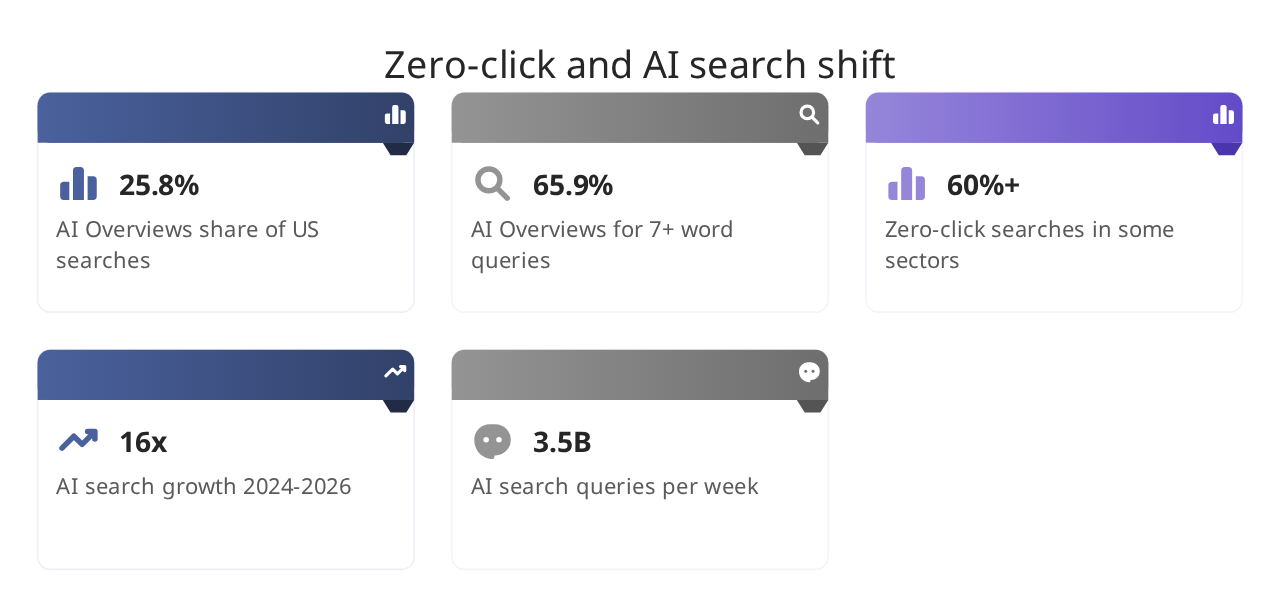
The classic type-query-click-link model is fading. Analysis cited in 2026 coverage by WebFX found approximately 25.8% of U.S. searches now trigger AI Overviews, rising to 65.9% for informational queries of seven words or more.[4]
In many categories a large share of Google searches now end without a click, because AI summaries satisfy the query on the page. Click-through on broad informational queries dropped, but the remaining clicks carry higher intent.
The Rise of Answer Engines
ChatGPT, Perplexity, Claude and Google’s AI Mode turned search into conversation. The 2026 GeoAura guide reports AI search traffic grew 16x between 2024 and 2026, with platforms now processing over 3.5 billion queries per week.[5]
These systems use retrieval-augmented generation to pull real-time web information. Ranking matters less than citability: can a model lift a clean passage and attribute it to you?
2. Understanding Search Everywhere Optimization (SEO 2.0)
Search everywhere optimization is visibility across all search touchpoints, not position on one results page. Coverage by Workshop Digital in 2026 defines it as a holistic strategy to reach audiences across the full spectrum of digital environments.[6]
The goal is to be cited as a source in AI answers, played aloud by assistants, found in TikTok search, and chosen on marketplaces. Each surface has its own ranking logic, but all reward clarity and evidence.
Defining SEO 2.0
SEO 2.0 keeps technical SEO fundamentals — crawlability, speed, structured data — and adds layers for AI, voice, social and marketplace retrieval. Analysis by Qtonix in 2026 frames it as the big shift from single-engine optimization to platform-native optimization.[7]
In practice, one idea needs several forms: a deep article for Google, chunked passages for chatbots, a captioned short video for TikTok, a transcript for YouTube.
Why Traditional Keyword Lists Fail
Keyword density does not explain entities to a model. AI engines prioritize entity clarity, relationships and context over isolated terms — the same move from keyword lists to meaning that topical maps use to find the content gaps humans miss.
Users also ask differently. They speak full questions with intent, location and constraints, not two-word fragments. Content built around fragmented keywords misses that conversational query.
3. The New Search Paradigm: GEO and AEO
Two disciplines carry most of the new work: Generative Engine Optimization for LLM citations and Answer Engine Optimization for direct answers. Both require a content-as-data mindset.
GEO makes content extractable for large language models. AEO makes it liftable for snippets and voice responses. Together they replace the old focus on density with information gain and structure.
Generative Engine Optimization (GEO)
GEO targets ChatGPT, Perplexity, Gemini and similar systems. It focuses on information gain, citation optimization and entity authority rather than keyword repetition.
That means original data, clear definitions of who you are, and passages a model can quote without rewriting. Provenance — who wrote it and why they know — counts.
Answer Engine Optimization (AEO)
AEO structures content so it can move unchanged into featured snippets, assistant replies and AI summaries. Guidance published by Cralite in 2026 recommends concise, front-loaded answers that machines can interpret.[8]
Tactically, this is question headings followed by immediate 40-60 word answers, tables for comparisons, and schema that labels the answer type.
4. Key Platforms for Search Everywhere Optimization
No single channel covers intent. Success in 2026 requires presence across five categories: AI chatbots, social and video, marketplaces, forums, and voice assistants.
Intent varies by surface:
- AI chatbots: research and synthesis
- Social/video: discovery and demonstration
- Marketplaces: purchase
- Forums: validation by peers
- Voice: immediate action, often local
| Platform type | User intent | What ranks |
|---|---|---|
| ChatGPT, Perplexity, AI Mode | Explain and compare | Clear chunks, citations, entities |
| TikTok, Instagram, YouTube | Show me quickly | Captions, hashtags, transcripts |
| Amazon, Etsy, eBay | Buy now | Titles, attributes, images, reviews |
| Reddit, Quora | Is it trustworthy? | First-hand detail, specificity |
| Siri, Alexa, Assistant | Do it near me | Concise answers, local data |
AI Search Engines and Chatbots
These tools retrieve live pages, then generate. Content must serve both machine consumption and human value, with definitions, steps and data clearly separated.
Allow retrieval bots in robots.txt, including OAI-SearchBot, Claude-SearchBot and PerplexityBot, as recommended in 2026 guides by GeoAura and Cralite.[5][8] Blocking them removes you from real-time answers.
Social Media and Video Platforms
Social is now a search starting point. Research cited in 2026 coverage by DigitalGuider found approximately 40% of Gen Z users turn to TikTok or Instagram first when looking for answers.[9]
YouTube, the second-largest search engine globally, acts as an intent powerhouse for how-to content, noted in 2026 coverage by Workshop Digital and Jim Bader Consulting.[6][2] YouTube is also among the most-cited domains in Google AI Overviews, which is why video earns a place in a search-everywhere plan.
E-commerce Marketplaces and Forums
High-intent buyers skip Google for Amazon or Etsy. Optimize titles, attributes, detailed descriptions and visuals natively; do not paste blog copy into listings.
For validation, buyers seek peers. Google data cited in 2026 coverage by DigitalGuider shows over 100 people add the word Reddit to searches every second to find peer-driven insights.[9] Specific experience beats generic claims there.
5. Optimizing for AI Answers: The Claim-Evidence-Context Framework
AI citations favor passages that make a verifiable point in one place. The Claim-Evidence-Context pattern does that: claim first, then supporting evidence, then why it matters.
A claim without evidence is ignored. Evidence without context cannot be placed in a generated answer. Together they form an atomic unit a model can quote intact.
What is Claim-Evidence-Context?
- Claim: one sentence, no hedge. What is true?
- Evidence: data, quotation, example or citation that proves it.
- Context: scope, limitation and implication. When does it apply?
Example structure: “Voice queries skew local. Over half carry local intent. For stores, that means accurate hours and categories outweigh blog volume.” Each sentence has a job.
Implementing the Framework
Start every H2 and H3 with the finding, not a preview. Follow with 1-2 sentences of evidence, then context. Keep each unit self-contained so it can stand alone when retrieved — there is no magic word count, and Google has said no special formatting is needed to appear in AI Overviews; write for clarity, not a supposed block size. Our companion guide on SEO content strategies for generative search covers the same ground in more depth.
Reinforce with schema: Organization, Person and Product to label who claims what.
graph TD
    A[Claim: clear finding] --> B[Evidence: stats, quotes, citations]
    B --> C[Context: scope and implication]
    C --> D[Atomic Unit: self-contained passage]
    D --> E[Markup: schema + headings]
    E --> F[Retrieval: RAG chunking]
    F --> G[Citation in AI Answer]
    B --> H[Provenance: author entity]
    H --> G
6. The 9 Proven GEO Strategies for AI Visibility
The Princeton/IIT Delhi study on generative visibility, as summarized in the 2026 GeoAura guide, tested additions that improve how often models cite a page.[5] Quotations, statistics and better fluency led the gains.
The lesson is not to stuff all nine tactics onto one page. Add the one your passage lacks: no expert voice, no number, or no source.
Top Strategies: Quotations, Statistics, and Citations
- Expert quotations add a 41% lift in visibility, per the Princeton/IIT Delhi findings summarized by GeoAura in 2026.[5]
- Original statistics add a 33% lift in the same study.[5]
- Inline citations to authoritative sources add a 28% boost, also reported in 2026 guides by GeoAura and DigitalPolygon.[5][10]
Use real numbers you measured or direct quotes you collected. Models cite what they cannot generate themselves.
Fluency and Unique Perspective
Improving flow and readability contributed a 29% lift in the Princeton/IIT Delhi results cited by GeoAura.[5] Short sentences, consistent terms and clean grammar help models parse.
More important is non-commodity perspective. Guidance cited in 2026 coverage by WebFX stresses original research and first-hand experience over summaries of common knowledge.[4] If the model already knows it, it will not cite you for it.
7. Content Architecture for AI Retrieval
AI favors three structural levels: comprehensive documents, self-contained chunks, and visual emphasis that signals what to quote. Get all three right and one article can serve Google, chatbots and voice.
Length alone does not win. Depth with clear hierarchy does, because it gives models more precise passages to choose from.
Macro-Structure: Comprehensive Documents
Aim for deep, comprehensive coverage with a clear H2/H3 hierarchy. Cover the entity, its variants and its relationships, not just one keyword.
Replace loose topic clusters with entity hubs that link brand, authors and concepts. Consistent naming across pages helps models resolve who is who.
Meso-Structure: Self-Contained Passages
Write each passage so it answers one sub-question on its own, with its own mini-claim and evidence. There is no target word count to hit; the point is that a passage lifted out of the page still makes sense.
Avoid cross-references like “as noted above.” A retrieved passage travels alone; it must make sense without the rest.
Micro-Structure: Visual Emphasis
Use bold for key terms, bullets for parallel items, and callouts for numbers. This micro-emphasis signals cite-worthy data to crawlers and skimmers alike.
Keep terminology identical across text, captions and transcripts. Multimodal guidance published by Verseodin in 2026 notes models now process text, image and audio together and match entities across modalities.[11]
8. The Importance of Non-Commodity Content
Models absorb commodity content and cite non-commodity content. If a passage restates what is widely known, the answer uses it without attribution. If it adds proof, it earns the link.
The 2026 WebFX summary of Google guidance makes the same point: offer insights AI cannot generate on its own.[4] That is the filter for what to publish.
What is Commodity Content?
Generic definitions, widely known facts and rewritten summaries. They may rank briefly, but they rarely get cited because they add no information gain.
Signs you wrote commodity content: no named source, no date, no method, no trade-off, no example with specifics.
How to Create Non-Commodity Content
- Publish small original data: counts, tests, before-after observations with method.
- Share case detail: what changed, for whom, under what constraints.
- Take a position the evidence supports and note what it does not show.
- Quote practitioners by name with role and context.
Research cited by GeoAura in 2026 found over 34% of AI citations go to sites with Domain Authority below 40, because retrieval rewards passage relevance over domain age.[5] Specificity beats authority when the passage answers better.
9. Optimizing for Voice Search: The Conversational Shift
Voice is not typed search spoken aloud. Queries are longer, question-shaped and action-oriented, and assistants read one concise answer.
Voice is a meaningful and growing slice of how people search, and voice queries behave differently from typed ones: they are longer, phrased as full questions, and more often action-oriented, since someone asking aloud is frequently mid-task rather than browsing.[13]
Frequently Asked: How long should a voice answer be?
Provide a 40-60 word answer immediately after a question heading, as recommended in 2026 guides by Cralite, Webflow and Buckley Planet.[8][14][15] That length reads cleanly aloud and fits snippet extraction.
Local SEO and Voice Intent
Over half of voice searches have local intent, according to 2026 guidance by Dageno AI.[13] Users are often moments from a purchase and ask “near me” or “open now.”
Highest-return actions: keep Google Business Profile hours, categories and photos accurate, and add LocalBusiness and Speakable schema. Use natural phrasing in headings, not keyword fragments.
10. Case Study: Earning AI Citations with Claim-Evidence-Context
A travel publisher restructured destination guides that ranked but were rarely cited. Each guide was rewritten into atomic units: claim about best time, cost or route, followed by evidence and context.
The restructuring process focused on parsing, not prose. Editors removed throat-clearing intros, split long sections into single-question chunks, added author bios with local expertise, and labeled FAQs with schema.
The Restructuring Process
- Each section opened with the finding, then stats or quoted operators, then limitations.
- Images kept consistent place names across alt text, captions and video titles.
- Retrieval bots were verified as allowed; transcripts were added for embedded video.
Results and Takeaways
Citations from ChatGPT and Perplexity increased, and AI-referred visits showed stronger intent than broad informational clicks. The same pattern shows up at larger scale: cited AI traffic can convert at higher rates than standard search visits because the model pre-qualifies the need — our guide to measuring ROI in zero-click discovery shows how to track it.
The takeaway transfers: one well-structured post that proves a point earns more than ten summaries.
11. Evaluating Tools: GrandRanker and Beyond
Search Console shows impressions for “grandranker reviews” without clicks, which means users want an independent read before trying a tool. There is little public documentation to review, so evaluate it like any AI visibility tool: by what it changes in your content, not by its claims.
Do not buy for a score alone. Buy for better entities, cleaner chunks and trackable citations.
What is GrandRanker?
In search demand, GrandRanker appears as a tool users associate with AI search visibility and reviews. Public detail on methodology and coverage is thin, so treat vendor pages as starting points and verify with your own tests.
If you trial it, run it on two comparable pages and leave one as control. Measure citation presence in ChatGPT, Perplexity and AI Overviews, not just rank movement.
How to Evaluate AI SEO Tools
- Structure support: does it enforce question headings, chunk length and schema?
- Entity clarity: does it map brand, authors and topics consistently?
- Source credibility: does it prompt for quotations, data and inline references?
- Citation tracking: does it monitor brand mentions and AI citations across engines, as discussed in 2026 coverage by Ahrefs’ Tim Soulo?[16]
- Workflow fit: can exports feed your CMS without manual reformatting?
Yahoo Finance coverage of Fast Hippo Media in 2026 illustrates the principle: results came from a content-everywhere platform tied to measurable AI outcomes, not from a single metric.[17]
12. Future-Proofing Your Search Strategy
Search will keep splitting across interfaces. The durable bet is structured, proven content that both people and models can reuse.
Keep fundamentals current — crawl access, speed, internal links — and add AI-specific checks: bot access, schema validity, transcript coverage and consistent entity names. Monitor presence in AI Overviews and snippets with tools that track SERP features, as outlined in 2026 coverage by Workshop Digital.[6]
Continuous Adaptation
Update pages when facts change and note the revision date. Models favor fresh, verifiable passages for time-sensitive queries.
Watch retrieval guidance, not rumors. Google has stated it does not currently use llms.txt for ranking or AI Overviews, as summarized in 2026 coverage by WebFX and GeoAura, though the file can still help agents navigate complex sites.[4][5]
Building a Sustainable Content Ecosystem
Invest in assets competitors cannot copy quickly: original measurements, expert relationships and documented processes. Repurpose natively per platform instead of duplicating.
Multimodal consistency matters. Descriptive alt text, transcripts and matching terminology across text and video help models recognize one entity, per 2026 guidance by Verseodin.[11]
For teams managing this shift across clients, Autoriax offers automated SEO audits including crawl, scoring and reporting with a traceable methodology designed for agencies and freelancers.
Conclusion
Start with one high-value page. Rewrite its headings as real questions, compress each answer to a quotable chunk, add one exclusive proof point, and label entities with schema. Verify retrieval bots can access it and check whether assistants cite it within weeks.
What remains open is measurement. Citation share, brand mentions across engines, and referral quality are still maturing as standards, and platform rules for agents and multimodal retrieval will change. Teams that publish verifiable, well-structured experience now will adapt faster than those chasing each interface separately.
Sources
- [2] Search Everywhere Optimization — https://jimbaderconsulting.com/articles/search-everywhere-optimization-the-new-seo
- [3] Search Everywhere Optimization: Unlocking The Future Of Search — https://addlly.ai/blog/search-everywhere-optimization
- [4] How to Optimize for AI Search, per Google’s Guidance — https://www.webfx.com/blog/ai/how-to-optimize-for-ai-search/
- [5] AI Search Optimization: The Complete 2026 Guide | GeoAura — https://geoaura.world/blog/ai-search-optimization
- [6] workshopdigital.com — https://www.workshopdigital.com/blog/search-everywhere-optimization-guide/
- [7] Search Everywhere Optimization Explained: The Big Shift in SEO — https://qtonix.com/blog/search-everywhere-optimization
- [8] How to Optimise for Voice Search & AI Queries in 2026 — https://cralite.com/blog/optimizing-for-voice-search-and-ai-queries
- [9] Search Everywhere Optimization - SEO for All Platforms — https://digitalguider.com/blog/search-everywhere-optimization
- [10] Optimizing Content for AI-Powered Search (AEO) — https://www.digitalpolygon.com/insights/from-keywords-to-conversations-optimizing-content-for-ai-powered-search/
- [11] How to Optimize Your Content for AI Visibility Across Text, … — https://verseodin.com/blog/multimodal-ai-search-how-to-optimize-content-for-ai-visibility
- [13] Voice Search Optimization — https://www.dageno.ai/blog/voice-search-optimization
- [14] SEO for voice search: How to optimize for voice queries — https://webflow.com/blog/voice-search-optimization
- [15] Content Strategy: Optimizing for Voice Search and AI Queries — https://buckleyplanet.com/2025/04/content-strategy-optimizing-for-voice-search-and-ai-queries/
- [16] Best AI SEO Tools for 2026 — https://medium.com/@timsoulo/best-ai-seo-tools-for-2026-content-optimization-keyword-research-and-ai-visibility-6e9a13c354db
- [17] Fast Hippo Media Achieves Breakthrough AI SEO Results — https://finance.yahoo.com/news/fast-hippo-media-achieves-breakthrough-182400046.html
Try Autoriax free — no credit card required
Get your first article in minutes. See the research depth before you commit.
Get 3 free articles3 articles free • No credit card • Cancel anytime