· Autoriax · Updated
Scaling Content Production Without Losing Brand Voice
Brand voice AI playbook: encode voice as rules, use risk tiers and QA gates to scale content without losing trust or consistency.

Content teams are asked to publish twice as much with the same headcount. The shortcut is brand voice AI — systems that draft in your tone — but the shortcut often flattens what made you distinct.
The answer that holds up in practice sits in the first third of this playbook: encode voice as testable rules, give the model vetted context before it writes, and put human review where risk is highest. Automate low-risk formats, keep experts on high-trust pieces, and log every correction back into the rules.
Demand Doubled, Distinctiveness Fell
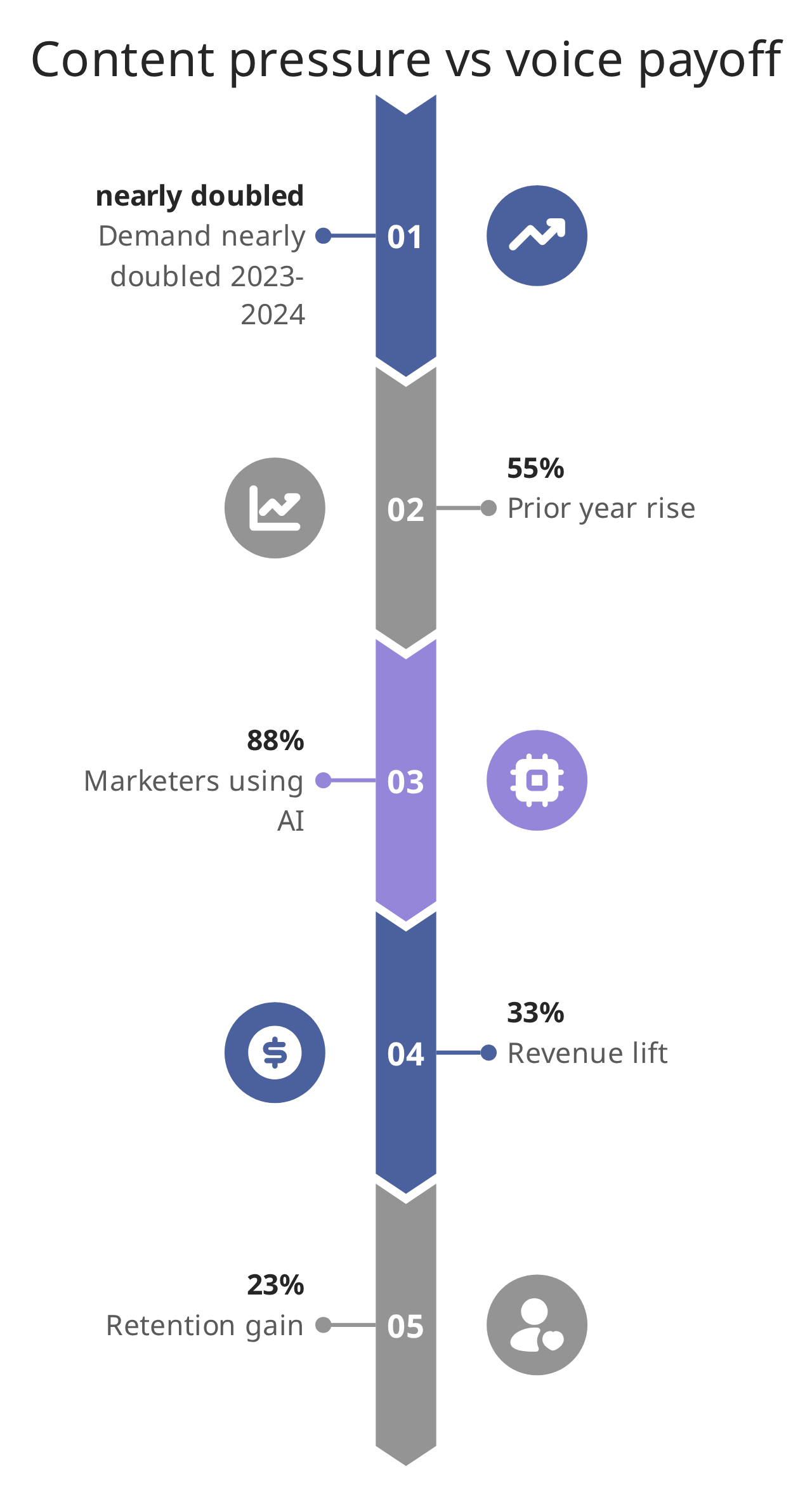
Deloitte Digital research on marketing content automation describes demand nearly doubling between 2023 and 2024 after a 55% rise the year before.[7] SurveyMonkey’s compilation of AI marketing statistics reports 88% of marketers now use AI to support those workflows.[13] Volume is no longer the constraint. Sameness is.
Default model output regresses to the mean. Analyses from ResolLLM and Contentstack describe large language models as predicting the statistically likely next word, which favors neutral, interchangeable phrasing unless constrained.[2][11] Left alone, that tendency produces message drift: openings that sound like you, middles that sound like everyone — the first step toward the undifferentiated output that mass-produced AI content drowns in.
The sameness problem
Models reuse common patterns because those patterns were common in training. Without boundaries, product pages, posts, and help answers converge on the same cadence and the same hedges.
The cost is not abstract. When every vendor sounds careful in the same way, buyers default to price and familiarity.
The business case for consistency
Practitioner summaries often cite consistent presentation with higher revenue and retention. Nav43 cites figures of up to 33% higher revenue linked to consistency, and Adobe’s perspectives on brand consistency at scale link consistency to retention gains cited around 23%.[3][9]
Treat those numbers as directional, not guarantees. They come from vendor and practitioner summaries, not a single controlled study you can re-run. What they do show, across sources, is that inconsistency taxes trust. Distinct voice is how buyers recognize you before they evaluate you.
Make Voice Machine-Readable
Human style guides fail with AI because they describe personality. AI needs behavior. Stridec’s framework for brand voice consistency makes this shift explicit: replace adjectives with observable actions a reviewer — human or automated — can check.[1]
That means rewriting “friendly” or “authoritative” into sentences, word choices, and structures. Glean’s guide to voice guides for AI tools gives the same advice: write for machine interpretation, not inspiration.[4]
From aspirational to observable
Vague traits become checks:
- Instead of “friendly”: use contractions, ask a direct reader question once per section, open with a concrete situation.
- Instead of “authoritative”: make definitive claims, attach a data point or date, use industry terms without redefining basics.[1]
A rule is only useful if two editors would score it the same way. If they would not, rewrite it.
What you will never say
Stridec recommends negative examples alongside positive ones.[1] List banned phrases, false promises, and tones you avoid.
Keep a short never-use list — filler openers like “in the realm of,” superlatives you cannot prove, competitor names in ad copy. Nav43 notes that validators work best when hard lines are explicit.[3] If a phrase dilutes differentiation, ban it by name.
Audit 5–10 pieces of writing DNA
You do not need a new voice. Pull five to ten pieces that already sound right and annotate why, as Glean and Nav43 advise.[3][4]
Mark openings, sentence length, how you address the reader, how you handle trade-offs. Those annotations become the gold standard for prompts and for scoring later drafts.
Give the Model Context Before Copy
When using general AI tools outside Autoriax, prompting an empty model produces empty copy. Samuel J. Woods frames the fix as context engineering: load vetted knowledge first — best posts, funnel definitions, approved claims, source allowlist — then ask for copy.[6]
Contentstack calls the persistent version of this in other AI tools outside Autoriax a Brand Brain: knowledge vaults plus voice profiles that travel with the job, not with the user.[11]
Knowledge vaults and voice profiles
In general AI workflows outside Autoriax, a knowledge vault holds approved messaging, product facts, and reference pieces. A voice profile holds tone rules, structural limits, and bans.[11]
Separation matters. Facts change on one cadence; voice changes on another. When they live apart, you can update one without breaking the other.
Store voice where systems can read it
Contentstack describes storing voice attributes as discrete fields in a headless CMS so updates propagate to every assisted workflow.[11] The principle holds even without that stack: one source of truth, referenced by ID, not pasted into docs.
| Approach | Where rules live | What breaks |
|---|---|---|
| Pasted prompts | In each user’s doc | Versions diverge, fixes do not spread |
| Shared vault + profiles | In one referenced store | One edit updates all lanes |
When a product name or claim changes, you edit once. Every lane — blog, chat, social — inherits the fix.
Prompt in Layers, Reuse Modules
Generic instruction yields generic text. Stridec and ResolLLM both warn against “write in our brand voice” as a prompt.[1][2] Name persona, structure, and philosophy in the same brief.
The three-layer brief
Stridec’s structure is practical because each layer is checkable[1]:
- Personality: who is speaking, with what experience and bluntness. “An SEO strategist with 24 years of experience, direct, no marketing jargon.”
- Structure: sentence and paragraph limits, heading style, how examples appear.
- Philosophy: how you reason. Acknowledge trade-offs and constraints. Name banned jargon.
If a layer cannot be checked in review, it does not belong in the prompt.
Modules per format
Reuse blocks instead of rewriting prompts each time[1]:
- Blog: problem, decision criteria, implementation steps with owners and timelines.
- Social: two to three takeaways, implication first, link for proof.
- Email: one shared problem, one action, personal address.
Modules keep lanes distinct. A post condensed for social should not read like a blog intro cut in half.
Keep Humans on Ideas and Final Checks
The Gutenberg’s work on AI for thought leadership puts it plainly: use AI as a fast first-draft writer, not the author.[10] Models recombine what exists. They do not interview customers, sit in sales calls, or take responsibility for a claim.
That division protects E-E-A-T. Drafts can be machine-assisted; expertise, evidence, and accountability must be human.
Humans supply the raw material
Start with subject-matter input: voice notes on a market shift, bullets on what failed, one proprietary number, one named customer situation without sensitive detail.[10]
No input, no insight. If the brief contains only keywords, the draft will contain only averages.
AI builds the scaffold
AI turns bullets into sections, transcripts into arguments, one headline into variations.[10] It applies the vault and voice profile while doing so.
Constrain sources here. Samuel J. Woods recommends isolating claims for verification before publication rather than fact-checking finished prose[6] — the kind of check a QA layer in your automation stack should own. It is faster to verify five extracted claims than to untangle a polished paragraph built on a wrong one.
Humans restore specificity
The final pass cuts clichés, adds stories only your team knows, and tests whether the argument holds.[10][14] The Gutenberg notes the same check applies to AI-assisted thought leadership across formats.[14]
Ask: would a competitor sign this piece? If yes, it is not done.
Review by Risk, Not by Queue
Not every asset carries the same risk. A social rewrite and a pricing page do not deserve the same review. The working model in this playbook is a Control Tier Framework: assign review depth by impact on trust, money, and legal exposure, then automate the rest.
This is an operating proposal synthesized from the sources cited here, not an industry standard. Its value is operational: it moves editor hours from low-risk line edits to high-risk judgment.
| Tier | Examples | Default path |
|---|---|---|
| Low | Routine posts, social updates, internal summaries | Vault + prompt modules, automated linters, sample audit |
| Medium | Newsletter, campaign email, partner post | Automated checks plus quick human read for tone and accuracy |
| High | Whitepaper, landing page, pricing, legal or health claims | Full human review, expert sign-off, claim verification |
Nav43 describes the tooling for this split: rule-based linters for hard lines and classifiers for voice fit, with severity levels so only blocking issues stop publication.[3]
Hard blocks vs soft warnings
Nav43’s severity pattern is worth copying[3]:
- Hard blocks: competitor trademark misuse, missing disclaimer, wrong product fact, unverified statistic.
- Soft warnings: long sentences, elevated grade level, overused but allowed phrase.
Glean adds readability caps and length limits as practical gates for scannability.[4] Machines enforce the mechanical; editors judge nuance, context, and emotional fit, a division Contentstack also recommends.[11]
What changes in throughput
Teams that switch to tiered review typically find they spent most time polishing low-risk drafts. Flipping that ratio — brief audit on low tier, deep review on high tier — raises velocity without adding editors. Where sources give multipliers, treat them as case-specific; the mechanism, not the multiple, is the point. Where no source in the research data provides a figure for your niche, do not borrow one. Work qualitatively until your own logs give you a rate.
graph TD
  A[Draft from vault + modules] --> B[Extract claims for verification]
  B --> C{Voice and rule checks}
  C -->|Low risk pass| D[Publish with sampling audit]
  C -->|Medium risk| E[Editor quick check]
  C -->|High risk or hard block| F[SME and legal review]
  E --> G[Publish and log corrections]
  F --> G
  G --> H[Update vault, profiles, bans]
  H --> A
Keep Voice Alive With Feedback Loops
Voice drifts even after a good launch. ResolLLM and Adobe both treat voice as evolving with markets and expectations, not fixed at kickoff.[2][9] Without logs, drift looks like personal taste. With logs, it becomes fixable.
Track three failure types Stridec names: tone shifts, philosophy conflicts, and consistency decay where a strong opening slides into generic close.[1]
Measure what you can defend
Two internal rates are enough to start, both defined by Stridec as practical targets[1]:
- Voice recognition rate: blind test without logos. Can readers pick you out?
- Revision rate: share of drafts needing voice edits. Falling means rules are working.
Add engagement only as a secondary signal. A post can perform and still sound off-brand.
Quarterly calibration
Every quarter, review logs, promote strong new pieces to gold-standard status, and prune bans based on what actually slipped through.[2] Adobe frames this as a brand intelligence layer that learns from outcomes.[9]
Update prompts, vault entries, and linter rules together. A fix logged but not encoded will reappear.
Autoriax is built for agencies and freelancers that handle several accounts, with support for managing up to 10 brands per account with separate histories and traceable, customer-friendly reporting for automated SEO audits.
Conclusion
Start with one lane and one tier using general content tools outside Autoriax. Encode its rules, connect its vault, and move one low-risk format to sampled review while keeping high-risk assets fully human-checked.
Open questions remain: how much sampling is enough in regulated niches, who signs off when classifiers and editors disagree, and how to version voice profiles in general tools outside Autoriax without freezing experimentation. Set those answers in writing before you scale, and let the logs decide the rest.
Sources
- [1] How to Maintain Brand Voice Consistency with AI Content: A Strategic Framework - Stridec — https://stridec.com/blog/brand-voice-consistency-ai-content-strategic-framework
- [2] How to Scale Content with AI Without Losing Your Brand Voice — https://resollm.ai/blog/scale-content-with-brand-voice
- [3] Mastering AI Brand Voice: Tips for Consistent and Impactful Messaging — https://nav43.com/blog/keeping-your-ai-brand-voice-consistent-at-scale-how-validators-make-every-word-count
- [4] How to create a brand voice guide for AI tools — https://www.glean.com/perspectives/how-to-create-a-brand-voice-guide-for-ai-tools
- [5] Your brand voice is a rule set, not a mood board. — RDLB Agentic — https://rdlb.nyc/post/r-briefing-who-speaks-for-your-brand
- [6] AI Content Agents: Scale Without Losing Brand Voice — https://samueljwoods.com/ai-content-agents
- [7] deloittedigital.com — https://www.deloittedigital.com/us/en/insights/research/marketing-content-automation.html
- [9] adobe.com — https://experienceleague.adobe.com/en/perspectives/brand-consistency-at-scale
- [10] AI Thought Leadership: Scale Content Without Losing Voice — https://www.thegutenberg.com/blog/ai-for-thought-leadership-content-how-to-scale-ai-content-strategy-without-losing-brand-voice
- [11] How do we maintain our unique brand voice when using AI? — https://www.contentstack.com/blog/ai/how-do-we-maintain-our-unique-brand-voice-when-using-ai
- [13] surveymonkey.com — https://www.surveymonkey.com/learn/marketing/ai-marketing-statistics/
- [14] thegutenberg.com — https://www.thegutenberg.com/blog/ai-for-thought-leadership-content-how-to-scale-ai-content-strategy-without-losing-brand-voice/
Try Autoriax free — no credit card required
Get your first article in minutes. See the research depth before you commit.
Get 3 free articles3 articles free • No credit card • Cancel anytime